About Fringilla coelebs Linnaeus, 1758
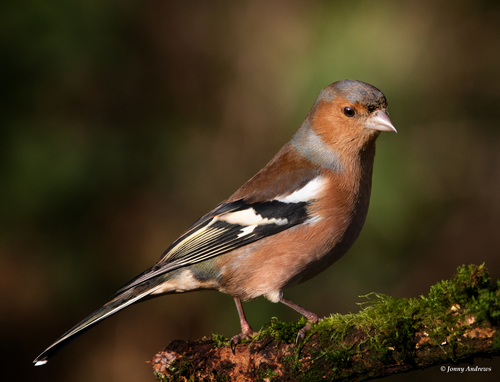
The Eurasian chaffinch (Fringilla coelebs Linnaeus, 1758) measures approximately 14.5 cm (5.7 in) in length, with a wingspan ranging from 24.5 to 28.5 cm (9.6 to 11.2 in) and a body weight between 18 and 29 g (0.63 to 1.02 oz). For the adult male of the nominate subspecies, the forehead is black, while the crown, nape, and upper mantle are blue-grey. The rump is light olive-green, and the lower mantle and scapulars form a brown saddle. The sides of the head, throat, and breast are dull rust-red, which fades to pale creamy-pink on the belly. The central pair of tail feathers are dark grey with a black shaft streak, and the rest of the tail is black, except for the two outer feathers on each side that have white wedges. Each wing has a contrasting white panel on the coverts, plus a buff-white bar on the secondaries and inner primaries. Flight feathers are black, with white on the basal portions of the vanes. Secondaries and inner primaries have pale yellow fringes on the outer web, while outer primaries have a white outer edge. After the autumn moult, the tips of new feathers have a buff fringe that gives coloured plumage a brown cast. The ends of the feathers wear away over winter, so that brighter underlying colours are visible by the spring breeding season. This species has dark brown irises and grey-brown legs. The bill is pale grey in winter, slightly darker along the upper ridge (culmen), but turns bluish-grey with a small black tip in spring. The male of F. c. gengleri, the subspecies resident in the British Isles, is very similar to the nominate subspecies, but has a slightly darker mantle and darker underparts. Adult females have a much duller appearance than males. The head and most of the upperparts are various shades of grey-brown, with paler underparts, and the lower back and rump are dull olive green. The wings and tail of females are similar to those of males. Juvenile Eurasian chaffinches resemble adult females. Eurasian chaffinches breed in wooded areas where the July isotherm falls between 12 and 30 °C (54 and 86 °F). Their breeding range covers most of Europe and extends east across temperate Asia to the Angara River and the southern end of Lake Baikal in Siberia. The species was introduced from Great Britain to several of Great Britain's overseas territories in the second half of the 19th century. In New Zealand, Eurasian chaffinches had colonized both the North and South Islands by 1900, and are now one of the most widespread and common passerine species there. In South Africa, a very small breeding colony in the Cape Town suburbs of Constantia, Hout Bay, Pinelands, and Camps Bay is the only remaining remnant of a separate introduction. The bird does not migrate in the milder parts of its range, but leaves colder regions for winter. It forms loose flocks outside the breeding season, sometimes mixing with bramblings. It occasionally strays to eastern North America, though some sightings may be of escaped captive birds.