About Freyeria trochylus (Freyer, 1845)
Scientific name: Freyeria trochylus (Freyer, 1845)
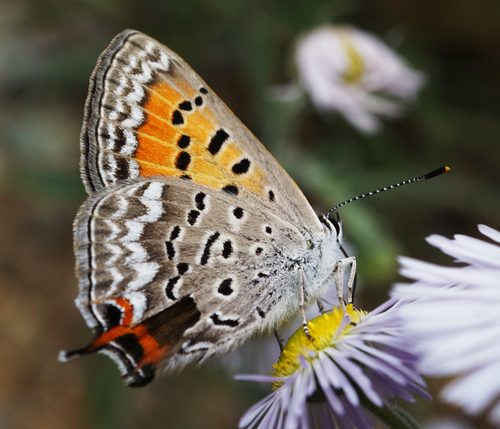
Male description: The upperside is brown, and its tint varies somewhat. Specimens collected from dry localities are much paler than those from areas with comparatively heavy rainfall. On the forewing, the color is uniform, and some specimens have a very ill-defined anteciliary dark line. On the hindwing, there is a subterminal series of round black spots crowned with pale ochraceous. The posterior four spots are generally well defined and edged outwardly with white, while the anterior spots are obsolescent, and lack the inner yellow edging or outer white edging. A well-marked, slender anteciliary black line is present on the hindwing. Cilia are white, with brown basal halves.
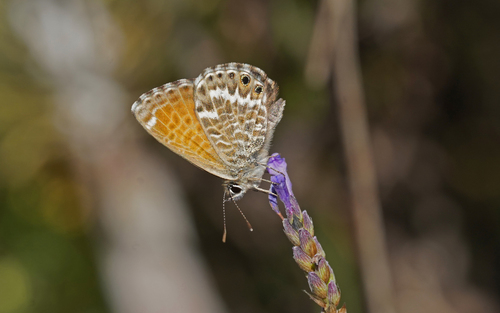
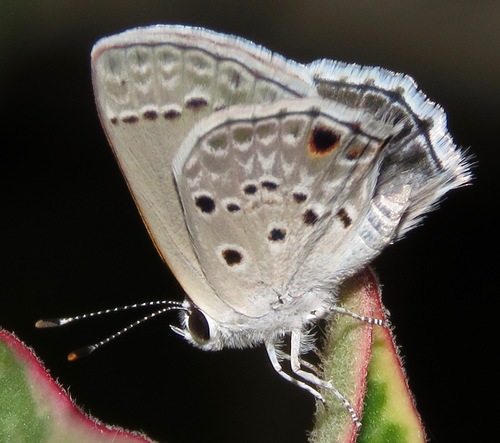
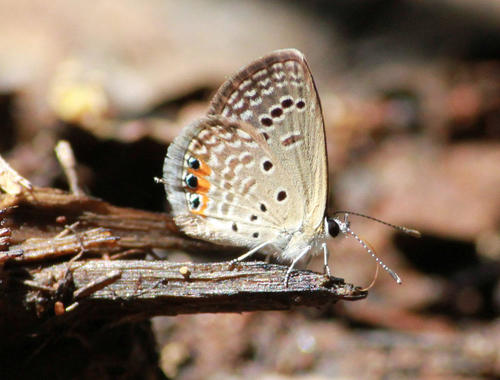
The underside is pale silky brown. The forewing has the following white markings: a short line on the inner and outer sides of the discocellulars; a transverse, slightly curved discal series of small, more or less incomplete rings; a transverse postdiscal series of disconnected slender lunules; a subterminal series of similar but more regular lunules; and a terminal broken line, followed by a dark unbroken anteciliary line. The ground color is slightly darker than the rest of the wing in the area between the two short discocellular lines, inside each ring of the discal markings, and between the subterminal lunules and the terminal line.
On the hindwing, there are two short white lines on the discocellulars. The discal, postdiscal and terminal markings match those on the forewing, except that a complete series of dark spots is enclosed between the subterminal series of white lunules and the terminal white line. The posterior three or four of these spots are jet-black, sprinkled outwardly with metallic-green scales, and encircled with pale ochraceous. Additionally, there is a transverse subbasal series of four black spots encircled with white, and a similar subcostal spot in the middle of interspace 7. Antennae, head, thorax and abdomen are brown; the shaft of the antenna is speckled with white. On the underside, palpi, thorax and abdomen are white.
Female description: The ground color and markings of the upperside and underside match those of the male, but the female's markings are larger and more clearly defined. On the hindwing, the yellow that crowns the black spots on the tornal area of the upperside, and surrounds the same spots on the underside, is wider and more prominent. Antennae, head, thorax and abdomen match those of the male.