About Fremontodendron californicum (Torr.) Coult.
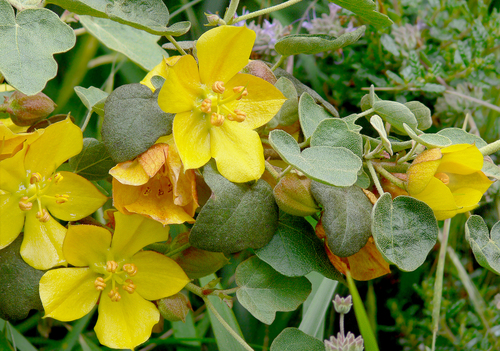
Fremontodendron californicum (Torr.) Coult. is a flowering evergreen hardwood shrub or small multi-trunked tree. It grows 2.4 to 5.5 metres (8 to 18 ft) tall and 1.8 to 3.0 metres (6 to 10 ft) wide. Its leaves measure 1 to 5 cm (3⁄8 to 2 in) long, range in color from olive to gray-green, have a fuzzy, flannel-like texture, and are palmately to pinnately lobed. The hairs that cover the leaves brush off easily when touched by humans, and can irritate skin and eyes. The undersides of the leaves are distinct, covered in a velvety brown coating. The plant produces large flowers 3.5 to 6 cm (1+1⁄2 to 2+1⁄4 in) in diameter, colored a rich yellow, sometimes with orange, coppery, or reddish margins around the base. Blossoms grow in large showy clusters, and tend to open one at a time. Each petal has an attractive curved shape that tapers to a point.
Fremontodendron californicum occurs across a wide range of habitats in California at elevations from 400 to 1,980 m (1,300 to 6,500 ft), growing most commonly in California chaparral and woodlands, Yellow Pine Forests, and Pinyon-juniper woodlands along the eastern San Joaquin Valley. Specific locations where it grows include: chalky, sandy, nutrient-poor soils in the western foothills of the Sierra Nevada along the eastern San Joaquin Valley; the east slope Cascade Range foothills of the northwest Sacramento Valley and the Klamath Mountains to the west; the California Coast Ranges across the entire state; the Transverse Ranges; and the Peninsular Ranges. It also grows in small, isolated populations in the mountains of central and western Arizona, within the Arizona transition zone-Mogollon Rim region, primarily in the Mazatzal Mountains and Superstition Mountains. Additional populations are found in isolated chaparral locations in the Peninsular Ranges of central to northern Baja California.
This species is cultivated as an ornamental plant by specialty plant nurseries, for use in native plant gardens, drought-tolerant gardens, wildlife gardens, natural landscaping projects, and habitat restoration projects. Established cultivated plants require good drainage and no supplemental summer water. Fremontodendron californicum ssp. decumbens is the most garden-tolerant taxon of all Fremontia, and can also be grown in large pots and planters.
Some indigenous peoples of California used this species as a traditional Native American medicinal plant: the sap from its inner bark was applied topically to treat mucous membrane irritation, and taken internally for gastrointestinal upset. The Yokuts and Kawaiisu peoples of California used its wood as a material for building and furniture, and its bark to make cordage, nets for holding acorn caches, and nets for snare hunting. Indigenous communities used the wood's flexible nature to make materials for the hoop-and-pole game, giving the plant cultural significance.