About Fregata magnificens Mathews, 1914
Common Name and Species Classification
Fregata magnificens, commonly called the magnificent frigatebird, is the largest species of frigatebird.
Size Measurements
It has a body length of 89–114 cm (2 ft 11 in – 3 ft 9 in), a wingspan of 2.17–2.44 m (7 ft 1 in – 8 ft 0 in), and a body weight between 1.1 and 1.59 kilograms (2 lb 7 oz – 3 lb 8 oz).
Adult Male Appearance
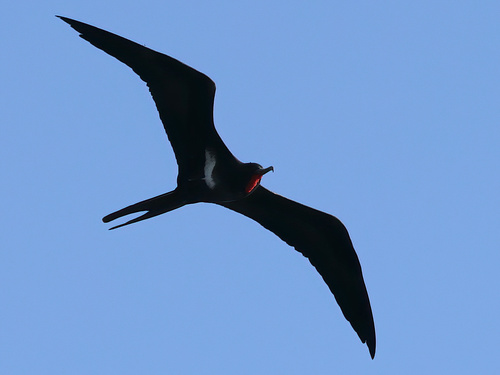
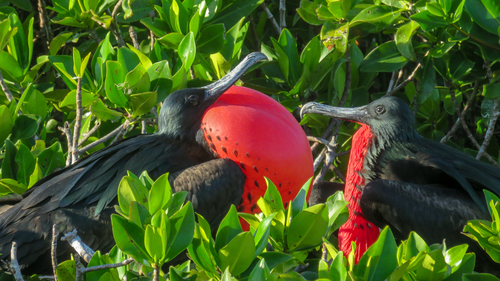
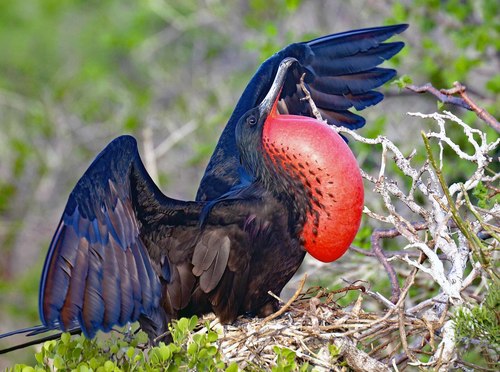
Adult males are almost entirely black, with a scarlet throat pouch that inflates into a balloon-like shape during the breeding season.
Male Plumage Iridescence
While all body plumage is black, the male's scapular feathers show a purple iridescence when hit by sunlight, which distinguishes it from male great frigatebirds that have a green sheen instead.
Adult Female Appearance
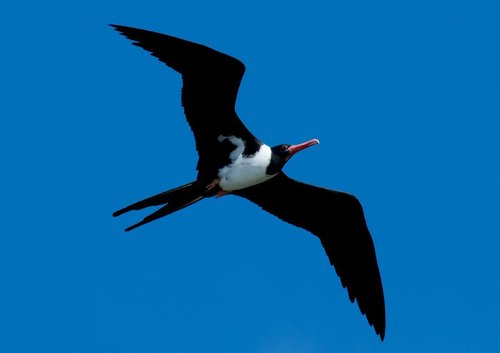
Adult females are also mostly black, but have a white breast and white lower neck sides, a brown wing band, and a characteristic blue eye ring that can be used to identify females of this species.
Immature Plumage
Immature magnificent frigatebirds have a white head and white underparts.
Similarity to Other Frigatebirds
This species is very similar in appearance to other frigatebirds, and matches their size with the exception of the smaller lesser frigatebird.
Distinguishing Morphological Features
Unlike other frigatebird species, it does not have a white axillary spur, and juvenile individuals have a distinct diamond-shaped belly patch.
Vocalization
Magnificent frigatebirds are silent while flying, but produce a range of rattling sounds when at their nests.
Flight Metrics
This species spends both days and nights flying, with an average flapping rate of 2.84 beats per second, a ground speed of 10 km/h (6.2 mph), and can travel up to 223 km (139 mi) before landing.
Flight Altitude Patterns
Individuals alternate climbing into thermals, occasionally reaching altitudes as high as 2,500 m (8,200 ft), with descending back to near the sea surface.
General Distribution
The magnificent frigatebird has a wide distribution across the tropical Atlantic.
Breeding Range
It breeds in large colonies in trees in Florida, the Caribbean, and along the Pacific coast of the Americas from Mexico south to Ecuador, including the Galápagos Islands.
Vagrant Records
It has also been recorded as a vagrant far outside its normal range, reaching locations including the Isle of Man, Denmark, Spain, England, Nova Scotia, the Magdalen Islands, and British Columbia.