About Fraxinus pennsylvanica Marshall
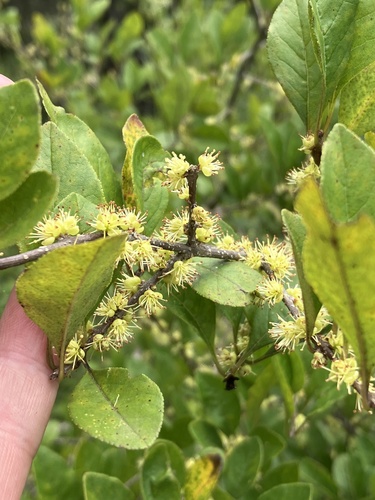
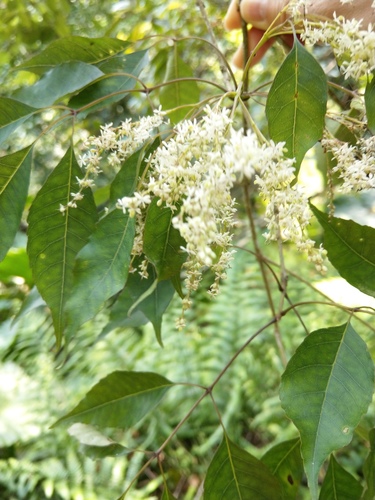
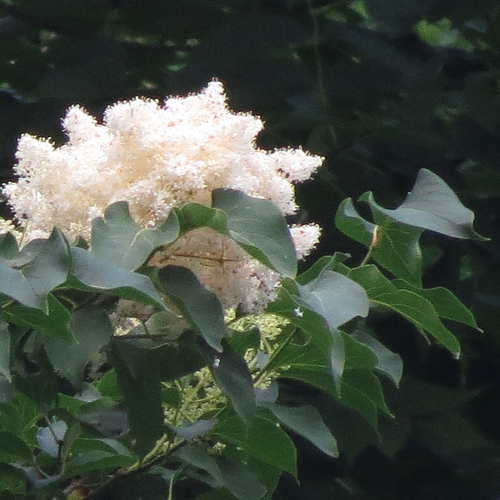
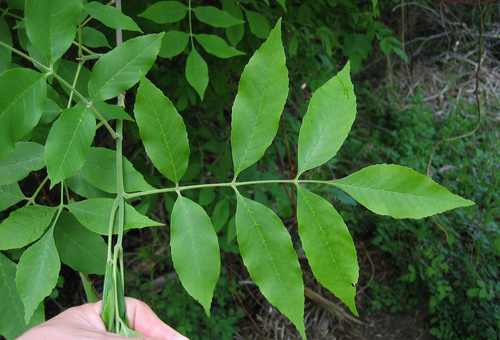
Fraxinus pennsylvanica Marshall, commonly called green ash, is a medium-sized deciduous tree that typically reaches 12–25 metres (39–82 feet) in height, rarely growing as tall as 45 m (148 ft). Its trunk can grow up to 60 centimetres (24 inches) in diameter. Young trees have smooth, gray bark that becomes thick and fissured as the tree ages. The tree’s winter buds are reddish-brown with a velvety texture. Its leaves are 15–30 cm (6–12 in) long, oppositely arranged, and pinnately compound, with 7 to 9 leaflets (occasionally 5 or 11). Individual leaflets are 5–15 cm (2–6 in) long, rarely up to 18 cm (7 in), and 1.2–9 cm (1⁄2–3+9⁄16 in) wide, with serrated margins and short, distinct, downy petiolules a few millimeters long. Both the upper and lower surfaces of the leaves are green. In autumn, leaves turn golden-yellow; in the northern parts of the tree’s native range, leaf color change can begin as early as the first week of September, depending on local climate. The tree produces flowers in spring at the same time new leaves emerge, growing in compact panicles. The flowers are inconspicuous, have no petals, and are pollinated by wind. The fruit is a samara 2.5–7.5 cm (1–3 in) long, made up of a single 1.5–3 cm (5⁄8–1+1⁄8 in) long seed with an elongated apical wing that is 2–4 cm (3⁄4–1+1⁄2 in) long and 3–7 mm (1⁄8–9⁄32 in) wide. This species was sometimes split into two varieties: Fraxinus pennsylvanica var. pennsylvanica (red ash) and Fraxinus pennsylvanica var. lanceolata (Borkh.) Sarg. (syn. var. subintegerrima (Vahl) Fern.; green ash), distinguished by the latter’s hairless leaves and narrower leaflets. However, the two varieties intergrade completely, so most botanists no longer recognize this distinction. Like other species in the section Melioides, Fraxinus pennsylvanica is dioecious, meaning male and female flowers grow on separate individual trees. It is the most widely distributed of all American ash species, with a native range centered on the midwestern United States and the Great Plains. Seedlings of this tree have high tolerance to waterlogging, which explains why green ash’s natural habitat is almost exclusively restricted to stream sides and bottomlands. The tree produces large annual seed crops that provide food for many types of wildlife. Green ash is currently threatened by the emerald ash borer, an invasive beetle introduced from Asia. This introduced pest kills nearly all ash trees it infests, and has caused mass die-offs of ash trees in North America and in Moscow, Russia. Asian ash species have high tannin content in their leaves, which makes them unpalatable to the beetle, while most American ash species (with the notable exception of blue ash) do not have this high tannin content. A common garden experiment confirmed that green ash is readily killed when exposed to the emerald ash borer, while the Asian species Fraxinus mandschurica shows resistance to the pest. The United States Forest Service has identified small numbers of "lingering ash" wild trees that have remained healthy after emerald ash borer invaded their populations. Researchers are currently investigating whether these trees carry genetic resistance to the beetle, in hopes of restoring green ash populations using the surviving trees. While more than 99% of green ash trees are killed by larval infestation of the invasive emerald ash borer, studies have found that emerald ash borer infestation induces production of secoiridoids in infested trees, and cultivars descended from "lingering ash" produce higher levels of these secoiridoids than the progeny of susceptible trees. The spread of the emerald ash borer was aided by the widespread planting of green ash as an ornamental tree in the central U.S. after American elms were lost to Dutch elm disease in the 1950s and 1960s. That earlier epidemic occurred because elms were overplanted in urban environments, creating a monoculture with no resistance to the disease. Modern regional cultivars of green ash were bred from just a small number of parent trees (sometimes only four), selected for unique traits and male seedless flowering, which created a similar lack of genetic diversity. After this pattern was recognized as a major risk, cities such as Chicago did not replace dead elms with a 1:1 ratio of ash to the original elm population. Instead, a variety of other species including Norway maple, silver maple, red maple, sugar maple, honey locust, linden/basswood, redbud, crabapples, and hackberry were used in urban and suburban planting projects. By adding these extra species, many cities reduced the share of ash in their urban tree population to an average of 20%, which is far lower than the 56% to 100% share that elms made up during the Dutch elm disease era. Pesticide injections and spraying are used to protect valuable ash trees in city parks from emerald ash borer infestation. Both American elm and green ash were extremely popular for urban planting because they grow quickly and tolerate urban pollution and road salt, so many housing developments in Michigan were planted entirely with rows of green ash. This gave emerald ash borers an enormous continuous food supply, which allowed the pest population to grow far above normal infestation thresholds. The tree was also widely propagated and sold by local nurseries. Back in the late 1980s, Dr. Frank Santamour Jr., then a research geneticist with the U.S. National Arboretum, proposed the 10-20-30 formula for urban forest diversity, which limits plantings in a community to no more than 10 percent of any single species, 20 percent of any single genus, and 30 percent of any single family. Due to the threat from emerald ash borer, many communities now use a stricter 5-10-20 diversity rule. Green ash is also vulnerable to several other diseases including ash yellows, ash dieback, and ash bacterial canker. These conditions cause gradual loss of tree vigor, and produce symptoms similar to emerald ash borer infestation including crown dieback, bark cracking, and epicormal sprouts. These diseases are most common in stressed trees growing in poor soil, areas affected by urban pollution, or areas with insufficient moisture. In the 1950s and 1960s, a major outbreak of ash dieback killed an estimated 70% of ash trees in the northeastern United States. Green ash wood has similar properties to white ash wood, and the two are marketed together under the name "white ash". Most commercial supply of this wood comes from the southern United States. It is very popular for making electric guitars, because it can be somewhat lighter than white ash without losing much tone. It produces a bright sound with long sustain, and its wood grain is considered aesthetically desirable by many guitar players. Gibson, Fender, Ibanez, Warwick, and many other luthiers use ash, including green ash, in constructing their guitars.