About Fraxinus excelsior L.
Fraxinus excelsior L., commonly known as European ash, is a large deciduous tree. It typically grows 12–18 m (39–59 ft) tall, and can exceptionally reach up to 43 m (141 ft). Its trunk grows up to 2 m (6.6 ft) in diameter, and can exceptionally reach 3.5 m (11 ft), with a tall, narrow crown. Young trees have smooth, pale grey bark, which becomes thick and vertically fissured as the tree ages. Shoots are stout and greenish-grey, with jet-black buds that distinguish this species from most other ash species, which have grey or brown buds.
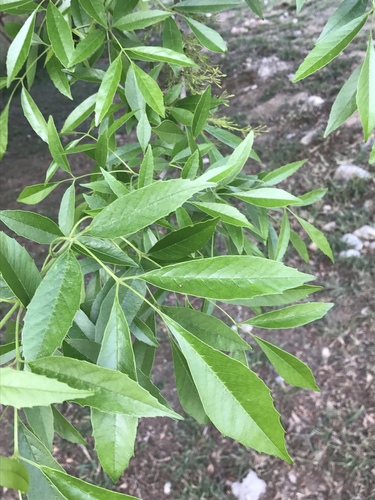
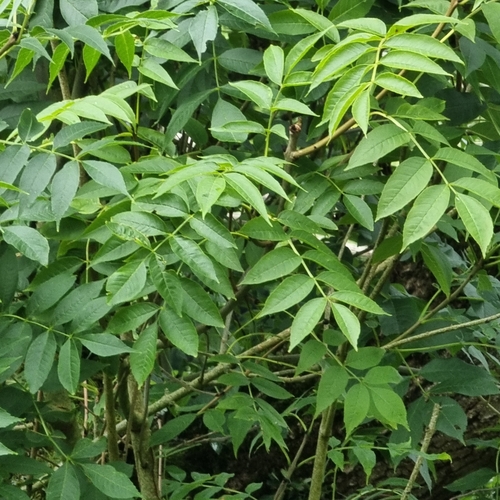
Leaves are opposite, 20–35 cm (7.9–13.8 in) long, and pinnately compound. They bear 7–13 coarsely serrated, elliptic to narrowly elliptic leaflets, each 3–12 cm (1.2–4.7 in) long and 0.8–3 cm (0.31–1.18 in) broad, which attach sessile to the leaf rachis. There are no stipules; this combination of traits distinguishes European ash from mountain ash (Sorbus aucuparia), which has alternate leaves with paired stipules. European ash leaves are often among the last to open in spring, and the first to fall in autumn when an early frost occurs. They often fall while still dull green, or may develop a bright yellow autumn colour.
Flowers grow in short panicles, open before leaves emerge, and have no perianth. Female flowers are slightly longer than male flowers, are dark purple, petal-less, and wind-pollinated. While both male and female flowers can grow on the same tree, it is more common to find separate male and female individual trees. A tree that produces only male flowers one year may produce female flowers the next year, and female trees can similarly become male. The fruit is a samara, 2.5–4.5 cm (0.98–1.77 in) long and 5–8 mm (0.20–0.31 in) broad, often called an 'ash key', which frequently hangs in clusters through the winter. If gathered and planted while still green and not fully ripe, the fruit will germinate immediately. Once the fruit turns brown and fully ripe, it will not germinate until 18 months after sowing, meaning germination occurs only after two winters have passed.
European ash rarely lives longer than 250 years. There are many specimens estimated to be 200 to 250 years old, and a small number are over 250 years old. The largest known specimen, located at Clapton Court, England, measures 9 m (29.5 ft) in girth. Derbyshire alone has multiple specimens with a girth over 4.5 metres (14.8 ft). The genome of Fraxinus excelsior has been sequenced using self-pollinated offspring of a tree from Worcestershire, England, held by the Earth Trust.
Fraxinus excelsior is native to Europe, ranging from northern Spain to Russia, and from southern Fennoscandia to northern Greece. It is also considered native to southwestern Asia, from northern Turkey east to the Caucasus and Alborz mountains. The northernmost location where it grows naturally is the Trondheimsfjord region of Norway, though it is planted further north. The species is widely cultivated and is reported to be naturalized in New Zealand, and in scattered locations across the United States and Canada, including Nova Scotia, New Brunswick, Quebec, Ontario, Ohio, Kentucky, British Columbia, Massachusetts, Connecticut, New York, New Jersey, and Maryland. It is native across Britain and Ireland, particularly on limestone; the most northerly native ashwood in Britain occurs on limestone at Rassal Ashwood in northern Scotland. It is widely planted in other areas beyond its native range.
European ash grows across a wide range of soil types, but is particularly associated with basic soils on calcareous substrates. It prefers moister soil types, and its range is commonly limited by temperature, so it is not found at higher, colder altitudes across much of Europe; however, in Iran it can grow up to 2000 m above sea level. Young seedlings are shade tolerant, while older trees require high light levels. It is an early-succession species, and can often outcompete later-succession species such as beech and oak.
The mycorrhizae of F. excelsior are of the internal arbuscular mycorrhizal type, where the fungus grows within root tissues and forms branched, tree-like structures inside the cells of the root cortex. Unlike other Fraxinus species, F. excelsior does not form ectomycorrhizae.
The Biological Records Centre of the UK has recorded 111 species of insects and mites that use ash as a food plant, 29 of which are specific to ash. A further six species are specific to ash and its Oleaceae relative wild privet (Ligustrum vulgare). Many Lepidoptera species use this tree as a food source. One ash-specific feeding moth is the centre-barred sallow (Atethmia centrago); its larvae burrow into buds when newly hatched, and later feed on the tree's flowers and leaves. A common moth that causes browning of ash leaves, as well as leaves of garden privet and lilac, is Gracillaria syringella. Its usually gregarious larvae create an epidermal gallery (feeding within the leaf tissue) that forms a brown blotch with black frass. Later, they form two successive cones by folding the tip of a leaf downwards. Fourteen different galls have been recorded on ash in Britain, and the British Plant Gall Society defines a gall as an abnormal growth produced by a plant under the influence of another organism.
European ash's resilience and rapid growth made it an important resource for smallholders and farmers. It was likely the most versatile wood used in rural countryside, with a wide range of applications. Until World War II, these trees were often coppiced on a 10-year cycle to produce a sustainable supply of timber for fuel, and poles for building and woodworking. The colour of the wood ranges from creamy white to light brown; the heartwood may be a darker olive-brown. Ash timber is hard, tough, very hard-wearing, with a coarse open grain, and a density of 710 kg/m³. It does not have the natural decay resistance that oak has, so it is less suitable for posts buried in the ground. Due to its high flexibility, shock resistance, and resistance to splitting, ash wood is the traditional material for bows, tool handles (especially for hammers and axes), tennis rackets, and snooker cues. It was used extensively in the construction of early aircraft, and is or has been used in manufacturing some motor vehicles, such as the Morgan and Morris Traveller.
Ash was commonly used green to make chair frames, which would then be fitted with a seat made from another timber or woven rush; for example, this method was used by Philip Clissett for traditional English regional chairs. Chair parts were turned on a pole lathe or shaped with a drawknife. This practice largely died out in the early 20th century, but has seen a revival in recent years.
Ash is an important component of wood pasture, a European land management system where open woodland provides shelter and forage for grazing animals. Ash was regularly coppiced and pollarded, often in hedgerows. Evidence of this practice can still be seen across parts of Britain, in the form of large trunks with multiple new trunks emerging at head height. The Glen Lyon ash is a notable example of a pollarded ash; at approximately 400–500 years of age, it reached a girth of 6 m (20 ft). In Northumberland, crab and lobster traps (called 'creeves' by local people) are still made from ash sticks. Due to its elasticity, European ash wood was commonly used for walking sticks. Poles cut from coppice have their ends heated in steam, then the wood can be bent in a curved vise to form the walking stick handle. The light colour and attractive grain of ash wood make it popular for modern furniture such as chairs, dining tables, doors, other architectural features, and wood flooring.
Ash is the only wood used to make hurleys (called hurls in parts of Leinster and camán in Irish), the wooden sticks used for the Irish game of hurling. Hurleys are made from the butt log, the bottom 1.5 m of the tree trunk, ideally from trees with a diameter at breast height of 25–30 cm (9.8–12 in). Only fast-grown, straight, knot-free ash can be used for this purpose. Due to a shortage of available ash in Ireland, over 75% of the timber needed to produce the 350,000 hurleys required for the game annually must be imported, mostly from Eastern European countries. The importance of ash timber to hurling is reflected in the common reference to the game across Ireland as 'The Clash of the Ash'.
Ash is a valuable firewood, because it burns well even when green, or freshly cut. Ash bark and leaves are used in modern herbal medicine for their astringent and laxative properties.