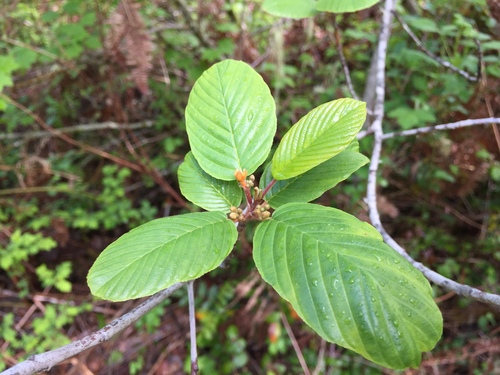
About Frangula purshiana (DC.) J.G.Cooper
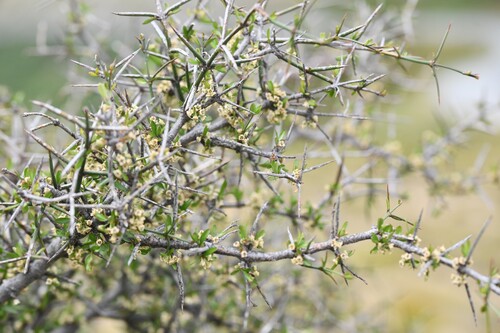
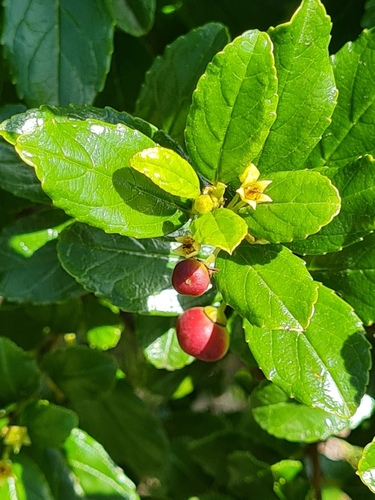
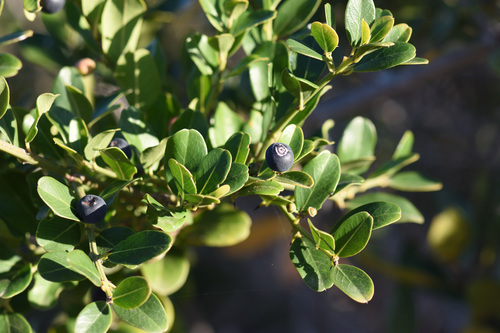
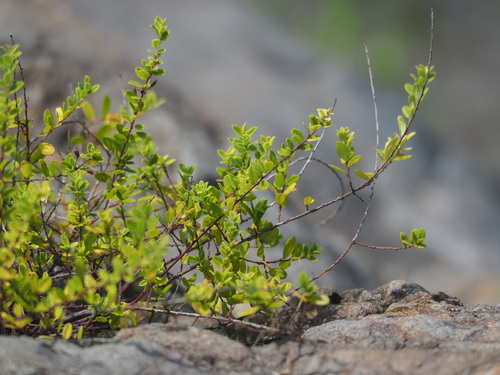
Frangula purshiana, commonly called cascara, is a large shrub or small tree that grows between 4.5 and 12 m (15–39 ft) tall, with a trunk measuring 20–50 cm (7.9–19.7 in) in diameter. Its buds lack scales, a trait unique to cascara in the northwest region. The plant has thin brownish to silver-gray bark marked with light splotches, often partially caused by lichens; its inner bark is smooth and yellowish, turning dark brown as it ages and is exposed to sunlight. Cascara bark has an intensely bitter taste that lingers in the mouth for hours, overpowering and even numbing the taste buds. Its leaves are simple, deciduous, and alternate, clustered near the ends of twigs. The leaves are oval, 5–15 cm (2.0–5.9 in) long and 2–5 cm (0.79–1.97 in) wide, growing from a 0.6–2 cm (0.24–0.79 in) petiole. They are shiny green on the upper surface and dull, paler green on the lower surface, with tiny teeth along the margins and 10–12 pairs of pinnate veins. Leaves turn yellow in autumn. Cascara produces tiny flowers 3–5 mm (0.12–0.20 in) in diameter, with five greenish yellow petals arranged in a cup shape. The flowers grow in umbel-shaped clusters on the ends of distinctive peduncles attached to leaf axils. The flowering season is short, running from early to mid-spring, and flowers disappear by early summer. The fruit is a drupe 6–10 mm (0.24–0.39 in) in diameter, bright red when young, that quickly matures to deep purple or black. It contains yellow pulp, and two or three hard, smooth, olive-green or black seeds. Cascara is native to the area from northern California to British Columbia, and east to the Rocky Mountains in Montana. It most often grows along streamsides in mixed deciduous-coniferous valley forests and moist montane forests. It is common in the understory of bigleaf maple forests, growing alongside red osier dogwood and red alder. High market demand for cascara bark has led to over-harvesting from wild trees in many areas, which may have greatly reduced cascara populations. Cascara's fruits are eaten by birds, bears, raccoons, and other mammals, which disperse the undigested seeds. Mule deer in Oregon and elk in northern Idaho browse the leaves, especially during winter. Olympic black bears, Oregon gray foxes, raccoons, and ring-tailed cats (where their range overlaps with cascara in Northern California) also eat cascara foliage. Cascara is shade tolerant, and its brushy stands provide abundant thermal cover and hiding places for wildlife. Fire usually kills the above-ground portion of cascara, but the plant can resprout from its root crown. After more severe fires, it re-establishes from off-site seed starting in the second year after the fire. It typically grows in areas with fire regimes ranging from 30 to 150 year intervals, though it is also found in areas with 500+ year fire regimes. Both the fruit and bark of cascara contain a bitter compound that makes them inedible to humans, though there are contested claims of medicinal use for the plant. Until 2002, cascara was the main ingredient in commercial over-the-counter laxatives sold in North American pharmacies. That year, the U.S. Food and Drug Administration (FDA) issued a final rule banning the use of aloe and cascara as laxative ingredients. Serious adverse effects can occur from using cascara, including dehydration, loss of electrolyte levels such as potassium, sodium, and chloride, irregular heart rhythms, and muscle weakness. There is also concern over its potential carcinogenicity. Laxatives should not be used by people with Crohn's disease, irritable bowel syndrome, colitis, hemorrhoids, appendicitis, or kidney problems. Use of cascara is a safety concern for pregnant or breastfeeding women, and for children. Cascara was used as a laxative in traditional medicine. The dried, aged bark of cascara was used by indigenous native cultures and Euro-American settlers as a laxative, similar to other anthraquinone-containing herbal preparations made from the leaves and fruits of senna, the latex of Aloe vera, and the root of the rhubarb plant. Commercially, the product is called "cascara sagrada", which means "sacred bark" in Spanish, while in traditional Chinook Jargon it is known as "chittem bark" or "chitticum bark". After it was introduced to formal U.S. medicine in 1877, it replaced the berries of Rhamnus catharticus as the preferred laxative. Historical demand for cascara harmed native cascara populations during the 1900s due to overharvesting. For preparation in folk medicine, bark is collected in spring or early summer, when it peels easily from the tree. After stripping, the bark must be aged for several months, because freshly cut, dried bark causes vomiting and severe diarrhea. Drying is generally done in shade to preserve the bark's characteristic yellow color. The process can be sped up by baking the bark at a low temperature for several hours. Botanist J. Morton recommends a dose of 10–30 grains dissolved in water, or 0.6–2.0 cc of fluid extract. J.A. Duke suggests an effective dosage is approximately 1–3 grams (15–46 gr) of dried bark, or 1–2.5 grams (15–39 gr) of powdered bark. Cascara's fruit can be eaten cooked or raw, but it has a laxative effect. The food industry sometimes uses cascara as a flavoring agent for liquors, soft drinks, ice cream, and baked goods. Honey made from cascara is tasty, but slightly laxative. Local people use the wood for posts, firewood, and turnery. Cascara is also planted as an ornamental, to provide food and habitat for wildlife, or to prevent soil erosion. Because of its bitter taste, cascara can be applied to fingernails to help stop nail-biting.