About Frangula californica (Eschsch.) A.Gray
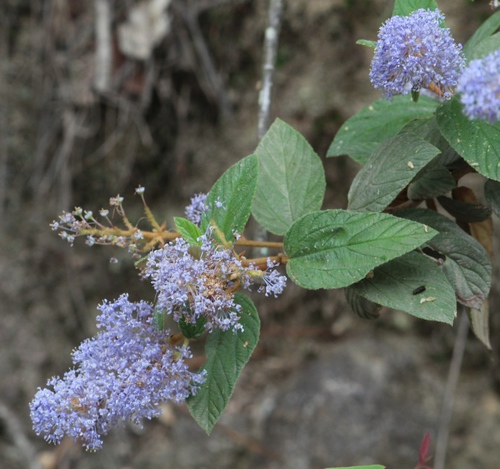
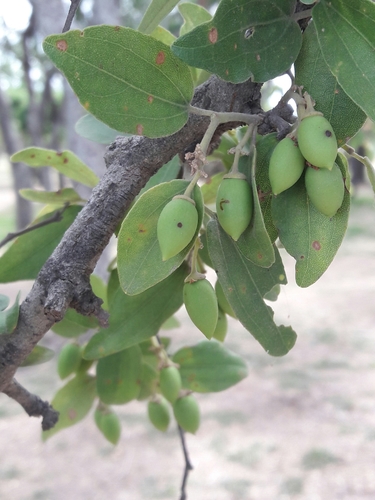
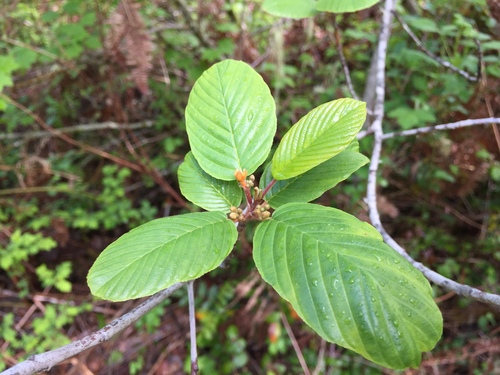
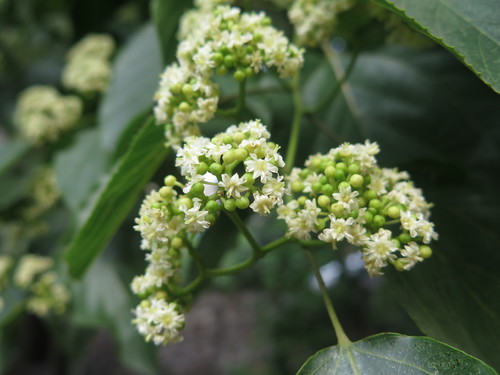
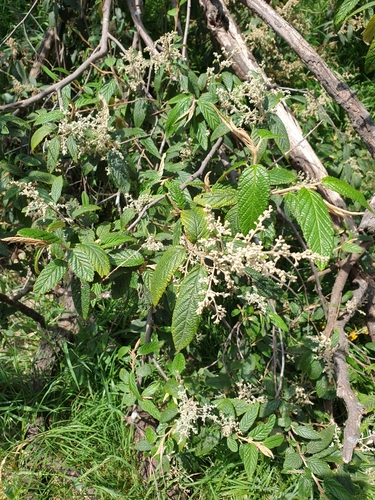
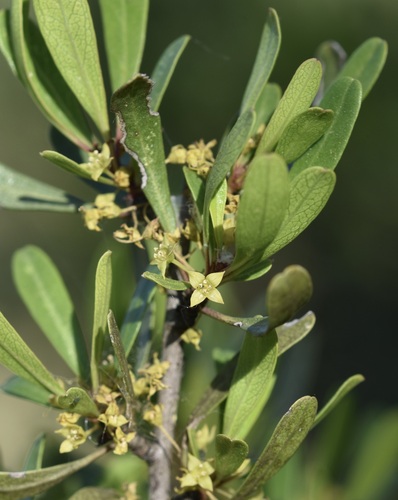
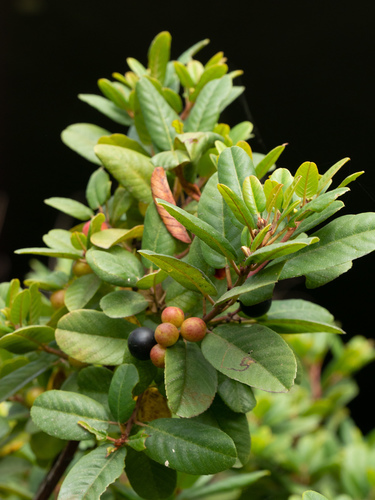
Frangula californica is typically a shrub between 0.9 and 3.7 metres (3 to 12 ft) tall, with variable form across its subspecies. In favorable growing conditions, it can grow into a small tree over 3.7 m (12 ft) tall, but it is most commonly a shrub between 0.9 and 1.8 m (3 to 6 ft) tall. Its branches may carry a reddish tinge, and new twigs are often red. Its alternately arranged evergreen leaves are glabrous, or smooth and hairless, on the upper surface, and usually have a waxy-white coating on the underside. Leaf blades are ovate to elliptic in shape: they grow thin in moist habitats, and smaller and thicker in dry areas. Leaves are fully developed around May. This plant is native to California, the Southwestern United States, and Baja California, Mexico, and it is an introduced species in Hawaii. Its largest populations are mainly found in Arizona and California, but it also occurs in New Mexico, Oregon, and Nevada. It grows in oak woodland, chaparral, and many other habitats across its native range, including forests mixed with redwood, evergreen, and red fir. It is a common shrub in forests of the Siskiyou Mountains, southwestern Oregon, and northern California. Individual plants have an estimated lifespan of 100 to 200 years. When this plant is abundant or dominant in an area, this usually indicates an imbalance in soil quality, because it commonly grows in rich, fertile soils. This long-lived shrub is part of many plant communities and grows in a wide variety of habitat types, including California chaparral and woodlands, coastal sage scrub, and California oak woodlands. It also grows in forest types such as foggy coastal oak woodlands, Coast redwood forests, California mixed evergreen forests, and mountain coniferous forests. It can be found growing alongside chaparral whitethorn (Ceanothus leucodermis), toyon (Heteromeles arbutifolia), skunkbush (Rhus trilobata), redberry (Rhamnus crocea), and western poison oak (Toxicodendron diversilobum). In brushy mountain habitat, it grows among many species of manzanita. Frangula californica reproduces both sexually by seed and vegetatively by sprouting. After wildfire or cutting, it generally resprouts from its root crown. Seed reproduction is most common in mature stands of the species. The plant begins producing seeds by 2 or 3 years of age, and seeds mature in the fall. Birds, which are attracted to the plant's fruit, most often disperse its seeds; some plants have all their fruit stripped by birds, so almost no seeds fall beneath the parent plant. This long-lived, persistent plant becomes a dominant species in many habitat types, including coastal woodlands. When there is no wildfire, the shrub can grow large and develop a wide spread that shades out other plants. When fire occurs, the plant can be heavily damaged, but it readily resprouts from the surviving root crown, which is covered in buds for this purpose, and regains its pre-burn size relatively quickly. Foliage and fruit of this plant serve as food for wild animals including mule deer, black bears, woodrats, many resident and migrating birds, as well as livestock. Cattle, goats, and sheep find the plant's berries palatable, but only heavily feed on them where the plant's annual growth is abundant. Two types of insect form galls on California coffeeberry: the moth Sorhagenia nimbosa causes swelling along leaf midribs, and a midge from the genus Asphondylia forms galls in flower buds. The plant's flowers attract native bees, and support pollination in areas with large amounts of coffeeberry. This plant is cultivated as an ornamental by plant nurseries, for use in native plant gardens, water-conserving gardens, and wildlife gardens; for planting in large pots and containers; and for natural landscaping and habitat restoration projects. It is also used for erosion control, typically on dry, steep hillsides where its roots hold soil in place and protect surrounding land from weather erosion. It is usually deer resistant, making it popular for ornamental landscape decoration, as deer do not find it palatable. It is drought tolerant and low maintenance, since it is easy to prune and shape. As a pollinator plant, it has special value to native butterflies and bees. It normally regenerates quickly after fire, and produces constant new vegetative growth, except under extreme or abnormal conditions. The berries of Frangula californica are edible, and the seeds inside have been used with limited success to make a coffee substitute. The bark of cascara, another member of the genus Frangula, is toxic. Native Americans of the west coast of North America used this plant for multiple purposes, including as a food source and as a traditional medicinal plant. Several California indigenous tribes ate the fruit fresh or dried. The Ohlone people used the plant's leaves to treat poison oak dermatitis, and the Kumeyaay people used its bark for similar purposes. The Kawaiisu used the fruit to treat wounds such as burns. The Chumash and Ohlone widely used the bark to make a laxative tea. Indigenous people also used the roots to treat toothaches, kidney problems, and poisoning, and rubbed leaves directly on the skin to help heal infected open wounds. In the Konkow language of the Concow tribe, the plant's names are pä and pö.