About Frangula alnus Mill.
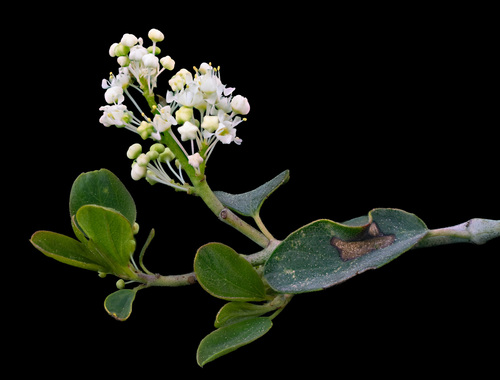
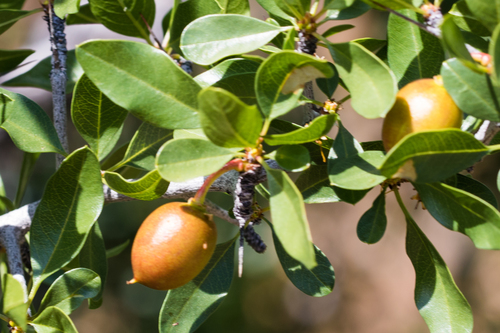
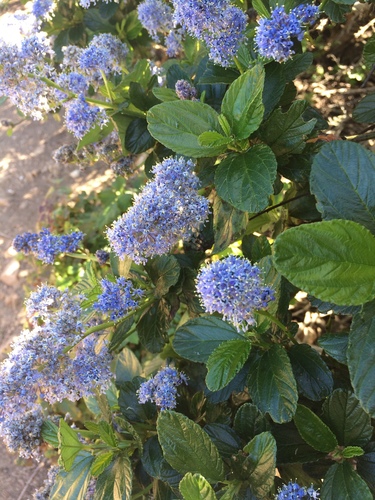
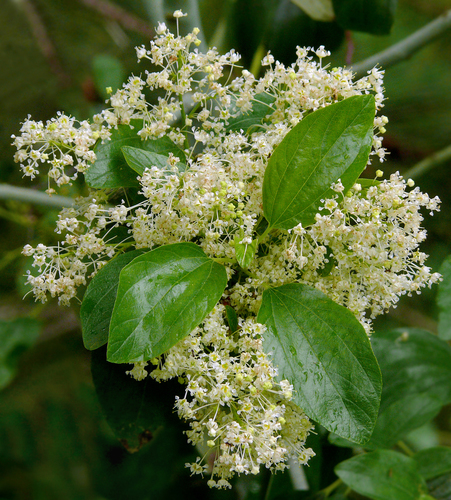
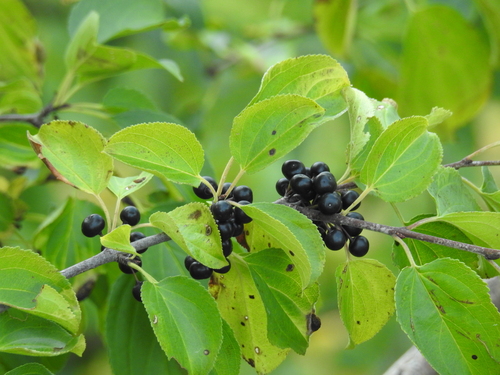
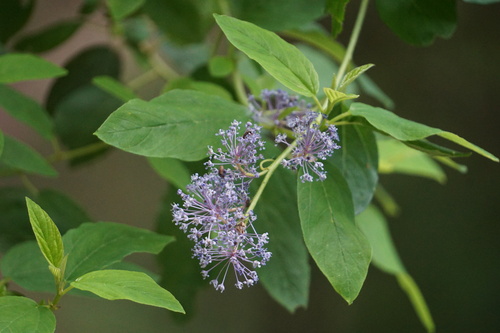
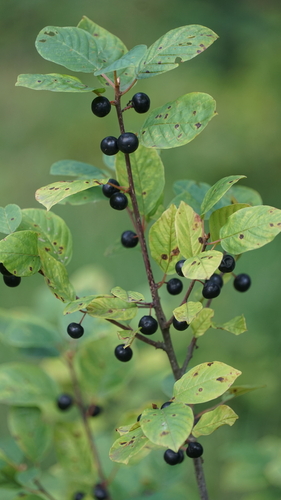
Alder buckthorn (Frangula alnus Mill.) is a non-spiny deciduous shrub that usually grows 3 to 6 meters (10 to 20 feet) tall, and occasionally reaches 7 meters (23 feet) in height. It is typically multistemmed, and rarely grows as a small tree with a trunk diameter of up to 20 centimeters (8 inches). Its outer bark is dark blackish-brown; cutting the bark exposes bright lemon-yellow inner bark. Shoots are dark brown, and winter buds have no bud scales, being protected only by densely hairy outer leaves. Leaves grow in an alternate arrangement on 8–15-millimeter (5⁄16–19⁄32-inch) petioles. They are ovate, measuring 3–7 cm (1+1⁄4–2+3⁄4 in) long by 2.5–4 cm (1–1+5⁄8 in) wide, and can rarely grow as large as 11 cm (4+1⁄4 in) long by 6 cm (2+1⁄4 in) wide. Leaves have 6–10 pairs of prominently grooved, slightly downy veins and an entire margin. The small flowers are 3–5 mm (1⁄8–3⁄16 inch) in diameter, star-shaped with five greenish-white acute triangular petals. They are hermaphroditic, insect-pollinated, and bloom from May to June in clusters of two to ten that grow from leaf axils. The fruit is a small black berry 6–10 mm (1⁄4–13⁄32 inch) in diameter. It ripens in stages, starting green, turning red in late summer, and reaching dark purple or black in early autumn. Each berry holds two or three pale brown 5-millimeter (3⁄16-inch) seeds. Seeds are primarily dispersed by frugivorous birds, which readily eat the fruit. On average, fruit persists for 15.3 days, each fruit holds an average of 2.0 seeds, fruits are 86.2% water by mass, and dry fruit weight is made up of 25.0% carbohydrates and 0.5% lipids. Frangula alnus is considered an invasive species in North America. In other locations such as Northern Ireland, it has suffered greatly from habitat loss due to the decline of its preferred bogland habitat. Currently, it is only found on the southern side of Lough Neagh, though it was also found on the northern side of the lake in the past. The Irish population of Frangula alnus also has lower genetic diversity compared to other populations of the species. Alder buckthorn grows in wet soils in open woods, scrub, hedgerows, and bogs. It thrives in sunlight and moderate shade, but grows less vigorously in dense shade. It prefers acidic soils, though it will also grow on neutral soils. Frangula alnus is one of only two food plants, the other being Rhamnus cathartica, used by the common brimstone butterfly (Gonepteryx rhamni). Its flowers are a valuable resource for bees, and its fruit is an important food source for birds, particularly thrushes. Galen, a 2nd century A.D. Greek physician, knew of alder buckthorn, though he did not clearly distinguish it from other closely related species in his writings. All these related plants were credited with the power to protect against witchcraft, demons, poisons, and headaches. The bark (and to a lesser extent the fruit) of alder buckthorn has been used as a laxative, because it contains 3–7% anthraquinones. Bark for medicinal use is dried and stored for one year before use, since fresh bark acts as a violent purgative; even dried bark can be dangerous if taken in excess. Alder buckthorn charcoal is highly prized for manufacturing gunpowder, and is regarded as the best wood for this purpose. It is especially valued for use in time fuses because it has a very even burn rate. Historically, its wood was used for shoe lasts, nails, and veneer. The bark produces a yellow dye, and unripe berries yield a green dye.