About Fragaria vesca L.
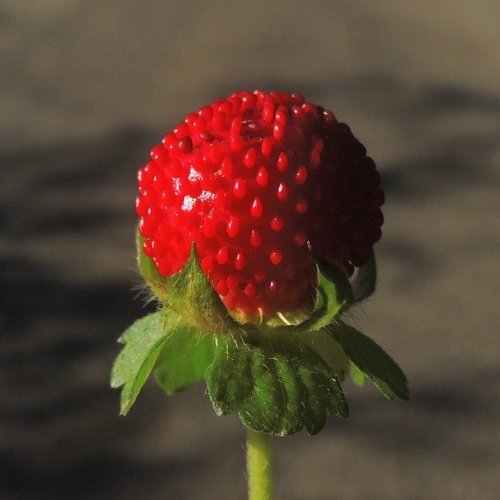
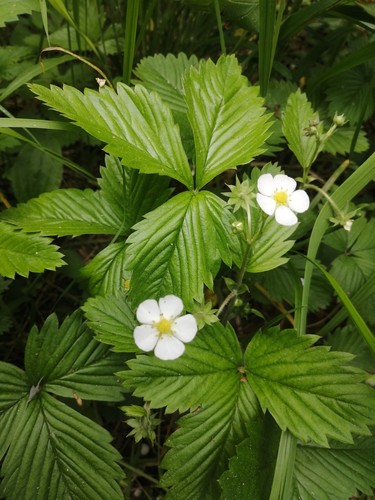
Fragaria vesca L. produces five to eleven soft, hairy white flowers, borne on a green, softly fresh-hairy stalk 3–15 centimetres (1–6 in) long that usually lifts the flowers above the plant's leaves. Its light-green leaves are trifoliate (made of three leaflets) with toothed margins. The plant spreads mostly via runners (stolons), but its seeds are viable and can grow into new populations. The fruit of this plant persists for an average of 1.2 days, which is possibly the shortest persistence of any fleshy fruit in Europe. It produces an average of 46.8 seeds per fruit, which is possibly the highest number of seeds per fruit of any fleshy fruit in Europe. Fruits average 84.0% water, and their dry weight contains 21.0% carbohydrates and 5.5% lipids, one of the highest lipid values measured among European fleshy fruits. This species' typical habitat includes trails and roadsides, embankments, hillsides, stone- and gravel-paved paths and roads, meadows, young woodlands, sparse forest, woodland edges, and clearings. It is common to find plants growing in locations where they do not get sufficient light to form fruit. In the southern part of its range, Fragaria vesca can only grow in shady areas; further north, it tolerates more sun. It tolerates a wide range of moisture levels, with the exception of very wet or very dry conditions. It can survive mild fires and can become established after fires. While Fragaria vesca primarily spreads via runners, its viable seeds are also stored in soil seed banks and tend to germinate when the soil is disturbed, far from existing Fragaria vesca populations. Its leaves are an important food source for a variety of ungulates, including mule deer and elk, and its fruit is eaten by a variety of mammals and birds, which also help distribute its seeds in their droppings. It acts as a larval host plant for the two-banded checkered skipper. Evidence from archaeological excavations shows that Fragaria vesca fruit has been eaten by humans since the Stone Age. Woodland strawberry fruit has a strong, distinct flavor, and is still collected and grown for personal domestic use, as well as grown on a small commercial scale for gourmet use, and as an ingredient in commercial jam, sauces, liqueurs, cosmetics and alternative medicine. In Turkey, hundreds of tons of wild Fragaria vesca fruit are harvested annually, mostly for export. Most cultivated varieties of Fragaria vesca have a long flowering period, and are classified by botanists as Fragaria vesca subsp. vesca 'Semperflorens'. These cultivated varieties are commonly called alpine strawberries. They either form runners, or grow multiple clustered crowns, produce fruit over a very long period, and bear larger fruit than wild common wood strawberries. They are usually propagated from seeds or by division of the parent plant. The most commonly cultivated type is everbearing and produces few runners. Cultivated plants tend to lose vigour after a few years due to their heavy fruiting and flowering, with final decline caused by viral diseases. Large-fruiting forms of Fragaria vesca have been known since the 18th century, and were called "Fressant" in France. Some cultivars produce fruit that is white or yellow when fully ripe, rather than the species' typical red. Cultivars that form stolons are often used as groundcover, while cultivars that do not form stolons are often used as border plants. Some cultivars are bred specifically for ornamental value. Hybrids named Fragaria × vescana have been created by crossing woodland strawberry with garden strawberry. Hybrids between woodland strawberry and the European species Fragaria viridis were in cultivation until around 1850, but these hybrids are now lost. Alpine strawberries have an undeserved reputation among home gardeners as being hard to grow from seed, with common rumors of long and sporadic germination times and a requirement for cold pre-chilling. In reality, when the very small seeds (which can easily be washed away with rough watering) are handled properly, 80% germination rates at 70 °F (21 °C) in 1–2 weeks are easily achieved. Alpine strawberries are sometimes used as edging plants in herbaceous borders. Seed-propagated garden varieties currently in cultivation include Rügen, the first modern cultivar: it is runnerless, everbearing and large-fruited, originating from Castle Putbus in Germany, and first offered for sale in 1920 by strawberry grower Emil Spangenberg from Morsleben. Other current cultivated seed-propagated varieties are Alexandria, first offered in 1964 by George W. Park Seed Co., USA; Baron Solemacher, first offered in 1935 by F. C. Heinemann, Germany; Weisse Solemacher (white-fruited), first offered by F. C. Heinemann; and Golden Alexandria (golden foliage). Forms with runners are still found in older gardens. Cultivars include Quarantaine de Prin, from France, which was commercially important before World War I but is now almost extinct, and may be identical to the variety Erigée de Poitou that was still offered for sale around 1960. Blanc Amélioré, from Great Britain, is white-fruited; it is uncertain if the clone in circulation today is identical to the original 1900 historical variety, due to its non-everbearing habit, but it is considered a good variety with rather large, sometimes oversized fruit of the Fressant type. Illa Martin, from Germany, is sold as an ornamental and is white-fruited; red achenes have been reported but have never been found, and most plants currently sold under this name are not true to the cultivar name. Gartenfreude, from Germany, is a large-fruited form that sometimes produces very large oversized fruit of the Fressant type. Unusual curious mutations have arisen that are sometimes grown by plantsmen and connoisseurs of unusual plants: Monophylla, also called "Strawberry of Versailles", which produces one large leaflet instead of the normal three leaflets; Vilmorin-Andrieux noted in 1885 that this mutation was raised by Duchesne. Multiplex, which has double flowers and sets fewer, smaller fruit. Muricata, also called "Plymouth strawberry", which has flowers made up of numerous small leafy bracts, and similarly spiky fruit.