About Fragaria chiloensis (L.) Mill.
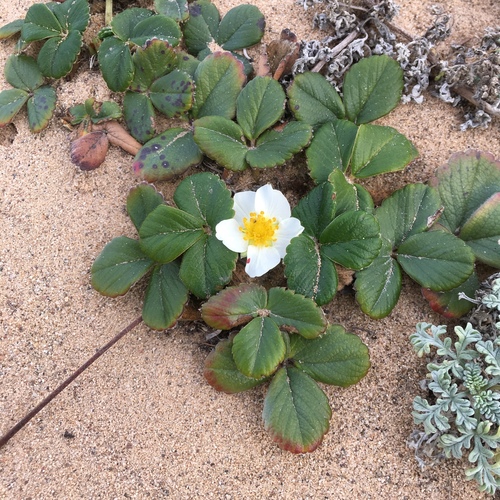
Fragaria chiloensis (L.) Mill., commonly known as beach strawberry, is an evergreen plant that reaches 15–30 centimetres (6–12 inches) in height. It has relatively thick, glossy green trifoliate leaves, with each leaflet around 5 centimetres (2 inches) long. Its stems are covered in long hairs, and its leaves sometimes bear a dense fringe of hairs. It produces white flowers in spring and early summer. Its fruit, which is a strawberry, is edible, with a red outer surface and white inner flesh. The natural range of Fragaria chiloensis covers Pacific Ocean coasts of North America, South America, and Hawaii. It grows primarily on sand beaches above the tidal zone in temperate to warm-temperate regions. It is thought that migratory birds dispersed F. chiloensis from the Pacific coast of North America to the mountains of Hawaii, Chile, and Argentina. Amédée-François Frézier (1682–1773) was the first person to bring specimens of this species back to the Old World. In Chile, the strawberry aphid Chaetosiphon fragaefolii has been recorded feeding on F. chiloensis. This aphid is a vector for strawberry mild yellow-edge virus (SMYEV), a pathogen that affects multiple species in the Fragaria genus. Sites with large aphid populations have a higher incidence of SMYEV. When this aphid-borne virus is present, it can cause ecological effects including reduced plant growth, vigor, and yield. Genetic patterns of Chaetosiphon fragaefolii indicate that human activities are the main driver of the aphid's dispersal, while dissemination into natural habitats is limited and not large-scale. Some clones of F. chiloensis, including 'Del Norte' and 'Yaquina', have been found to be resistant to aphids. Field trials have recorded fewer aphids on these clones than on other cultivated strawberry varieties, indicating potential future use in breeding programs to improve aphid resistance in F. chiloensis. The fruit of Fragaria chiloensis is sold as a local delicacy in some South American produce markets. Beach strawberry is harvested for use by several Indigenous groups, particularly along the Pacific coast of North America. The Makah, Quileute, and Quinault Indigenous groups of Washington, and the Wiyot and Pomo of California, have harvested the fruit as a food source. Indigenous tribes also use parts of the plant other than the fruit for medicinal purposes. For example, the Quileute tribe chews the leaves to make a paste that is applied to relieve burns. California tribes brew the leaves into a tea to consume its high vitamin C content, and use the roots to soothe stomach discomfort and support dental and gum health.