About Forsskaolea tenacissima L.
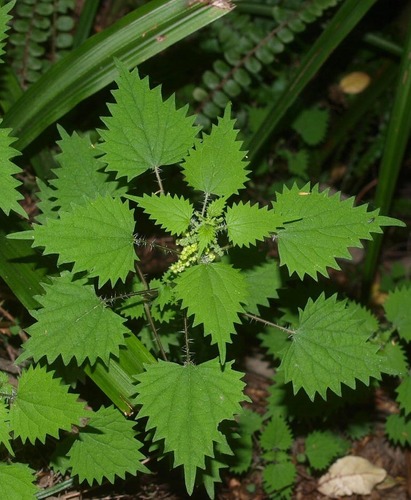
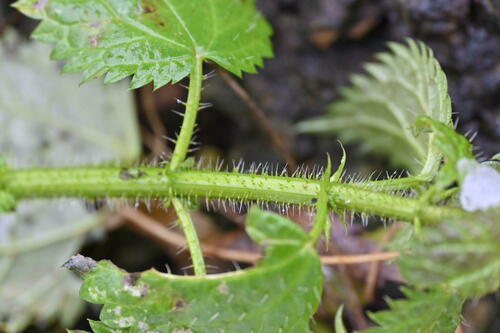
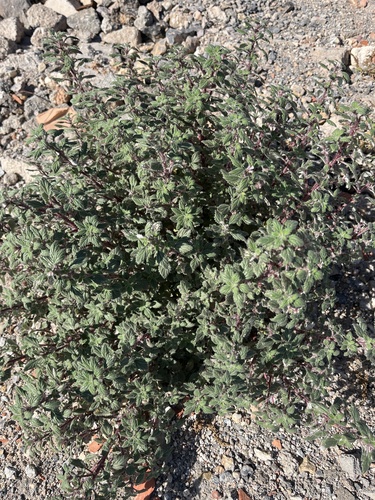
Forsskaolea tenacissima L. is a woody annual chamaephyte with an almost upright growth habit, reaching approximately 65 centimeters (26 inches) in height. It has fleshy stems covered in stiff hairs. It typically emerges after rains in rocky, hard-to-cultivate locations, including the Sahel of Mauritania, the Horn of Africa (Northeast Africa), and it has also been recently recorded in Niger. Livestock greatly relish this plant. Leaf stalks measure between 5 millimeters (0.20 in) and 20 millimeters (0.79 in) long. Leaf blades range from squared-oval to rounded in shape, measuring 1 centimeter (0.39 in) to 5 centimeters (2.0 in) long and 1 centimeter (0.39 in) to 7 centimeters (2.8 in) wide. The upper surface of leaves bears both straight and hooked hairs, while the lower leaf surface is densely covered in white, wooly hairs. The small leafy outgrowths (stipules) found at the base of the leaf stalks are rounded, measuring 3 millimeters (0.12 in) to 5 millimeters (0.20 in) long and 1.5 millimeters (0.059 in) to 2.5 millimeters (0.098 in) wide; they are persistent and dry, rather than green. For its flowers, there are five narrow, tapering involucral bracts that measure 5 millimeters (0.20 in) to 6 millimeters (0.24 in) long and are densely wooly. Each flower head, which attaches directly to the stem, contains four to eight male flowers and two to six female flowers clustered in its center. Flowers have three unequal sepals. Stamens measure 3 millimeters (0.12 in) long and bear pointed anthers; the ovary is conical, 2 millimeters (0.079 in) long, and surrounded by dense wool. The stigma is the same length as the ovary. The seeds (achenes) are elliptical, reddish-brown, and 2 millimeters (0.079 in) long. In Spain, F. tenacissima has been recorded growing on rocks or in gravel wadis of the Tabernas Desert, in a phytosociological association with Senecio flavus. It has also been observed growing in the lower sections of wadis alongside Acacia tortilis, Aerva javanica, Lotononis platycarpa, and Farsetia longisiliqua. It can also be found growing in rock crevices and water-collecting depressions above the stone pavements of Hamadas, where it grows alongside Anastatica hierochuntica, Fagonia latifolia, Farsetia aegyptia, Nauplius graveolens, Reseda villosa, Salvia aegyptiaca, Enneapogon desvauxii, and Enneapogon scaber. This species is common in arid and semi-arid wastelands, growing in sandy clay and gravelly soils from sea level up to 1,200 meters (3,900 ft) elevation. It occurs in habitats including Mediterranean woodlands and shrublands, semi-steppe shrublands, shrub-steppes, deserts, and extreme deserts. Its native distribution in the Palearctic realm includes: Northern Africa: Algeria, Egypt; Southwestern Europe: Spain; Southeastern Europe: Malta; Western Asia: Israel, Jordan, Libya, Palestine, Sinai, Tunisia. Its currently recorded distribution is: Palearctic: Northern Africa: Algeria, Egypt; Southwestern Europe: Spain; Southeastern Europe: Malta; Western Asia: Afghanistan, Iran, Israel, Jordan, Libya, Pakistan, Palestine, Sinai, Tunisia; Temperate Asia: India; Afrotropic: Arabian Peninsula: Saudi Arabia, Oman, United Arab Emirates; Northeast Tropical Africa: Eritrea; West Tropical Africa: Mauritania. Local people in the Sahara use the inner bark of this species to make rope.