About Formica sanguinea Latreille, 1798
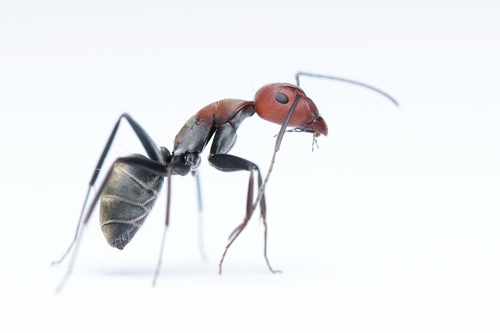
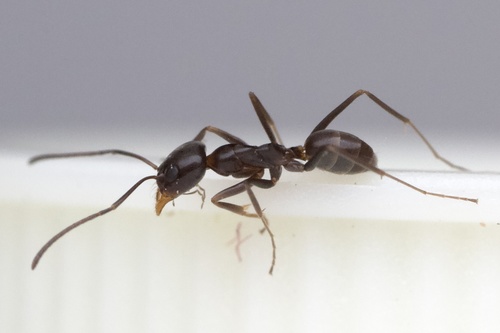
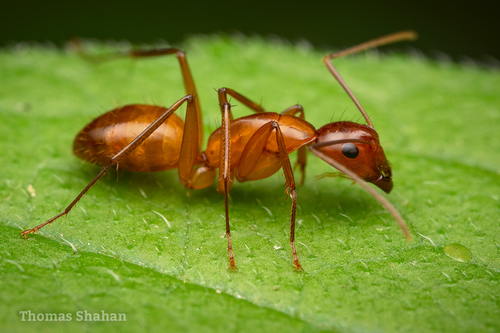
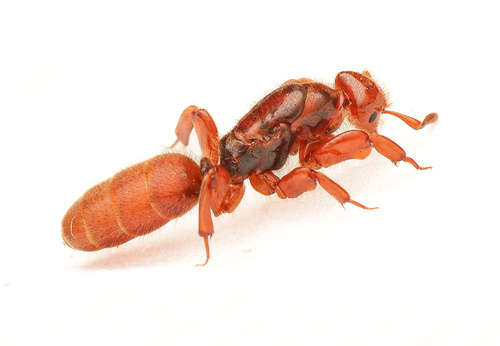
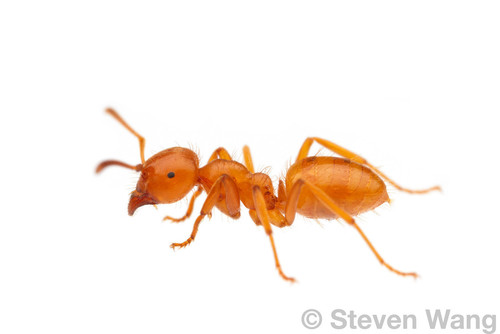
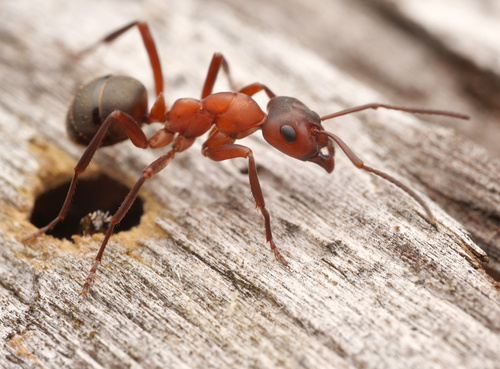
Formica sanguinea, commonly called the blood-red ant, is a species of facultative slave-maker ant in the genus Formica. It is defined by its ability to secrete formic acid. Its distribution stretches from Central and Northern Europe through Russia to Japan, China, the Korean Peninsula, Africa, and the United States. Members of this species are red and black in color, and worker individuals reach up to 7 mm in length. A colony of F. sanguinea can exist either as an independent free colony, or as a social parasite that targets other Formica species, most commonly Formica fusca, Formica japonica, Formica hayashi, and Formica rufibarbis.
Most F. sanguinea colonies are monogynous, meaning they contain only one queen. This species is typically polyandrous: the single queen mates with more than one male. Studies of the species have found that 70% of queens mate with multiple males, and F. sanguinea has higher levels of polyandry than any other Formica species. When colonies are polygynous (contain more than one queen), polyandry rates decrease. It is thought that colonies use either polyandry or polygyny to increase the colony's genetic diversity, so two distinct reproductive strategies are employed. The first strategy involves a female mating with many males, then dispersing to found a new colony. The second strategy involves a female mating with fewer males, and remaining near her birth colony alongside other females that have also mated with fewer males. In polygynous colonies, one dominant queen that contributes more to sexual reproduction than the other queens has been observed. Polyandrous F. sanguinea colonies show paternity skew, meaning the offspring of the mated males are not equally represented in the colony population. It remains unclear whether this pattern comes from internal selection or sperm competition.