About Formica rufa Linnaeus, 1761
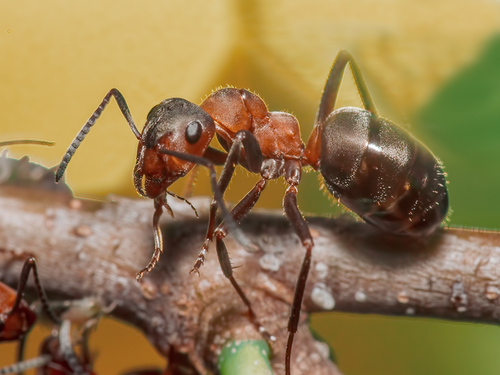
Nests of Formica rufa Linnaeus, 1761 are large, noticeable, dome-shaped mounds constructed from grass, twigs, or conifer needles. These mounds are often built against a rotting stump, and typically located in woodland clearings where sunlight can reach them. Large colonies can hold 100,000 to 400,000 worker ants and 100 queens. F. rufa is highly polygynous, and often readopts postnuptial queens from its original mother colony. This process leads to old, multi-gallery nests that may contain more than 100 egg-laying females. These colonies can often reach several meters in both height and diameter. F. rufa is aggressively territorial, and frequently attacks and removes other ant species from its local area. Nuptial flights occur in spring, and are often accompanied by brutal battles between neighboring colonies as they re-establish territorial boundaries. New nests are founded either through budding from existing nests in spring, or through temporary social parasitism, using species from the F. fusca group as hosts, most commonly F. fusca and F. lemani. Newly established F. rufa colonies have also been recorded in nests of F. glebaria and F. cunicularia. When using temporary social parasitism, an F. rufa queen removes the existing queen of the host nest, lays her own eggs, and the existing host workers care for her offspring until her offspring take over the nest. Formica rufa, a wood ant, actively collects resins from coniferous trees and integrates them into their nests for multiple purposes. Combined with formic acid from the ants' venom gland, resin provides the nest with structural stability, defense against predators, and protection against microbes, fungi, and other pathogens. Because wood ant nests have dense populations and accumulate organic debris within their large, complex structures, they are vulnerable to rapidly growing microbial populations. By using the antimicrobial properties of resin, wood ants maintain the health of their colonies. Terpenes and phenolic acids in conifer resin provide antimicrobial defense and inhibit pathogen growth inside nests when mixed with the ants' formic acid. Nests reinforced with resin have significantly lower microbial diversity than nests that do not contain resin. By modifying their nest environment, wood ants effectively protect colony health, with the direct benefit of lower pathogen exposure for the queen and developing brood. In addition to antifungal and antimicrobial defense, resin improves the nest's structural integrity and creates a protective barrier against potential intruders and predators. Since wood ant nests are often large, complex, and built above ground, they face many external threats. Binding resin to other organic materials gives the nest a cohesive building material that makes it less likely to collapse. Adding resin to the nest also provides waterproofing and weather resistance, which is an additional method of preventing fungal growth. The stickiness and occasional toxicity of resin help create a protective barrier against small arthropods and mites that may attack the nest. Chemically, the resin provides camouflage and deters intruders that rely on chemical cues to find nests. Red wood ants (Formica rufa) have been used to make yoghurt in Bulgaria and Turkey: a small number of ants are added to warm milk and left to ferment. Modern research indicates that the formic acid from the ants acidifies the milk, allowing microbes carried by the ants to grow successfully, and enzymes from the ants or their associated bacteria break down milk proteins to produce yoghurt.