About Formica pratensis Retzius, 1783
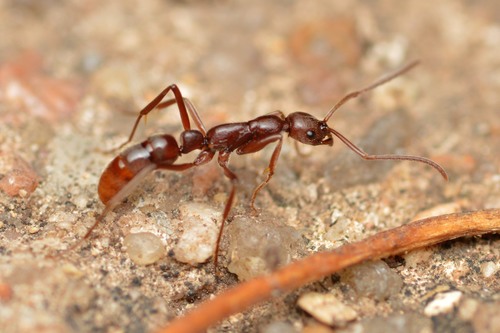
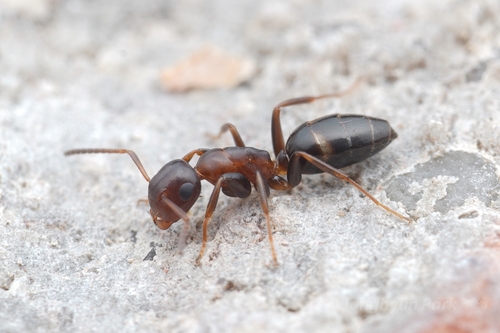
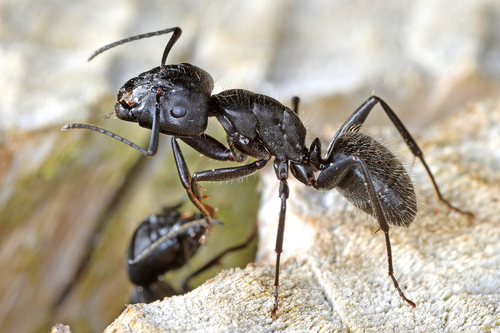
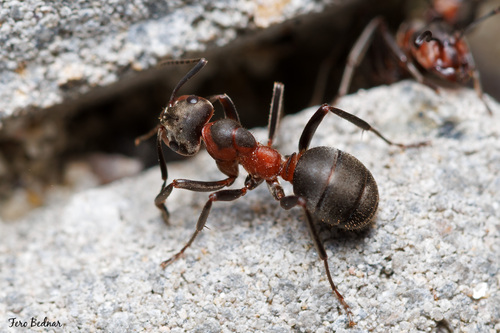
Workers of Formica pratensis reach a body length of 4.5–9.5 mm (0.18–0.37 in), making them slightly larger than workers of related species like the more common southern wood ants Formica rufa and Formica polyctena. Queens of this species reach a body length of 9.5–11.3 mm (0.37–0.44 in). The thorax is primarily reddish, while the abdomen and the top of the head are black or dark brown. As a whole, this large ant is much darker than other wood ant species. The entire body is covered in fine hairs, and two large, deep black patches are present on the pronotum and mesonotum. The legs, antennae, and well-developed mouthparts are reddish or dark brown. This species occurs in Austria, Belgium, Bulgaria, the Czech Republic, Estonia, Finland, France, Georgia, Germany, Guernsey, Hungary, Italy, Latvia, Lithuania, Luxembourg, Moldova, the Netherlands, Norway, Poland, Romania, Russia, Serbia and Montenegro, Slovakia, Spain, Sweden, Switzerland, Turkey, and Ukraine. It is also found in the East Palearctic realm and the Near East. The species has been extinct in the United Kingdom since 1988. In central European forests weakened by pollution and acid rain, red wood ant populations including this species are often endangered for reasons that remain poorly understood, and this endangerment causes further imbalances to predator-prey dynamics and the broader ecosystem. F. pratensis is characteristic of rough alpine pastures, occurring up to an elevation of around 1,500 meters. It can also be found in dry heathland, meadows, and along roadsides. Nests of this species are constructed from grasses, pine needles, and straw, and can grow up to one meter in diameter. A single nest holds either one queen or very few queens. Winged males and females are present in nests from late April to September, as the species produces two separate generations. The first generation develops from late April to mid-July, while the second generation develops from mid-August to late September. This species feeds mainly on insects and other small animals, and also collects honeydew from aphids.