About Fontinalis antipyretica Hedw.
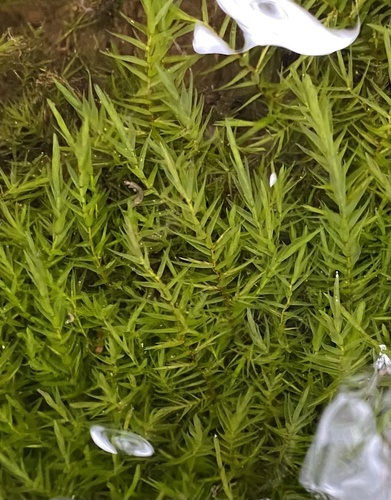
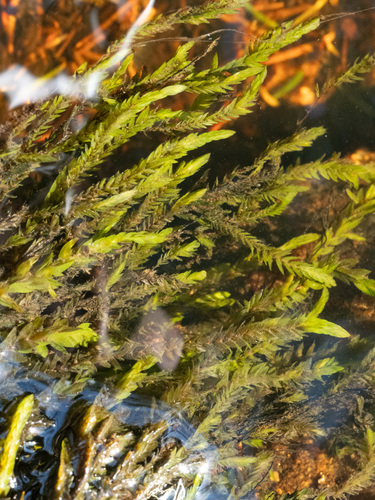
Fontinalis antipyretica Hedw. has branched, trailing stems that are triangular in cross-section and can reach up to 60 cm (24 in) in length. Its leaves are quite stiff, arranged in three overlapping rows, and are either lance-shaped or egg-shaped with a keel and a sharp point. Individual leaves measure 4 to 9 mm (0.16 to 0.35 in) long. This species does not produce flowers, but minute spores are sometimes formed in smooth sporangia, or capsules, that are between 2 and 2.6 mm (0.08 and 0.10 in) long. This moss is distributed across Europe, Asia, and parts of Africa. It grows attached to submerged rocks in fast-flowing water, and can also be found attached to substrates in lakes, forming floating masses in still water. It may be washed up onto waterside beaches. It grows best in shady locations and prefers acidic water, with a maximum tolerated pH of around 8.4. In highly acidic mountain and moorland streams of the UK, it is replaced by Fontinalis squamosa. Fontinalis antipyretica grows in large clumps and mats that offer shelter for fish eggs and fry. Many types of invertebrates take shelter among its fronds: Chironomid larvae hide at the base of the leaves, mayfly, caddisfly, and stonefly larvae cling to the fronds, and black fly larvae are often present in fast-flowing water. Diatoms and other microscopic algae grow epiphytically on its fronds. This species was traditionally used in cool-water aquaria. In tropical aquaria, Java moss, a similarly structured Vesicularia species, is used in its place instead.