About Fomitopsis pinicola (Sw.) P.Karst.
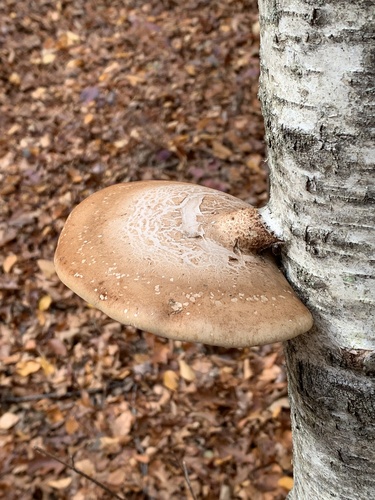
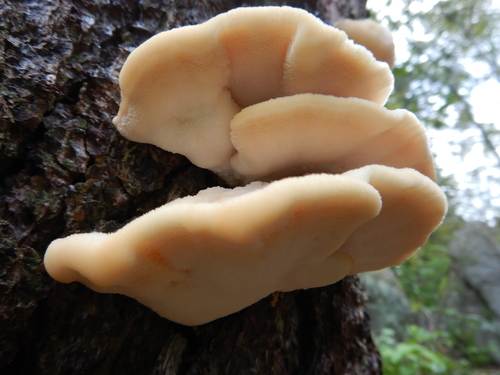
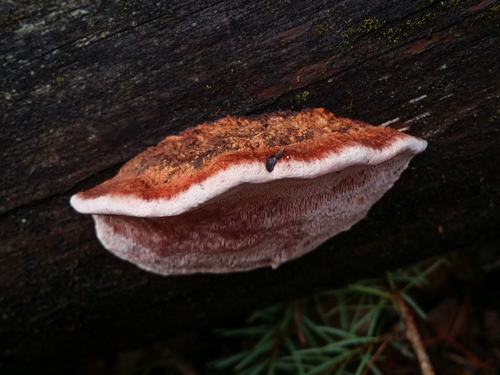
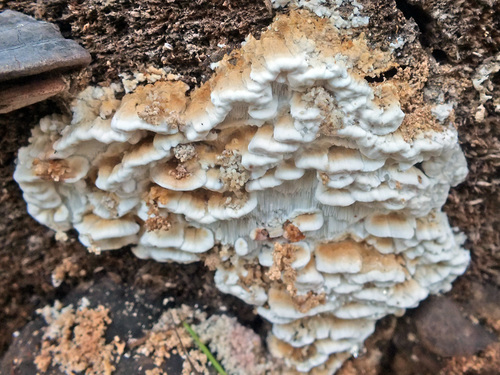
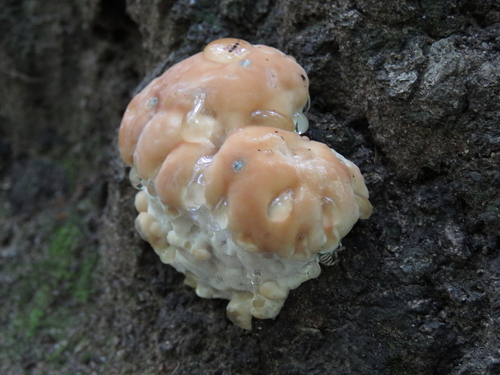
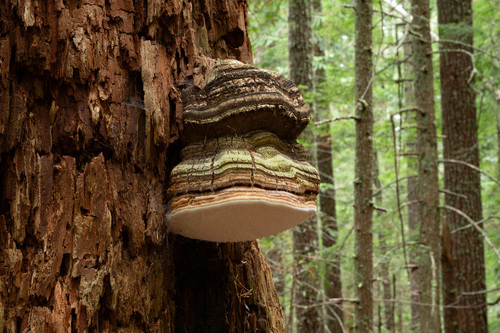
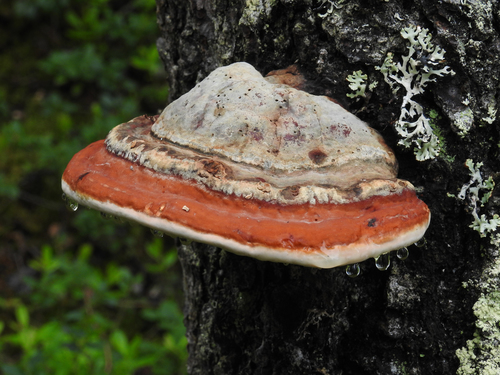
Fomitopsis pinicola (Sw.) P.Karst., also called red-belted conk, produces a woody, pileate perennial fruiting body known as a conk. The cap is typically hoof-shaped or triangular, and sometimes forms a shelf-like shape. It is hard and tough, reaching up to 30 cm or more across and 15 cm thick. The cap surface is mostly smooth; when young it is orange-yellow with a white margin, and as it matures it becomes dark reddish to brown, often developing an orange margin. The pore surface ranges from pale yellow to leather-brown, with 3–4 pores per mm. When young, pores are whitish, and become somewhat brownish with age. Spores are pale yellow and smooth. This fungus most often grows as thick shelves on live and dead coniferous trees, and less commonly on deciduous trees. It can also grow as a layer of tubes on the underside of fallen wood. Like other polypores, it produces a new layer of pores each year on the bottom of the existing pore layers, as its fruiting body is perennial. The underside of the conk holds pores lined with basidia. This species causes brown rot stem decay (heart rot) in trees. Brown rot primarily degrades cellulose, leaving behind lignin. Most stem decay caused by this fungus in mature forests does not disrupt the normal growth or physiological processes of live trees, because the tree’s vascular tissue remains unaffected. In the early stage of wood decay, affected wood shows yellowish to brownish discoloration; advanced decay turns wood brown and crumbly, which breaks into cubical pieces. Wood damaged by Fomitopsis pinicola becomes more brittle, prone to breaking in high winds, and cannot be used for pulp production. The fungus enters trees through exposed wood at wound sites, and continues decaying wood after the tree dies. On dead trees, it typically affects sapwood first before progressing into heartwood. It can grow anywhere on tree roots or stems, but is most common low on the tree bole, where frequent wounds encourage infection. Fruiting bodies produce abundant basidiocarps and basidiospores, which are dispersed by air currents and germinate when they contact wood or other substrates. Actual wood degradation is carried out by the fungus’s thread-like vegetative mycelium growing inside the tree. This species is common throughout temperate Eurasia, and grows on both softwood and hardwood trees. In southeast Alaska, it is frequently found on live conifer trees including Western hemlock, Mountain hemlock, White spruce, Lutz spruce, and Sitka spruce. It is normally found on dead pines, but can grow on all conifers, and is also observed growing on large stem wounds, broken tops, and dead tissue of live trees. After invading and colonizing the wood of living trees, it decomposes the wood before the tree dies. The residual lignin structure it leaves behind after degrading cellulose is low-density but stable enough to be excavated by woodpeckers. In mature forests of southeast Alaska, stem decay caused by this fungus leads to enormous annual wood volume loss of major local tree species. Approximately one-third of the old-growth timber board-foot volume in Southeast Alaska is defective, largely due to decay from this fungus. In contrast, young-growth stands with frequent wounding from commercial thinning, wind damage, or animal feeding have very little decay. In the temperate rainforest ecosystems where this fungus occurs, large-scale disturbances like fire are uncommon, and stem decay from this fungus predisposes large old trees to bole breakage and windthrow, creating small but ecologically important disturbance regimes. Stem decay from this fungus creates canopy gaps, alters stand structure and succession, increases biodiversity, and improves wildlife habitat. The fungus also carries out critical nutrient cycling functions in these forests by decomposing dead stems, branches, roots, and boles. Cavities formed by the fungus in standing trees provide essential habitat for many wildlife species, including bears, voles, squirrels, and multiple bird species. The lack of frequent large-scale disturbances and long lifespan of individual trees in these systems gives this slow-growing decay fungus enough time to cause significant decay. There is increasing interest in developing methods to encourage earlier development of stem decays like this in second-growth stands, to meet wildlife and other non-timber management objectives. Due to its very hard woody texture, Fomitopsis pinicola is inedible, but it can be used as tinder. It can be processed into a famine food through a long, laborious preparation process. In Asia, its basidiocarps are reported to have medicinal uses, and its fruiting bodies have been found to have significant antioxidant activity.