About Fomitopsis officinalis (Vill.) Bondartsev & Singer
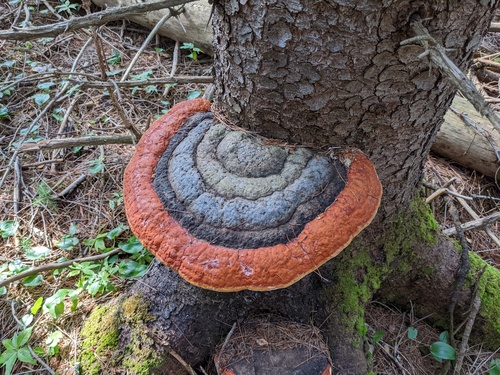
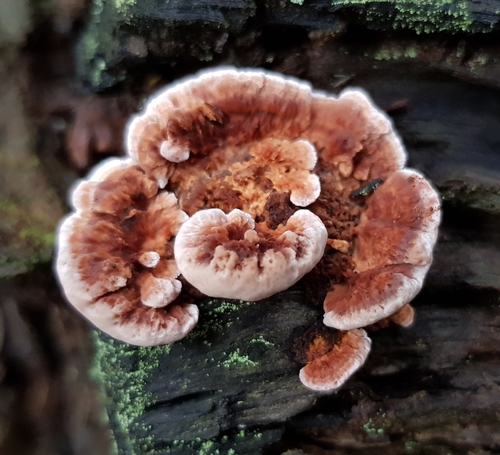
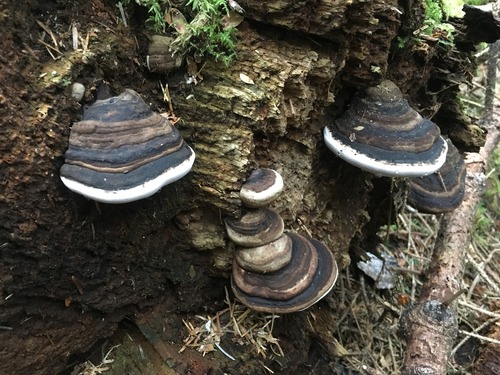
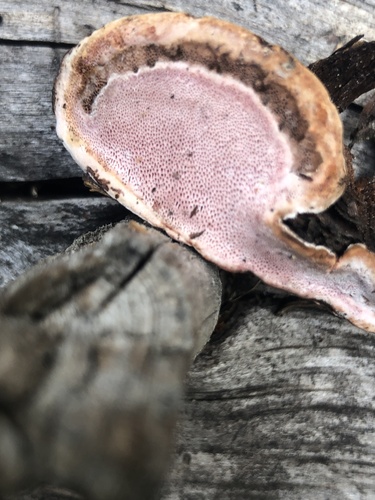
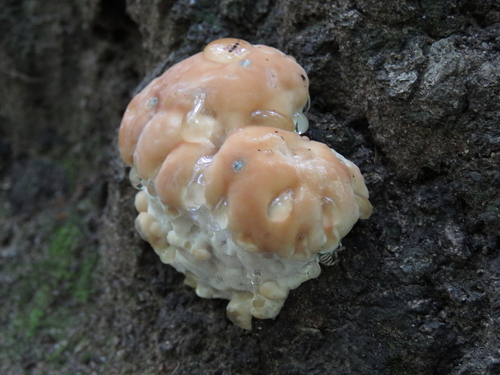
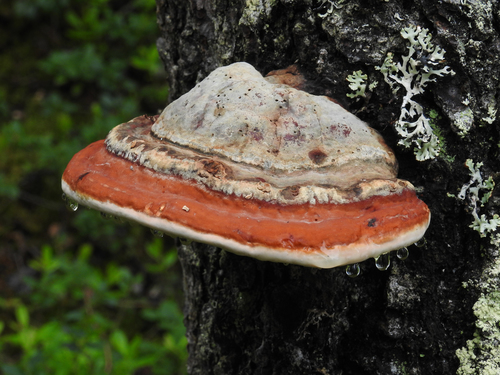
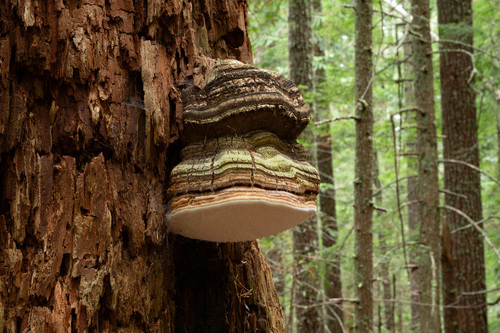
This fungus, officially known by the scientific name Fomitopsis officinalis (Vill.) Bondartsev & Singer, produces distinctive conk fruiting bodies. These conks grow out from the sides of host trees or hang from host tree branches, at heights up to 20 metres (65 feet) above ground. They form either a hoof-like shape or a columnar shape. Some individuals exceed 65 centimetres (2 feet) in length, measure nearly 40 centimetres (1 and 1/2 feet) in girth, and can weigh up to 9 kilograms (20 pounds). Young fruiting bodies are soft and yellow-white, and they soon harden to become chalky throughout their structure. As the conks age, they develop red, brown, or gray coloration, and crack into cubic shapes with thick white felts visible in larger cracks. The fungus produces white, ellipsoidal spores, which are released through the bottom of the fruiting body during warmer months. Both the conks and their internal felts have a distinct bitter taste, and their scent ranges from mild to mealy. This species predominantly grows in old-growth forests, with a distribution covering Eurasia, Morocco, and North America. It most commonly prefers to grow on various Larix (larch) species, but has also been observed growing on other coniferous tree species from the Pinus (pine) and Cedrus (cedar) genera. A single visible conk on a tree usually indicates the tree is completely infected by the fungus, and an infected dead tree can become a habitat for snag-nesting organisms. Ancient Greeks used this fungus to treat consumption (tuberculosis), as documented in the writings of Pedanius Dioscorides from 65 CE, and some Indigenous peoples used it to treat smallpox. Later, conks of this species were collected extensively to produce a medicinal quinine substitute, giving the fungus the common name "quinine conk". People believed it contained quinine due to the bitter taste of its powdered conk, but in fact this fungus does not have anti-malarial properties. Mycologist Paul Stamets has conducted numerous investigations into the biological activities of this species, and his work found that fungal extracts show antiviral activity against a range of viruses in vitro. This in vitro activity has specifically been observed against pox family viruses, HSV-1, HSV-2, Influenza A, Influenza B, and Mycobacterium tuberculosis. Other researchers have isolated novel chlorinated coumarins from this fungus, and these compounds showed notably low minimum inhibitory concentrations against the Mycobacterium tuberculosis complex.