About Fomitopsis betulina (Bull.) B.K.Cui, M.L.Han & Y.C.Dai
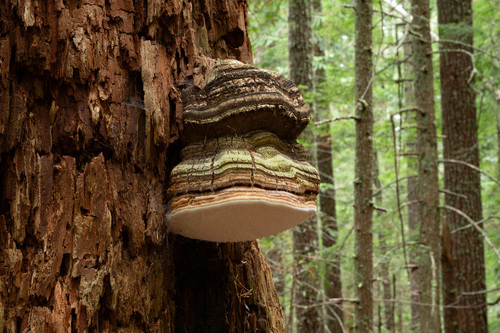
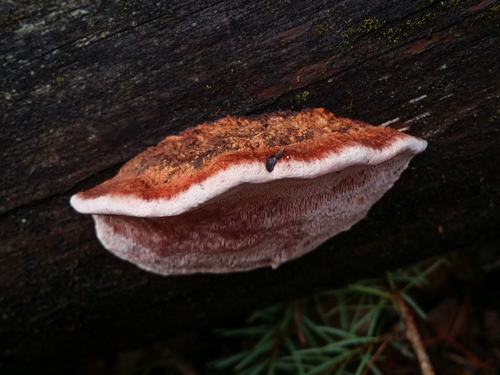
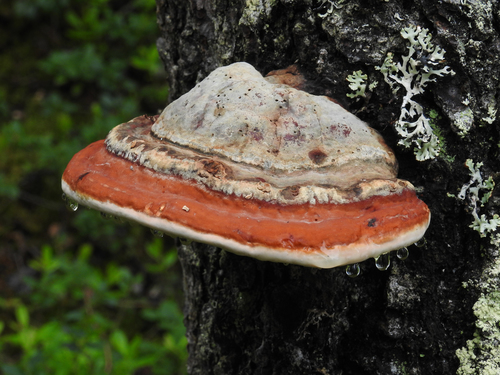
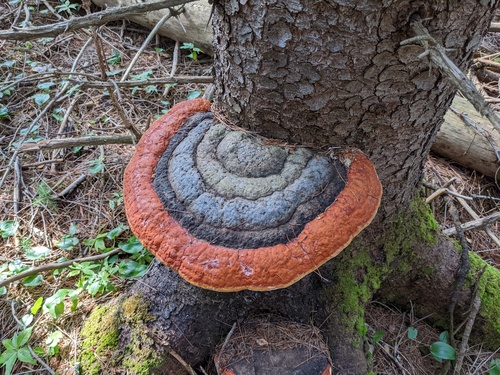
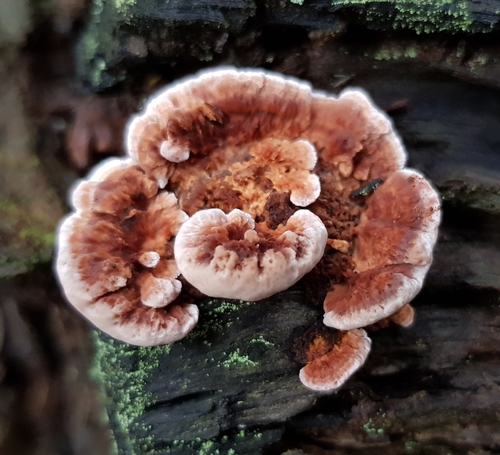
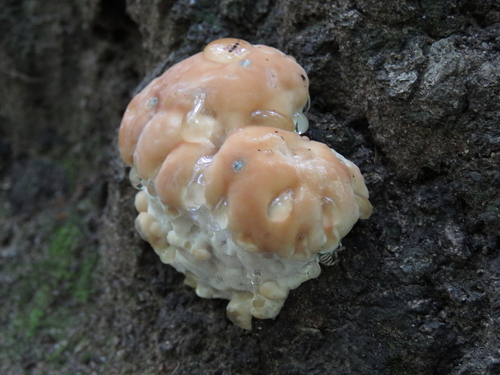
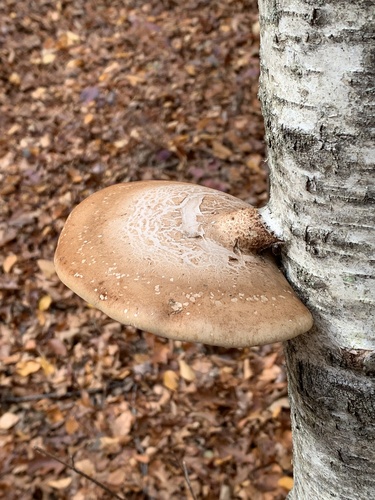
Fomitopsis betulina has pale basidiocarps (fruit bodies) with a smooth greyish-brown upper surface. The creamy white underside of the fruit body bears hundreds of spores-containing pores. Fruit bodies have a rubbery texture that becomes corky as they age. Both wood decayed by this fungus and cultured mycelium of the species often have a distinct smell of green apples. Its spores are cylindrical to ellipsoidal, and measure 3–6 by 1.5–2 μm. This species has a bipolar mating system: monokaryons or germinating spores can only mate to form a fertile dikaryon with an individual that carries a different mating-type factor. At least 33 different mating-type factors exist in the British population of this fungus, and all are variants or alleles of a single gene. This differs from the tetrapolar mating system of some other basidiomycete species, which involves two separate genes. Fomitopsis betulina is one of the most common species of brown rot fungi. Its geographic range is restricted to the Northern Hemisphere, covering North America, Europe, and Asia. It grows exclusively on birch trees, including the species Betula pendula, B. pubescens, B. papyrifera, and B. obscura. There is some uncertainty whether isolates from continental Europe, North America, and the British Isles can interbreed. It acts as a necrotrophic parasite on weakened birches, causing brown rot that eventually kills the host tree, and is one of the most common fungi found growing on dead birches. The fungus likely becomes established through small tree wounds and broken branches, and may lie dormant and compartmentalized into a small area by the tree’s own defences for years, until an event weakens the host tree. Common stressors that cause this weakening include fire, drought, and overshading by other trees. Most infected birches host only one fungal individual, but occasionally multiple individuals can be isolated from a single tree; this may happen when the fungus colonizes the tree after another agent has already killed it. These separate fungal individuals can sometimes be visualized by incubating a slice of brown-rotted birch wood in a plastic bag for several days. This allows the fungus’s white mycelium to grow out from the wood surface. If more than one dikaryotic individual is present, lines of intraspecific antagonism form as the two individual mycelia interact and repel one another. The fungus can host a large number of insect species that rely on it for food and breeding sites. A large-scale study of over 2,600 fruit bodies collected in eastern Canada found 257 species of arthropods associated with the fungus, including 172 insects and 59 mites. It is also eaten by the caterpillars of the fungus moth Nemaxera betulinella. Old fruit bodies that have survived through winter are often colonized by the white to pale yellow fungus Hypocrea pulmonata. Traditionally, the velvety cut surface of Fomitopsis betulina’s fruit body was used as a strop for finishing razor edges, and as a mounting material for insect collections. It has also been used as tinder and as an anesthetic. It is considered inedible, with the only possible exception being young fruit bodies.