About Fomes fomentarius (L.) Fr.
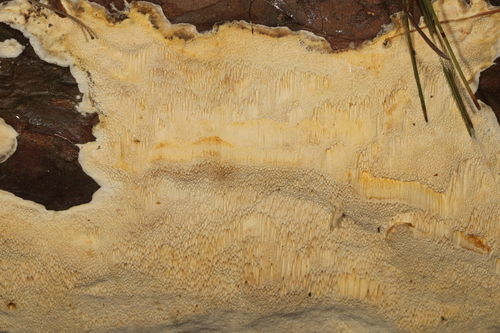
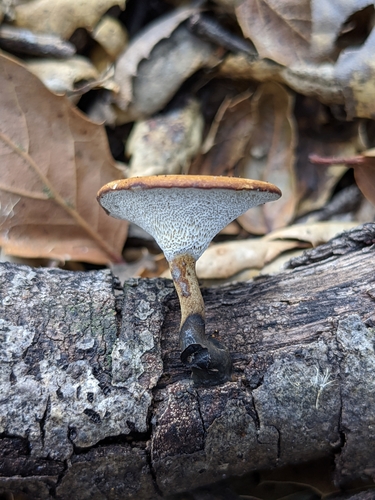
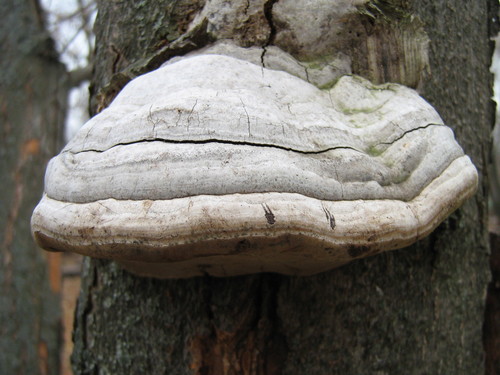
The scientific name of this fungus is Fomes fomentarius (L.) Fr. Its fruit bodies measure 5 to 45 centimetres (2.0 to 17.7 in) across, 3 to 25 cm (1.2 to 9.8 in) wide, and 2 to 25 cm (0.8 to 9.8 in) thick, and attach broadly to the tree they grow on. While most often shaped like a horse's hoof, it can also form a more bracket-like shape with an umbonate attachment to its substrate. This species typically has broad concentric ridges and a blunt, rounded margin. Its flesh is hard, fibrous, and cinnamon brown in colour. The tough, bumpy, hard, woody upper surface varies in colour, most often light brown or grey, and the margin is whitish during growth periods. A hard crust 1 to 2 mm (0.04 to 0.08 in) thick covers the tough flesh. On the underside, round pores are cream-coloured when new, mature to brown, and darken when handled. The pores are circular, with 2–3 pores per millimetre. The pore tubes are 2 to 7 mm (0.08 to 0.28 in) long and rusty brown. Fruit body size and colouration vary based on where the specimen grows: silvery-white, greyish, and nearly black specimens have all been recorded. The darkest fruit bodies were previously classified as the separate species Fomes nigricans, but this is now recognised as a synonym of Fomes fomentarius. Fruit bodies are typically lighter in colour at lower latitudes and altitudes, and on Northern Hemisphere specimens that grow on the south side of trees. Studies have found no reliable way to differentiate varieties of Fomes fomentarius; instead, observed phenotypic differences can be attributed either to different ecotypes or to interactions between the genotype and its environment. Fomes fomentarius has a circumboreal distribution, and is found in both northern and southern Africa, throughout Asia, into eastern North America, and throughout Europe, where it is frequently encountered. The optimal temperature for its growth is between 27 and 30 °C (81 and 86 °F), and the maximum temperature for growth is between 34 and 38 °C (93 and 100 °F). F. fomentarius typically grows alone, but multiple fruit bodies can sometimes occur on the same host trunk. The species most often grows on hardwoods: in northern areas it is most common on birch, in more southern regions beech is the most typical host, and in the Mediterranean region oak is the typical host. It has also been recorded growing on maple, cherry, hickory, lime tree, poplar, willow, alder, hornbeam, and sycamore, and exceptionally even grows on softwoods such as conifers. Fomes fomentarius is a stem-associated white-rot fungus that degrades both lignin and cellulose in hardwood tissues, producing pale, fibrous wood. Although it was long considered primarily a pathogen of living trees, its ecological strategy has been reassessed. The species is apparently unable to colonise freshly wounded sapwood directly, and instead requires prior colonisation of the wood by other microorganisms. In experimental studies of European beech (Fagus sylvatica), the fungus was not recovered from freshly cut healthy wood, but was frequently isolated after incubation under drying conditions. This suggests F. fomentarius has latent mycelia present within living stem tissues. In these studies, F. fomentarius was isolated mostly from stem tissues rather than branches, which matches the typical position of its fruit bodies on mature trees. Microscopic examination found fungal hyphae within xylem lumina after incubation, consistent with activation of previously quiescent thalli. These findings have led some authors to interpret F. fomentarius as having an endophytic phase during part of its life cycle, remaining latent within living trees and becoming actively saprotrophic when host tissues senesce or environmental conditions change. Like many wood-decay fungi, the line between parasitic colonisation of living tissue and saprotrophic decay of senescent or stressed wood may be gradual rather than discrete. Its fruit bodies are perennial and can survive for up to thirty years. The strongest growth period occurs between early summer and autumn. Yearly new growth always forms on the bottom of the fungus, meaning the lowest layer is the youngest. This pattern continues even after the host tree has fallen to the forest floor, which can occur due to the white rot the fungus causes; this growth pattern is called positive gravitropism. Very large numbers of spores are produced, especially in spring: some fruit bodies can produce up to 887 million basidiospores per hour. Spore production also occurs in autumn, though at much lower levels. Spores are released at comparatively low temperatures, and are visible as a white powder in dry weather. This species is not considered edible; its flesh has an acrid taste and a slightly fruity smell. It has economic significance: as the parasitic infection advances, it reduces the value of host timber. Fomes fomentarius infects trees through damaged bark.