About Fluvicola nengeta (Linnaeus, 1766)
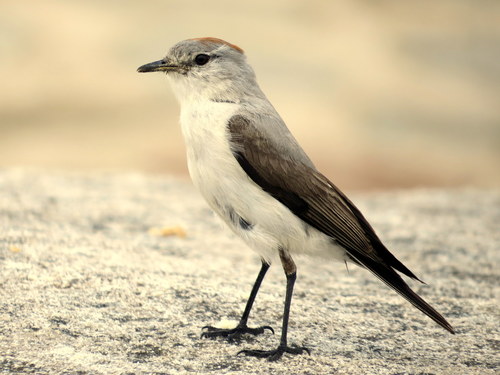
The masked water tyrant, Fluvicola nengeta, measures 14.5 to 15 cm (5.7 to 5.9 in) in length. Males and females have identical plumage. Adults are predominantly white, with a black stripe running through the eye that forms the species' eponymous mask. Their back has a brownish gray tinge, their wings are black, and their black tail has white feather tips. Their underparts are completely white. The subspecies F. n. atripennis has blacker wings than the nominate subspecies, with white fringes on the tertial feathers; the extent of this white varies between individuals. Both subspecies have a dark iris, a black bill, and black legs and feet.
The masked water tyrant has a highly disjunct distribution, with the nominate subspecies occupying the much larger range of the two. The nominate subspecies occurs mainly in eastern and southern Brazil, ranging from eastern Pará and Tocantins east to Rio Grande do Norte, and south from there to Mato Grosso do Sul and Santa Catarina. Its range extends into far northeastern Argentina's Misiones Province, and it has been recorded as a vagrant in Paraguay and Uruguay. Subspecies F. n. atripennis is found from extreme southwestern Colombia's Nariño Department, south through western Ecuador, and extends slightly into far northwestern Peru's Tumbes Department.
The species inhabits somewhat open shrublands located close to freshwater bodies, and especially favors marshy areas and rice fields. It also occurs along the banks of ponds, lakes, streams, and rivers, and is occasionally found in nearby open grasslands. In Brazil, it has increasingly been spotted in urban and suburban parks. The nominate subspecies mostly occurs at elevations from sea level to about 300 m (1,000 ft), but is occasionally found at much higher elevations. Subspecies F. n. atripennis occurs mostly below 800 m (2,600 ft) in Ecuador.