About Flueggea tinctoria (L.) G.L.Webster
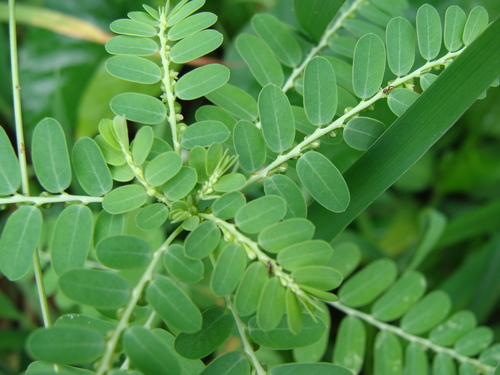
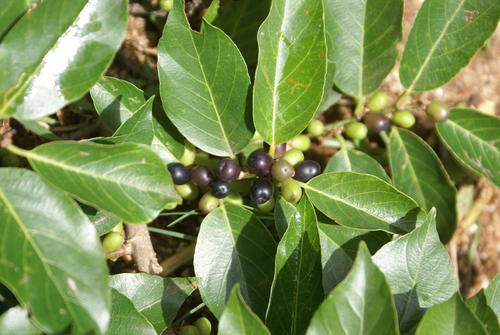
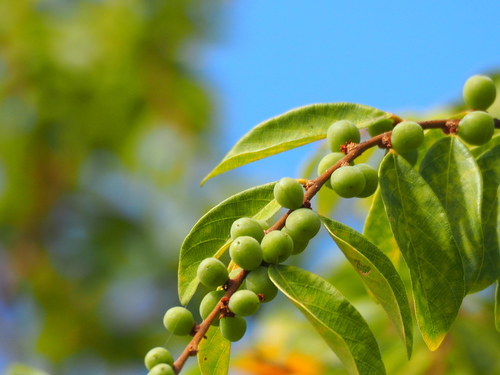
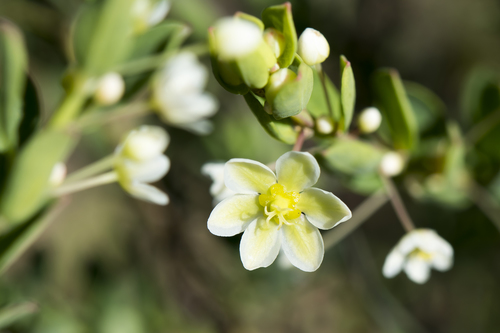
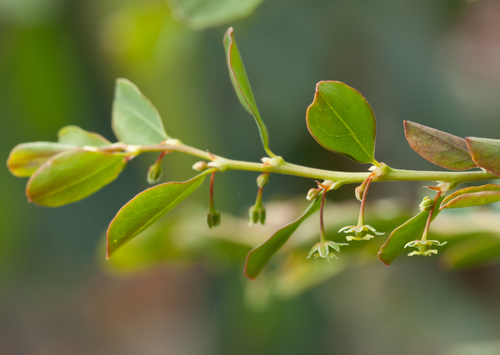
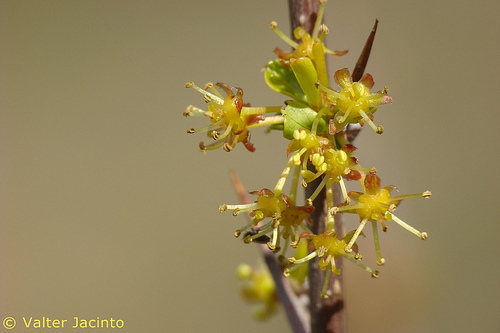
Flueggea tinctoria (L.) G.L.Webster is a dioecious, deciduous shrub that grows up to 2 m (6 ft 7 in) tall, and it branches heavily starting from its base. Its branches are erect-spreading, spinescent, cylindrical, and can be either smooth or warty; they are either glabrous or puberulous, bearing short, small, thick hairs. Leaves are arranged alternately and are glabrous. Inflorescences hold 2 to 4 flowers (and up to 6 at most), which are either fasciculate or solitary. Male flowers grow in an erect-spreading orientation, while female flowers are somewhat pendulous. Male flower pedicels measure 2–6 mm (0.079–0.236 in), and female flower pedicels measure 5–8 mm (0.20–0.31 in). This species has 5 to 8 strongly exerted stamens. Fruits are 3.5–4 mm (0.14–0.16 in) in diameter, shaped subglobose, depressed, and marked with three grooves; fruit pedicels can reach up to 15 mm (0.59 in) long. Seeds are smooth, measure approximately 2 mm × 1.5 mm (0.079 in × 0.059 in), and are convex on the back and flat along the sides.
This species is native to the southwestern quadrant of the Iberian Peninsula, found in inland Portugal and central-western to southwestern Spain. It is a characteristic representative of western Iberian sclerophyllous and semi-deciduous forests. It grows in shrubby communities, on flood beds and torrential watercourses, on usually stony siliceous terrain, at altitudes ranging from 20 to 200 m (66 to 656 ft). It is especially dominant in the river basins of the Guadalquivir, Guadiana, Tagus and Douro.