About Flueggea leucopyrus Willd.
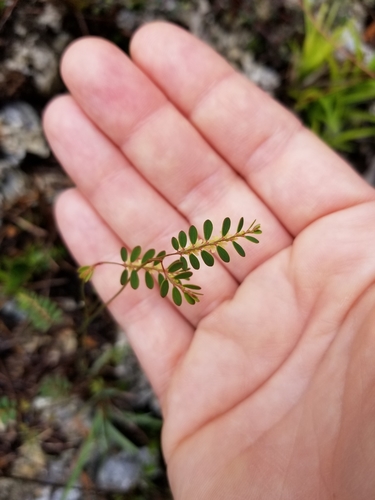
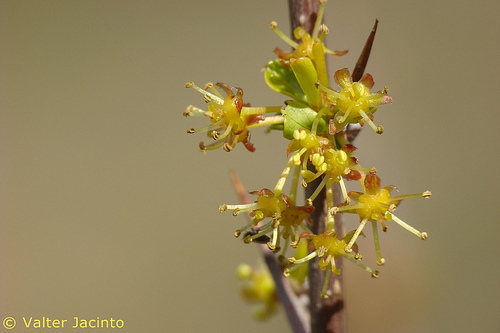
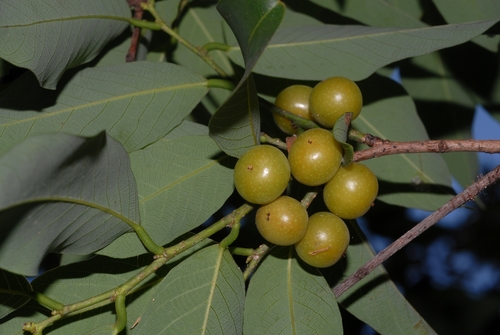
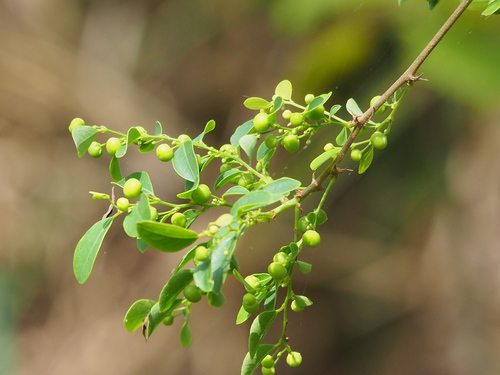
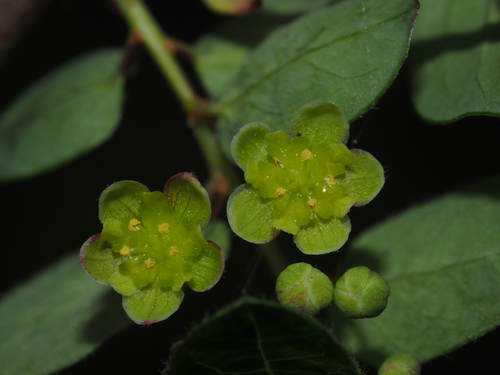
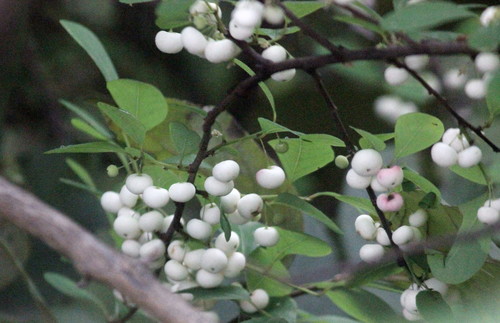
Flueggea leucopyrus Willd. is an erect, many-branched shrub that reaches up to 5 meters in height. It has angular branchlets that end in sharp spines. Its leaves are alternate, shaped obovate to elliptic, and grow up to 2.5 cm long and 1.5 cm wide. Male flowers are greenish-yellow, clustered in axillary fascicles, and have five perianth lobes, five free stamens, and a disc of five glands that alternate with the stamens. Female flowers are solitary. The ripe fruits of this species are white, globose, around 5 mm across, and three-celled. Its seeds are trigonous, smooth, and pale brown.
The native range of Flueggea leucopyrus covers parts of East Africa, South Asia, and Southeast Asia. It occurs naturally in Ethiopia, Somalia, Socotra, Sajid Island, Pakistan, India, Sri Lanka, Bangladesh, Myanmar, and the Chinese provinces of Sichuan and Yunnan. It is most commonly found on foothills in scrub forests and dry deciduous forests, growing at elevations between 0 and 900 meters.
Flueggea leucopyrus flowers from February to May and is pollinated by honey bees. Its fruiting period runs from April to November, and goats feed on this plant.
The fruits of Flueggea leucopyrus are edible. Leaf juice or paste is combined with tobacco to remove worms from sores. It has been used in Ayurveda and folk medicine, especially Sri Lankan folk medicine, to manage both acute and chronic wounds. Flueggea leucopyrus is used as an antifungal treatment against Aspergillus. It shows potential anti-inflammatory effects against protein denaturation and as a proteinase inhibitor, a property that may come from its flavonoid and polyphenol content. Further research is required to identify its active components and understand their mechanisms of action.
Extracts from Flueggea leucopyrus have antioxidant properties, with the strongest effects seen in chloroform and alcohol extracts. These extracts showed a dose-dependent increase in antioxidant activity, reaching 82.5% for chloroform extracts and 88.4% for alcohol extracts. Flavonoids, alkaloids, tannins, and steroids found in the extracts are thought to be responsible for this free radical scavenging activity. When ranked by effectiveness, alcohol extracts are the most active, followed by chloroform extracts, ethyl acetate extracts, hydro-alcohol extracts, and hexane extracts. This antioxidant activity works through the plant's chemical constituents acting as hydrogen donors to reduce the stable radical DPPH.
A decoction made from the aerial parts of Flueggea leucopyrus shows cytotoxic effects on breast cancer cells, with stronger activity against Her2 negative cell lines MCF-7 and MDA-MB-231 compared to Her2 positive SKBR-3 cells and non-cancerous MCF-10A cells. This finding supports the traditional use of the plant for its anticancer properties. Young branches of Flueggea leucopyrus have been used as brooms by aboriginal inhabitants of India's Nilgiri Biosphere Reserve in the Western Ghats region.