About Flindersia bennettii F.Muell. ex C.Moore
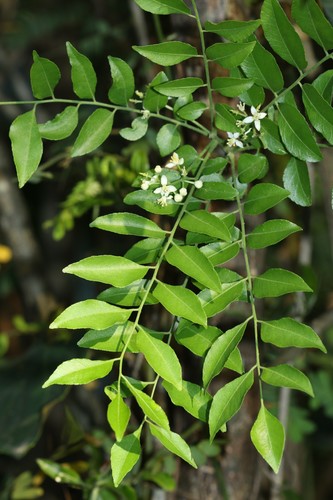
Flindersia bennettii, commonly known as Bennett's ash, is a tree that usually reaches a height of 43 metres (141 feet). Its leaves grow in opposite pairs, and are most often pinnate, with between three and nine elliptical to egg-shaped leaflets. These leaflets measure 60 to 190 millimetres (2.4 to 7.5 inches) long and 17 to 80 millimetres (0.67 to 3.15 inches) wide. The upper surface of the leaflets is glossy dark green, while the lower surface is paler. Side leaflets grow on petiolules 1 to 6 millimetres (0.039 to 0.236 inches) long, and the end leaflet grows on a petiolule 8 to 30 millimetres (0.31 to 1.18 inches) long.
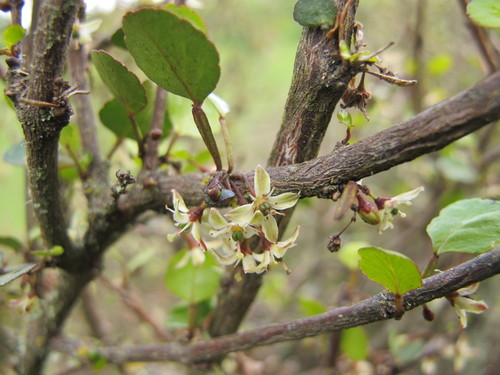
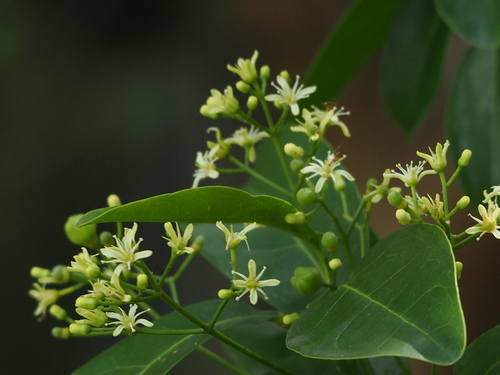
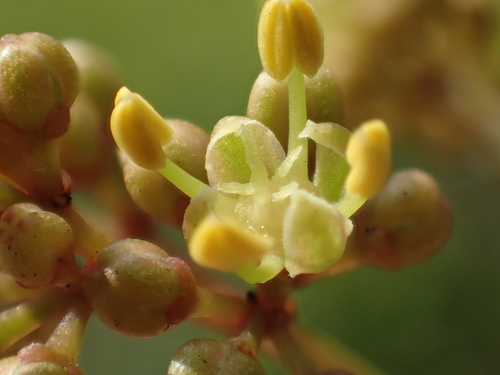
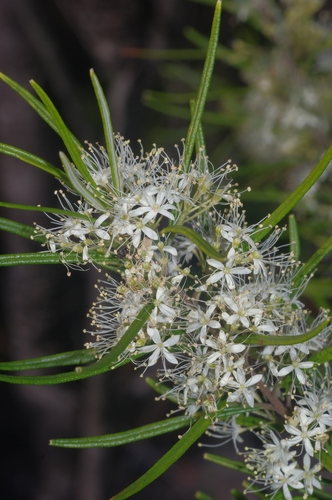
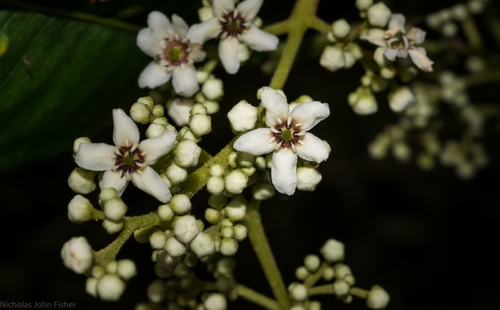
The species' flowers are arranged in panicles at the ends of branchlets, and sometimes grow in upper leaf axils. These panicles can reach up to 250 millimetres (9.8 inches) long. The sepals are 1 to 1.5 millimetres (0.039 to 0.059 inches) long, and the petals are cream-coloured to white, 2.5 to 5 millimetres (0.098 to 0.197 inches) long, with a small number of hairs on the back. Flowering takes place from May to October. The fruit is a capsule 4 to 7 millimetres (0.16 to 0.28 inches) long, covered with rough pointed projections up to 4 millimetres (0.16 inches) long. The seeds are 30 to 45 millimetres (1.2 to 1.8 inches) long and have wings at both ends.
Bennett's ash grows primarily in streamside, seaside or subtropical rainforest, from sea level up to an altitude of 300 metres (980 feet). Its natural range extends from the Clarence River in New South Wales to Bundaberg in south eastern Queensland.
The timber of Bennett's ash is straight-grained and easy to work. It was historically used for construction in coach-making, boat building, cabinetry and joinery work, and it is considered an excellent carving wood. The timber has a density between 800 and 850 kilograms per cubic metre.