About Flemingia strobilifera (L.) W.T.Aiton
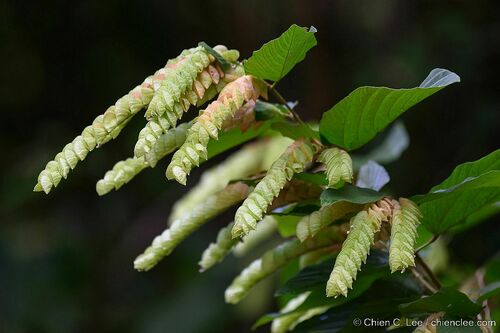
Flemingia strobilifera (L.) W.T.Aiton is an erect perennial shrub that grows 1.5 to 2 meters tall. Its leaves are ovate to oblong, with pinnate venation and wavy margins. Flowering occurs between October and December. Each small, white pea-shaped flower is enclosed by a pair of reniform flower bracts. The alternating bracts are arranged in two files along the raceme, and turn papery when they dry out. This species produces small cylindrical seed pods that release tiny black and red seeds through explosive dehiscence. It is commonly found across China, Taiwan, Bhutan, India, Nepal, Pakistan, Sri Lanka, Laos, Myanmar, Thailand, Vietnam, Indonesia, Malaysia, Papua New Guinea and the Philippines. It is classified as an invasive plant species in New Caledonia and in Panama. Across many parts of the Indian subcontinent, Flemingia strobilifera is used as a traditional medicine to treat epilepsy, hysteria and fever. It is a core part of the Bihu (গৰু বিহু) festival, where cattle are washed and gently beaten with twigs from this plant. In the northeastern Indian state of Assam, it is called makhiyoti (মাখিয়তী).