About Flemingia macrophylla (Willd.) Kuntze ex Merr.
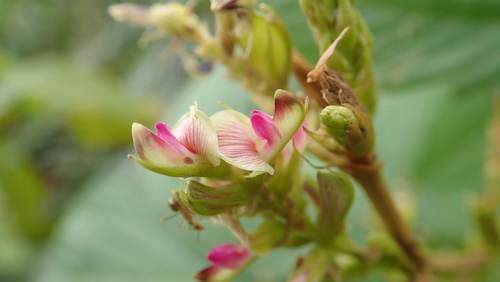
Flemingia macrophylla (Willd.) Kuntze ex Merr. is a woody, perennial, deep-rooting, leafy shrub. It grows 0.6–2.4 meters high, and rarely reaches 3 meters. Its main stem is either prostrate or erect, and many stems grow from a single base. Young branches are greenish, ribbed, triangular in cross-section, and covered in silky texture; older stems are brown and nearly round in cross-section. Its leaves are trifoliate, and leaflets have a papery texture with a hairless upper surface. Inflorescences are densely spicate-racemose or paniculate; bracts are either leaf-like or dry, and either persistent or deciduous. Pods are small, turn brown when ripe, and are dehiscent, usually holding two shiny black seeds inside. Seeds are globular, 2–3 mm in diameter, and shiny black. This species gets its specific epithet macrophylla, meaning "large leaved" from Greek makros (large) and phyllon (leaf), because its leaves are disproportionately large. This species is native to subhumid to humid (sub)tropics with an average annual rainfall of 1100–3500 mm, up to 6 dry months per year, and grows at altitudes up to 2000 m above sea level. Its native range includes Asia, specifically Bhutan, southern China, Cambodia, India, Indonesia, Laos, Myanmar, Malaysia, Nepal, northern Pakistan, Papua New Guinea, Philippines, Sri Lanka, Taiwan, Thailand and Vietnam. It has been cultivated and naturalized in sub-Saharan Africa (including Côte d'Ivoire, Ghana, Nigeria, Cameroon), Central and South America (such as Costa Rica, Panama, Colombia), and tropical Australia. Its natural habitat is most often found in shaded locations, scrub, woodlands, grasslands, gallery forest edges and similar environments, growing on soils with fertility ranging from very low to intermediate, even in soils with high acidic content. The shrubs are most commonly found under trees along watercourses, in grasslands, and on clay and lateritic soils. The species tolerates light shade, is moderately fire-resistant, can withstand fairly long dry periods, and can survive on very poorly drained waterlogged soils. It grows well across a wide variety of soils with a pH range of 4–8, and tolerates high soluble aluminium at 80% saturation. It requires a minimum annual rainfall of about 1100 mm, and up to 3500 mm per year for normal propagation, and is very drought tolerant. It can produce flowers and fruit year-round. Extracts from Flemingia species have been used in traditional folk medicine to treat rheumatism.