About Flaveria trinervia (Spreng.) C.Mohr
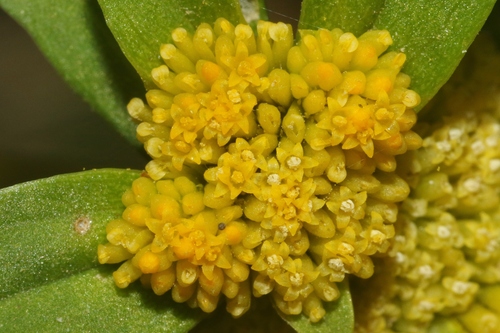
Flaveria trinervia (Spreng.) C.Mohr is a species of flowering plant in the family Asteraceae, commonly known by the common names clustered yellowtops, speedyweed, and yellow twinstem. It is native to parts of the Americas: the southeastern and southwestern United States (including Florida, Texas, Arizona, and New Mexico), most of the Bahamas, Mexico, Belize, and parts of the Caribbean, especially Cuba, the Cayman Islands, Jamaica, Hispaniola, Puerto Rico, and Barbados. It is also an introduced species in many other regions, and often acts as a noxious weed, for example in Hawaii. Flaveria trinervia grows readily in many types of wet habitats, and can tolerate saline and alkaline soils as well as highly disturbed areas. This is an annual herb that grows erect, and can reach over two meters (7 feet) in height. Its leaves are lance-shaped to oval, up to 15 centimeters (8 inches) long, and arranged in opposite pairs around the stem, with their bases sometimes fusing together. Leaf edges generally have tiny, widely spaced teeth. The inflorescence is a large, dense cluster of many very small flower heads, sometimes holding over 300 flower heads in a single cluster. Each flower head contains 0 to 1 yellow or whitish ray floret and 0 to 2 yellow disc florets. This species uses C4 carbon fixation. Phototoxic secondary metabolites have been found in the flower heads of this Asteraceae species, as well as in the bark of Simira salvadorensis. The Australian species F. australasica is very similar to F. trinervia and may be closely related. Some authors recognize the two as separate distinct species, while others treat F. australasica as a synonym of F. trinervia.