About Fixsenia pruni (Linnaeus, 1761)
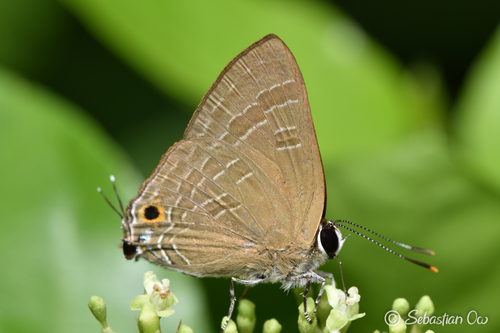
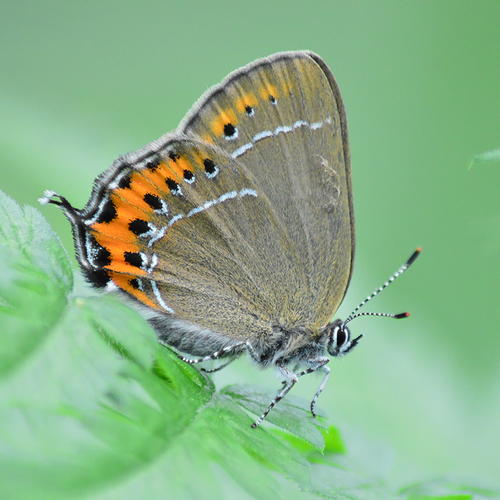
This species is Fixsenia pruni, originally described as Thecla pruni by Linnaeus in 1761. The description from Seitz notes that on the upper side of the wings, males have a few anal spots, while females have a brick-red anal half-band and sometimes a brick-red discal spot. On the underside of the wings, the line of white bars is very thin. The brick-red submarginal band of the hindwing sits between two rows of black spots thinly edged with bluish white, and this band sometimes continues onto the forewing. The species ranges across Central and Southern Europe, extending from the Atlantic coast and Great Britain through Europe and Asia to Amurland and Korea. It is absent from North Africa and likely absent from Japan; records from Japan probably refer to the species mera or prunoides. Several named aberrations exist: ab. fulvior Tutt (found particularly in females) has an orange-yellow discal patch on the forewing, with the rest of the wing dusted golden brown; ab. ptorsas Hfngl. has a reddish yellow submarginal band on the upper side of both wings, while transitional specimens with an incomplete band are called ab. progressa or excessa; ab. obsoleta Tutt has no reddish yellow anal spots on the upper side; ab. lutea Tutt has pale yellow anal spots instead of red; ab. paupera Tutt is a lutea specimen with a dull underside and no black spots on the proximal side of the hindwing band; and ab. albofasciata Tutt has a broad white macular band on the underside parallel to the outer margin. The egg is quite flat, greyish brown, with a chagreen texture and a concave top; it is laid singly or in pairs. The larva is woodlouse-shaped and green, with a darker dorsal stripe and small brown warts or tubercles along the sides of the stripe. It can be found from April to the end of May feeding on blackthorn and plum trees. Naturalist F. Frohawk observed that F. pruni larvae will attack other F. pruni larvae that have already fastened themselves before moulting. The pupa is somewhat angular at the anterior end, is black-brown with darker markings and a pale saddle-shaped patch, has a tuberculate, strongly raised abdomen, and overall resembles a small bud or bird dropping. Adult butterflies emerge in June, usually flying singly, but are so abundant in some years that you can easily collect several dozen within an hour. When abundant, they fly around the twigs of their food trees and the undergrowth beneath these trees, and they strongly prefer flowering privet. This butterfly is native to Europe, ranging from Scandinavia to Ukraine, and occurs as far east as Mongolia, Korea, and Japan. The IUCN classifies it as a species of least concern with a stable population. It has a univoltine (single-brooded) life cycle. Eggs are laid singly on young growth of blackthorn (Prunus spinosa), and this is the life stage that hibernates over winter. While blackthorn is its main foodplant, wild plum (Prunus domestica) and other Prunus species are sometimes used. Caterpillars hatch the following spring at the end of April, just before buds open, and feed on the flower buds. Older larvae are green and well camouflaged against the leaves they feed on. Pupation occurs on leaves or twigs in June; the pupae are black and white patterned to mimic a bird dropping as a defense against predators. Adult butterflies are active from the end of June to mid July.