About Fitzroya cupressoides (Molina) I.M.Johnst.
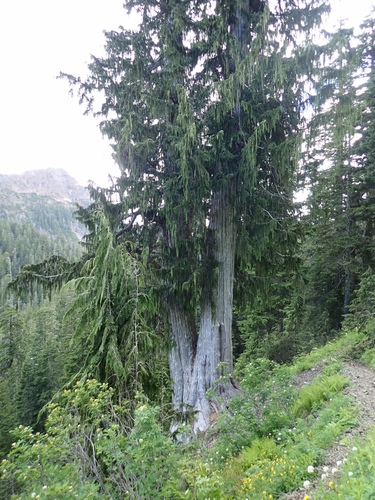
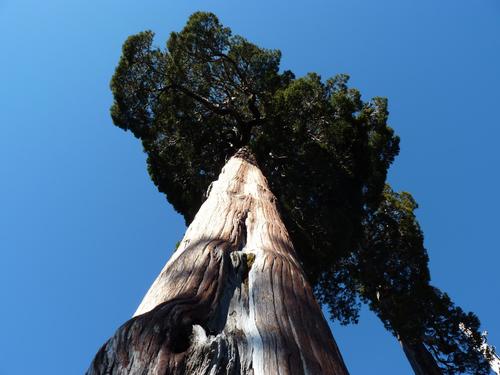
Fitzroya cupressoides (Molina) I.M.Johnst. is the largest tree species native to South America. It typically grows to 40–60 m (130–200 ft) tall, occasionally reaching over 70 m (230 ft), with trunk diameters up to 5 m (16 ft). Its rough pyramidal canopy provides growing cover for southern beech, laurel, and myrtle. The largest known living specimen of this species, Alerce Milenario, is located in Chile’s Alerce Costero National Park, measuring over 60 m (200 ft) tall with a 4.26 m (14.2 ft) trunk diameter. Far larger specimens existed before extensive logging of the species in the 19th and 20th centuries; Charles Darwin documented a specimen with a 12.6 m circumference, which equals approximately 4.01 m in diameter. This tree’s leaves grow in decussate whorls of three, 3–6 mm long, reaching up to 8 mm long on seedlings, and 2 mm broad, marked with two white stomatal lines. Fitzroya cupressoides is a dioecious species, meaning male and female cones develop on separate individual trees. Its cones are globose, 6–8 mm in diameter, opening flat to 12 mm across, and bear nine scales arranged in three whorls of three. Only the central whorl of scales is fertile, holding 2–3 seeds per scale; the lower and upper whorls are small and sterile. The seeds are 2–3 mm long and flat, with a wing along each side, and mature 6–8 months after pollination. The thick bark of F. cupressoides may be an evolutionary adaptation to wildfire. In 1993, a Chilean specimen called "Gran Abuelo" or "Alerce Milenario" was found to be 3622 years old. This makes it the second oldest fully age-verified living tree (verified by counting growth rings), after the bristlecone pine. More recent research has proposed that this individual is actually the oldest tree in the world. Researchers from the University of Tasmania discovered fossilized foliage from a Fitzroya species along the Lea River in northwest Tasmania. The 35-million-year-old (Oligocene) fossil was named F. tasmanensis, and its discovery confirms the ancient floristic links between Australasia and southern South America that botanists refer to as the Antarctic flora. Around 40 to 50 thousand years ago, during the interstadials of the Llanquihue glaciation, Fitzroya and other conifers had a much larger, continuous geographical range than they do today, which included the eastern lowlands of Chiloé Island and the area west of Llanquihue Lake. At present, Fitzroya grows mainly at moderate to high altitudes above sea level. Stands of Fitzroya located near sea level are most likely relict populations.