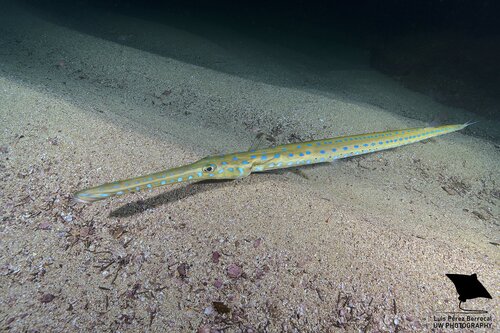
About Fistularia commersonii Rüppell, 1838
Taxonomy and Nomenclature
Bluespotted cornetfish, known by the scientific name Fistularia commersonii Rüppell, 1838, has a maximum recorded length of 1.6 m (5.2 ft), with an average length of around 1 m (3 ft 3 in).
Body Shape
This species has a distinctively long and extremely slender body shape.
Head and Tail Features
It features a tubular snout, large eyes, and a long tail filament that is lined with sensory pores; these pores may help the fish detect prey.
Base Coloration
Its base body coloration ranges from blue-grey to greenish-grey, with two thin blue stripes or lines of dots running along its back, and a lighter color on the front portion of its body.
Camouflage Pattern
To achieve camouflage, the fish’s body pattern changes to a broad-banded pattern at night.
General Distribution
This species is widespread in the tropical and subtropical waters of the Indo-Pacific.
Indo-Pacific Range Extent
Its range extends north as far as Japan, east to the west coasts of the Americas, and it is also found in the Red Sea, including the waters of Panama and Mexico’s Sea of Cortez.
First Mediterranean Sighting
Its presence in the Mediterranean Sea off Israel was first reported in 2000.
Mediterranean Population Expansion
Over the 20 years following this first report, this species experienced a population explosion in the Levantine Sea and spread rapidly westward.
Westward Mediterranean Spread
By 2007, it had reached the westernmost sectors of the Mediterranean and extended as far north as the Gulf of Lions.
Current Mediterranean Distribution
Today, it has been recorded in all Mediterranean sub-basins and is very common in the eastern portion of the sea.
Invasive Species Status
F. commersonii is now classified as an invasive species in the Mediterranean Sea.
Invasion Impact Drivers
This status stems from its rapid development to reproductive maturity, as well as its detrimental impact on native fish populations.
Lessepsian Migration
Its colonization of the Mediterranean is an example of Lessepsian migration, a process where species (typically fish from the Red Sea) migrate into the Mediterranean Sea via the Suez Canal.
Founder Population Origin
All Mediterranean populations of this species are descended from a small number of founding ancestors, likely from a single invasion event.
Genetic Variability
As a result, Mediterranean individuals have lower genetic variability than conspecifics from the Red Sea.