About Fimbristylis littoralis Gaudich.
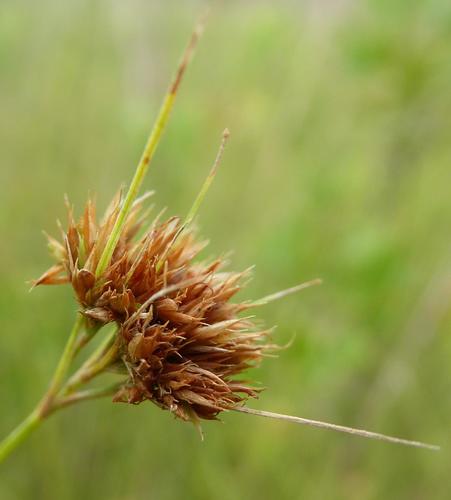
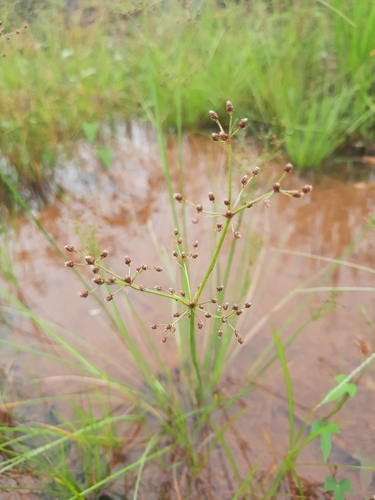
Fimbristylis littoralis Gaudich. is an annual grass-like or herbaceous sedge with a tufted growth habit, typically growing to a height of 0.05 to 0.7 metres (0.16 to 2.30 ft). In Australia, this species blooms between February and August, producing green-brown flowers. It has slender, 40 to 60 cm (16 to 24 in) long culms that are four or five-angled and noticeably flattened. Its leaves grow up to 40 cm (16 in) long and 1.5 to 2.5 mm (0.059 to 0.098 in) wide; the stiff, threadlike basal leaves are about half the length of the culms. The inflorescence is a diffuse compound umbel 6 to 10 cm (2.4 to 3.9 in) long, bearing spherical to ovate reddish-brown spikelets. The spikelets measure 2.5 to 4 mm (0.098 to 0.157 in) long and 1.5 to 2 mm (0.059 to 0.079 in) wide, and are round or acute toward the apex. It has 1 mm (0.039 in) long ovate spirally arranged glumes and yellow anthers. In Australia, Fimbristylis littoralis Gaudich. is found in the Kimberley region of Western Australia, where it grows in swamps, along creeks and rivers, and in other damp areas, growing in sandy-clay alluvium often near basalt. It is also found across the top end of the Northern Territory and in tropical parts of Queensland. This species has been introduced to North and South America, where it is regarded as a weed. It is thought to have been introduced into the West Indies as a contaminant in the late nineteenth century, and was first collected in 1886 in Puerto Rico. It is known to be a problematic weed in rice plantations across the world's tropical and subtropical regions. It can also be found in banana and maize plantations in Taiwan, abaca plantations in the Philippines, taro plantations in Hawaii, and sugarcane and maize crops in Indonesia.