About Filipendula ulmaria (L.) Maxim.
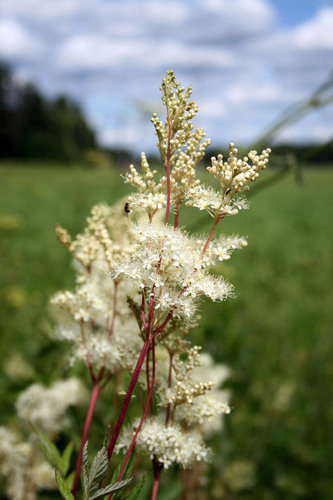
Filipendula ulmaria (L.) Maxim., commonly known as meadowsweet, has erect, furrowed stems that grow 1 to 2 metres (3+1⁄2 to 6+1⁄2 ft) tall, with a colour ranging from reddish to sometimes purple. Its leaves are dark-green on the upper surface, and whitish and downy underneath; they are heavily divided, interruptedly pinnate, featuring a few large serrate leaflets and smaller intermediate leaflets. Terminal leaflets are large, 4 to 8 cm long, and three- to five-lobed. Meadowsweet produces delicate, graceful creamy-white flowers that are clustered closely together in irregularly branched cymes. The flowers have a very strong, sweet scent that resembles antiseptic. Flowering occurs from early summer to early autumn, and the blooms are visited by a range of insects, particularly Musca flies. Flowers are small and numerous, with 5 sepals, 5 petals, and 7 to 20 stamens. In terms of distribution and habitat, meadowsweet is common across the British Isles in damp locations, and it is a dominant species in fens and wet woods. It is consistently found in the Juncus subnodulosus-Cirsium palustre fen-meadow and purple moor grass and rush pastures BAP habitat plant associations of Western Europe. All parts of this herb have a pleasant taste and flavour, with the green portions sharing the same aromatic character as the flowers. Because of this, the plant was used as a strewing herb, scattered across floors to give rooms a pleasant aroma, and it is also used to add flavour to vinegar, wine, and beer. Flowers can be added to stewed fruit and jams to give these foods a subtle almond flavour. Some foragers also use meadowsweet flowers to flavour desserts like panna cotta. Meadowsweet has a range of medicinal properties, and the whole plant is used as a traditional remedy for an acidic stomach. Dried flowers are added to potpourri, and it is a commonly used spice for Scandinavian varieties of mead. Its chemical constituents include salicin, flavone glycosides, essential oils, and tannins. In 1838, Raffaele Piria extracted salicylic acid from meadowsweet buds. Later, in 1899, scientists at the pharmaceutical firm Bayer used salicylic acid sourced from meadowsweet to synthesise acetylsalicylic acid, also known as aspirin. Aspirin was named after meadowsweet's old botanical name, Spiraea ulmaria, which gave the plant its connection to the final drug name. A natural black dye can be made from the plant's roots when a copper mordant is used. In traditional Austrian herbal medicine, tea made from Filipendula ulmaria flowers or leaves has been used to treat rheumatism, gout, infections, and fever.