About Filipendula rubra (Hill) B.L.Rob.
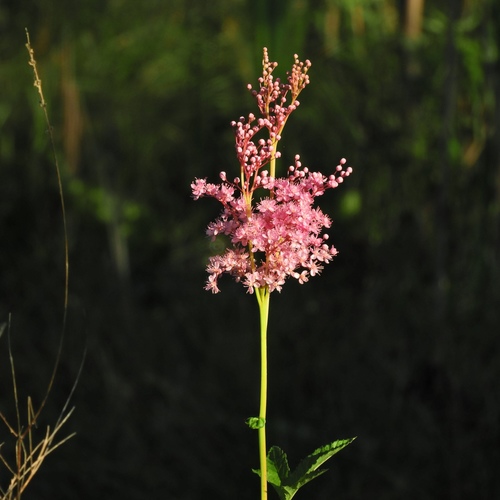
This species, scientifically named Filipendula rubra (Hill) B.L.Rob., is a spreading herbaceous perennial. It grows 1.8–2.5 m (5 ft 11 in – 8 ft 2 in) tall and 1.2 m (3 ft 11 in) wide, reaching a maximum height of 2.5 m (8 ft) and width of 1.3 m (4 ft 3 in) at a medium growth rate. It has large lobed, coarse-textured foliage that ranges from medium to dark green, with foliage that is somewhat maple-like and emerges early in spring. It has branching red stems, and aggressive growth via creeping roots and rhizome (underground stem) spreading, eventually forming large masses from an initial spreading clump. It is hardy to UK zone 2. In summer, specifically from July to August, it produces sweet fragrant deep pink or peach flowers clustered in corymbs held on branching red stems. Its inflorescences are technically panicles: each can hold 200–1,000 small pink-petaled flowers on 1–2 m stems, and can produce up to around 5,000 small seeds. Numerous stamens give the flowers a fuzzy appearance. Each flower has five to 15 pistils, with separate carpels that are free from one another. Seeds are small due to the large size of the species' clones, and when seeds are produced, seedlings often fail to establish in large numbers. The species is hermaphrodite, with both male and female organs, and is self-fertile, though it is also self-incompatible: pollination that produces viable seed only occurs when pollen is transferred to a different plant, so the vast majority of pollen from the same clone is incompatible. This species has airborne pollen, and pollination is assisted by insects including bees, flies, beetles, and sweat bees that spread pollen; some sources note it primarily uses wind pollination. Seeds ripen from August to September. The species attracts wildlife, though current knowledge of its floral and faunal associations shows it offers comparatively little value to wildlife: it is not a host plant for butterflies and native moths, does not produce nectar, its seeds are not an important food source for birds or rodents, and herbivores do not find its foliage appealing. Its flowers only act as a food source for pollen-eating insects, and wind-pollination strategies mean comparatively little pollen is available for these insects. This native plant is originally found from Pennsylvania west to Illinois, and north of Georgia. It has established successfully as an alien species in areas like Massachusetts, where it was first recorded in 1875 and still occurs today. It is classified as a threatened species in many of both its native ranges (such as Indiana) and introduced ranges. Its typical native habitat is wetland plant communities, especially calcareous fens, though it is occasionally found in spring seeps and wet prairies. Because calcareous fens are rare and small in area, most F. rubra populations are generally small and widely separated from each other. Native Americans used the root of F. rubra in traditional medicine to treat heart problems, and also used it as an aphrodisiac. The root has a high tannin content, so it works as an astringent to treat diarrhea, dysentery, and bleeding. It is grown in gardens for its attractive, fragrant lilac-scented flowers. It is sold at many native and conventional nurseries, but it remains uncommon in most American gardens and landscapes. The most common cultivar is 'Venusta', which produces bright rose-pink blooms. It grows best in full sun or partial shade, and requires moist to well-drained wet soil; it suffers damage during drought. Like many perennials, it is easy to dig up and replant when it becomes overcrowded or overgrown. It self-sows to varying degrees, from minimal to heavy, in garden settings. If it becomes unhealthy after drought, it can be pruned back and will regrow to a healthy appearance. Because it offers little wildlife value, it competes for the shrinking wetland acreage (lost to human development) with plant species that support more wildlife. For this reason, some conservationists recommend this plant only for gardens focused on ornamental aesthetics, and suggest using other native species for wetland restoration work.