About Ficus watkinsiana F.M.Bailey
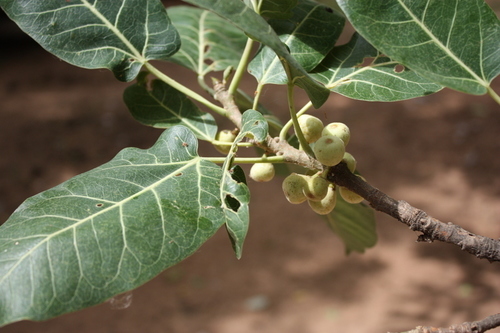
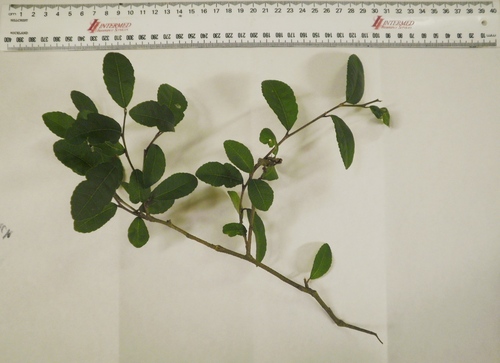
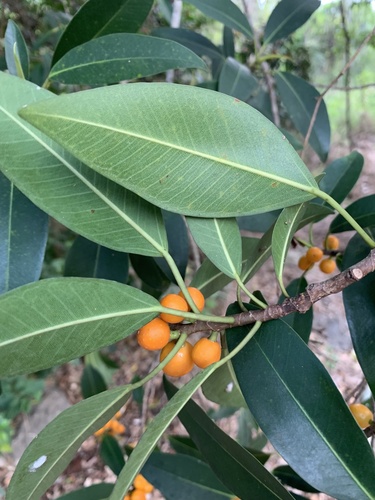
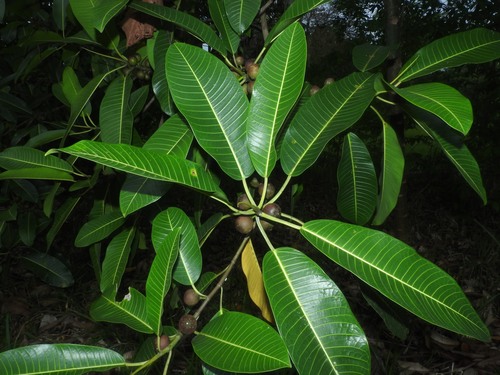
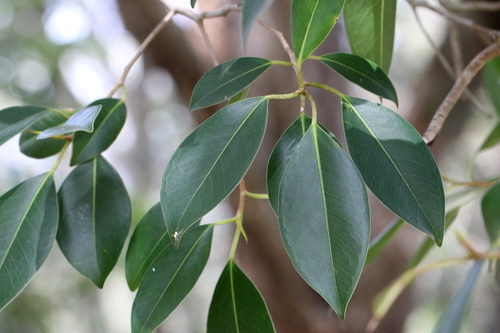
Ficus watkinsiana F.M.Bailey is a hemiepiphyte that can reach around 60 m (200 ft) in height and 2 m (6 ft 7 in) in trunk diameter. It has smooth bark and may develop buttresses. Its leaf-bearing twigs are finely hairy and measure approximately 1 cm (0.4 in) in diameter. The leaves are somewhat stiff, lanceolate-shaped, and grow up to 20 cm (7.9 in) long and 7 cm (2.8 in) wide, borne on petioles that are about 7 cm (2.8 in) long. Leaves have 10–17 indistinct primary lateral veins and many more very faint secondary lateral veins; all of these veins join to form an intramarginal vein just inside the leaf margin.
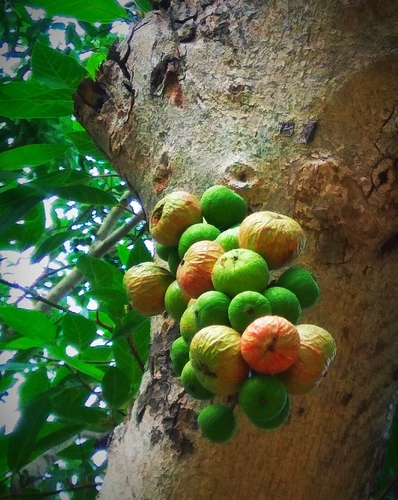
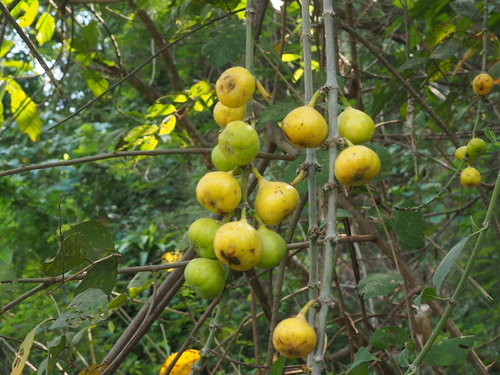
The syconia, or fig fruits, of Ficus watkinsiana grow in pairs from leaf axils, attached to short, broad peduncles. They are purplish brown to black, have visible lenticels on their surface, and are slightly longer than wide, measuring around 4 cm (1.6 in) long by 3.5 cm (1.4 in) wide, with a nipple-like protrusion at the apex.
Ficus watkinsiana has two disjunct populations in eastern Australia. One population is found in northeastern Queensland, ranging from the Windsor Tablelands south to the area around Paluma Range National Park. The second population ranges from near Bundaberg, Queensland, south to around Lismore, New South Wales. This species grows in rainforest, most often on basaltic soils, and is found in upland forest; in north Queensland, it mostly occurs at elevations above 700 m (2,300 ft).
The fruits of Ficus watkinsiana are eaten by spectacled flying foxes (Pteropus conspicillatus) and many bird species, including the southern cassowary (Casuarius casuarius). All Ficus species are pollinated by wasps in the family Agaonidae, most often following a strict one-to-one relationship where a single fig species is pollinated by only one wasp species, and each wasp species pollinates only one fig species. This extreme symbiosis is called "obligate mutualism", meaning both species depend entirely on each other for survival. Originally, Pleistodontes nigriventris was recorded as the only pollinator of Ficus watkinsiana in Australia, but recent research has provided new insight into this relationship. On the Hawaiian island of Kauai, where many exotic fig species including F. watkinsiana and the closely related Australian species F. rubiginosa are cultivated, the pollinator wasp of F. rubiginosa, Pleistodontes imperialis, has been found living in the figs of F. watkinsiana. This discovery shows that the mutual relationship between figs and their pollinator wasps can be disrupted under certain circumstances.