About Ficus sycomorus L.
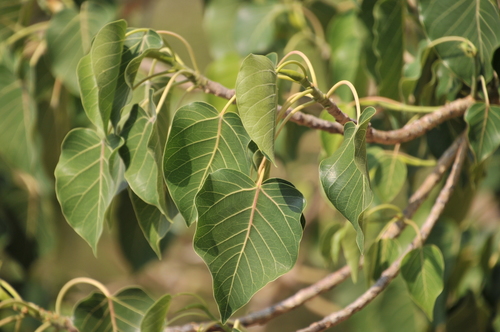
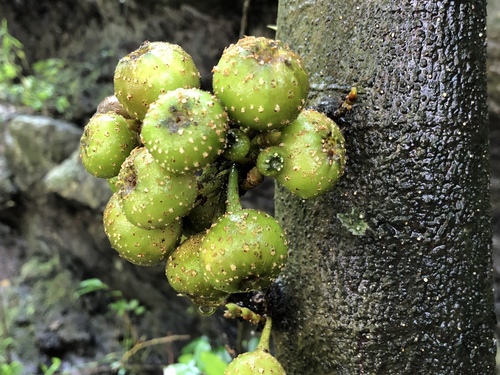
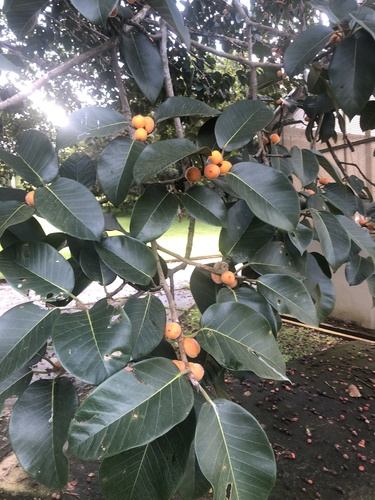
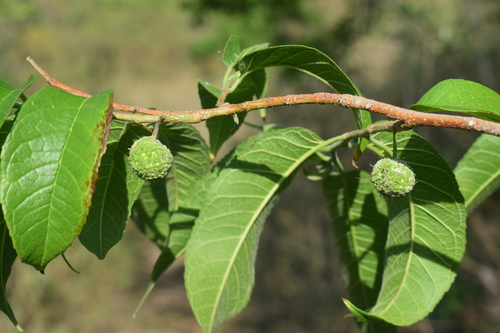
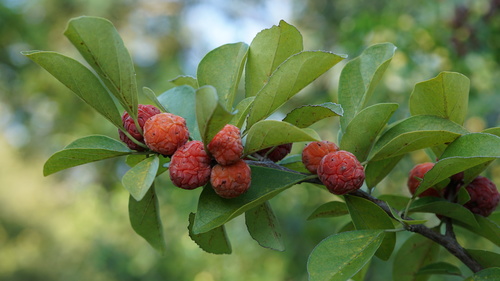
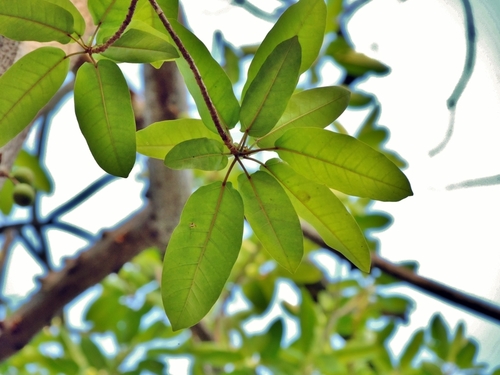
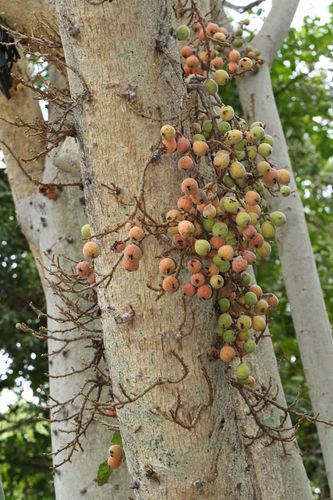
Ficus sycomorus L. grows to 20 metres (66 ft) tall, with a considerable spread and a dense round crown of spreading branches. Its bark ranges from green-yellow to orange, and exfoliates in papery strips to reveal yellow inner bark. Like all other figs, this species contains latex. Its leaves are heart-shaped with a rounded apex, measuring 14 centimetres (5+1⁄2 in) long by 10 cm wide, arranged spirally around twigs. Leaves are dark green on the upper surface, lighter with prominent yellow veins on the lower surface, and both leaf surfaces are rough to the touch. The petiole is 0.5–3 cm (1⁄4–1+1⁄8 in) long and pubescent. Flowering and fruiting occurs year-round, starting in April or later depending on variety, and peaks from July to December. The fruit is a large edible fig, 2–3 cm in diameter, that ripens from buff-green to yellow or red. Fruits grow in thick clusters on long branchlets or in leaf axils, and sometimes form five successive separate "crops".
Ficus sycomorus is native to Africa south of the Sahel and north of the Tropic of Capricorn, excluding central-west rainforest areas. It also grows naturally in Lebanon, the southern Arabian Peninsula, Cyprus, very localised areas of Madagascar, and Israel, Palestine and Egypt. In its native habitat, the tree is usually found in rich soils along rivers and in mixed woodlands.
Two major varieties of Ficus sycomorus are recognized in Egypt. The first is Roumi, also called Falaki or Turki: this variety has more horizontally spreading branches, stouter shoots and petioles, more densely spaced leaves that are wider than they are long, and larger, flatter, broad pink fruits. The second is Kelabi, also called Arabi or Beledi: this variety has more vertically oriented branches, a more slender growth habit, smaller leaves, and smaller yellowish pear-shaped fruits.
In modern Egyptian history, many people once made a ring of bruises and cuts around the base of their sycamore trees once a year, on the feast day of a particular saint. According to botanists Daniel Zohary and Maria Hopf, cultivation of this species was "almost exclusively" carried out by the ancient Egyptians. Remains of F. sycomorus first appear in predynastic Egyptian times, and occur in large quantities starting at the beginning of the third millennium BC. It was the ancient Egyptian tree of life. Zohary and Hopf note that "the fruit and the timber, and sometimes even the twigs, are richly represented in the tombs of the Egyptian Early, Middle and Late Kingdoms." In numerous cases, the parched fruiting bodies called sycons "bear characteristic gashing marks indicating that this art, which induces ripening, was practised in Egypt in ancient times."
Although this fig species requires the symbiotic wasp Ceratosolen arabicus to reproduce sexually, and this insect is extinct in Egypt, Zohary and Hopf have no doubt that Egypt was "the principal area of sycamore fig development." Some caskets holding Egyptian mummies are made from the wood of this tree. In tropical areas where the symbiotic wasp is common, complex mini-ecosystems involving the wasp, nematodes, other parasitic wasps, and various larger predators are centered around the life cycle of the fig. The tree's year-round random fruit production in these environments ensures consistent attendance by the insects and animals that form this ecosystem. Sycamores were often planted around artificial pools in ancient Egyptian gardens.
The sycamore tree was brought to Israel by Philistines during the Iron Age, along with opium poppy and cumin. These sycamore trees were once numerous in western Beirut, lending their name to the neighborhood of Gemmayzeh (الْجُمَّيْزَة al-Ǧummayzah, meaning "sycamore fig"). However, the trees have largely disappeared from this area.