About Ficus subpisocarpa Gagnep.
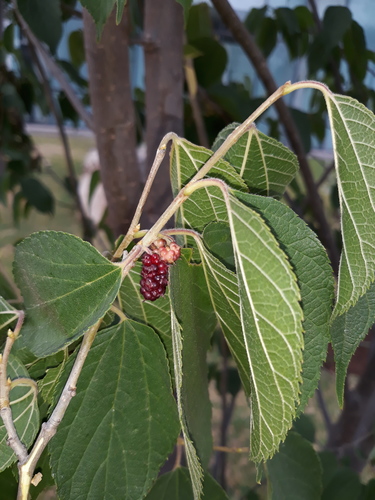
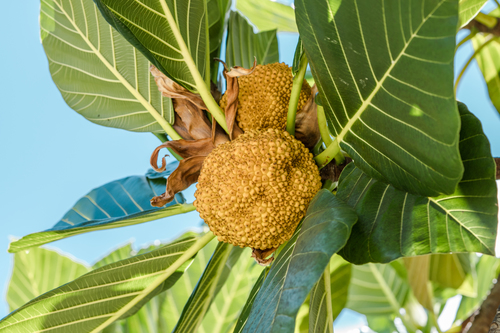
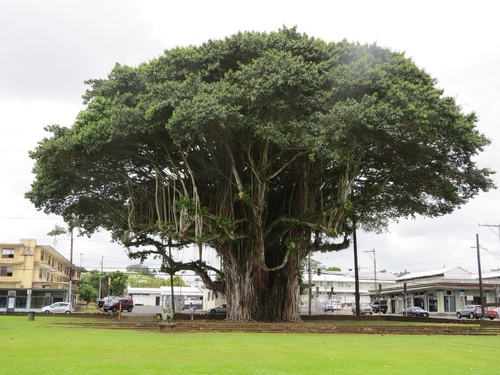
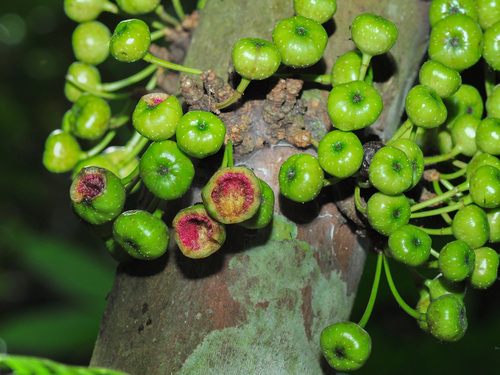
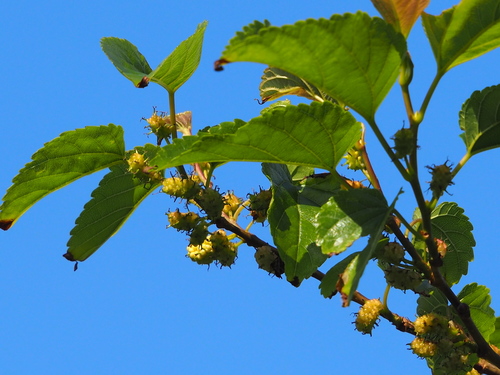
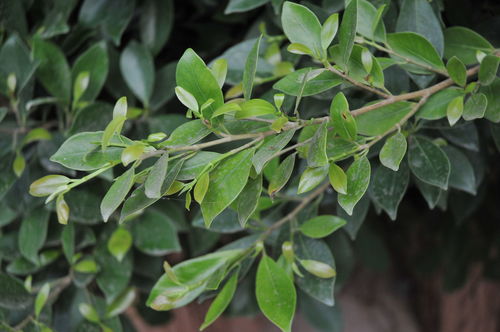
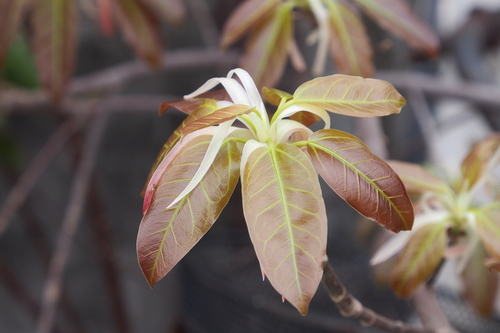
Ficus subpisocarpa Gagnep. is a tree that reaches up to 12 metres (39 feet) tall. It can grow as a terrestrial plant or as a hemiepiphyte starting directly on other trees. Its bark is dark brown, and its branches range in color from reddish brown to dark grey. In some regions, this species is deciduous, though it may remain evergreen in others; even where deciduous, trees are only leafless for around one week before new leaves emerge. Leaves and their petioles are glabrous (hairless). The leaves are symmetrical, elliptical to oblong with a rounded base, and measure 4 to 24 cm (1.5 to 9.5 in) long by 1.5 to 13 cm (0.59 to 5.12 in) wide. They grow in a spiral arrangement along stems. New foliage develops when an entire section of a branch buds and becomes covered in leaves. Its figs are ramiflorous, meaning they grow directly on branches, in groups of one to three. Fig color varies widely between individual trees and seasons; mature figs range from whitish pink to dark purple, are often marked with pale spots, and are shaped from bulbous to globose, with a diameter of 0.5 to 0.8 cm (0.20 to 0.31 in). Fig maturation is also highly variable, even on a single tree: development is synchronous until pollinating fig wasps emerge, but becomes variable afterward, with some figs ripening rapidly and others taking up to five weeks after wasp emergence to fully mature. A single tree can produce two to four crops of figs each year. This species is pollinated by Platyscapa ishiiana, a fig wasp in the family Agaonidae. The nominate subspecies of Ficus subpisocarpa occurs from southern Japan, Taiwan, Hainan, and eastern China (specifically Fujian, Guangdong, Guangxi, southern Yunnan, and southeastern Zhejiang provinces), through Vietnam, Laos, and Thailand, to Indonesia, where it reaches as far as Ceram in the Moluccas. It may also be present in Cambodia. Subspecies pubipoda occurs in Vietnam, Cambodia, Thailand, and Peninsular Malaysia. Both subspecies grow in deciduous and evergreen forests: the nominate subspecies is found at low altitudes, while subspecies pubipoda occurs up to 1,400 m (4,600 ft) above sea level. A field study conducted in Taiwan found that ants inhabit cavities in the internodes of young Ficus subpisocarpa branches. The ants feed on wasps, more often preying on non-pollinating wasp species than the pollinating wasps required for the fig to reproduce. It has been suggested that F. subpisocarpa evolved these cavities to host ants. 75% of the ants recorded in the study belonged to the genus Crematogaster, with the remaining ants belonging to the genera Technomyrmex, Myrmica, and Prenolepis. Occasionally, two different ant species share the same cavity. Most cavities measure between 2 and 14 cm (1 and 5.5 in) in length. The ants also appear to tend aphids and scale insects growing on the Ficus subpisocarpa plant. This is only the second Ficus species observed to have ants inhabiting branch cavities; the first observation was of Ficus obscura var. borneensis in Borneo. The bark of Ficus subpisocarpa is rigid, which makes it suitable for carving and sculpture. The species also grows a broad crown that provides abundant shade, so it is widely planted along streets and in parks.