About Ficus rubiginosa Desf. ex Vent.
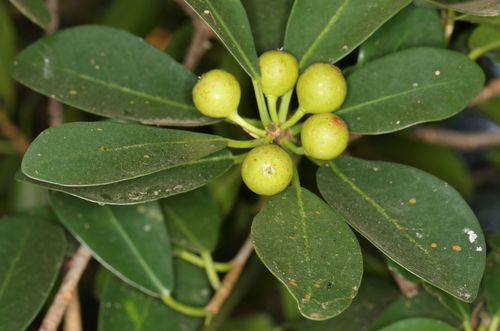
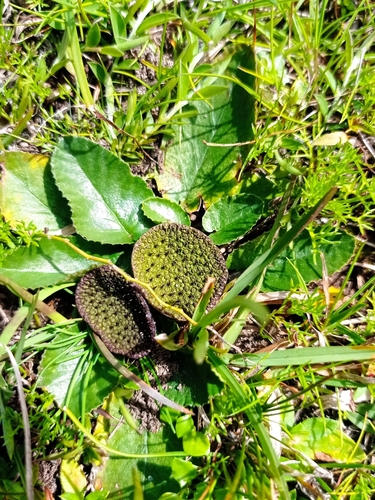
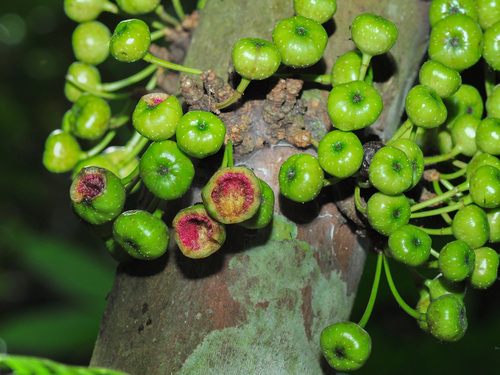
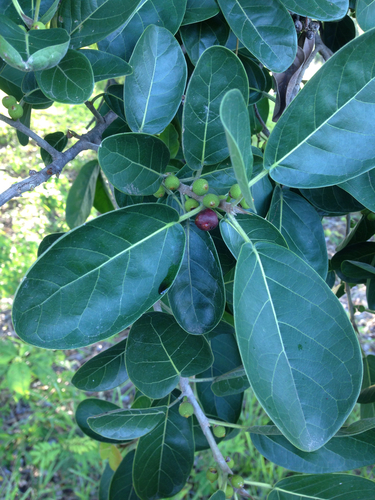
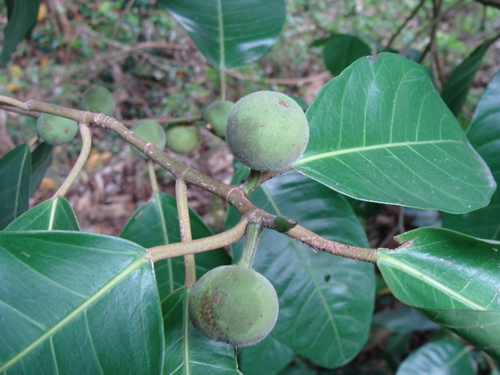
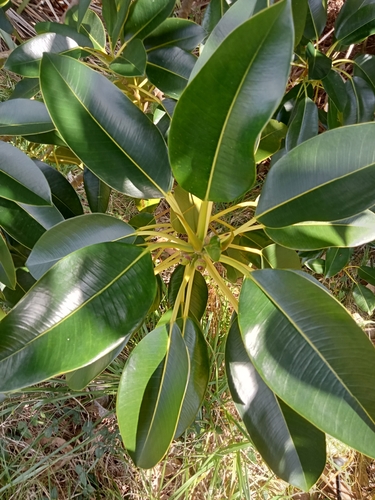
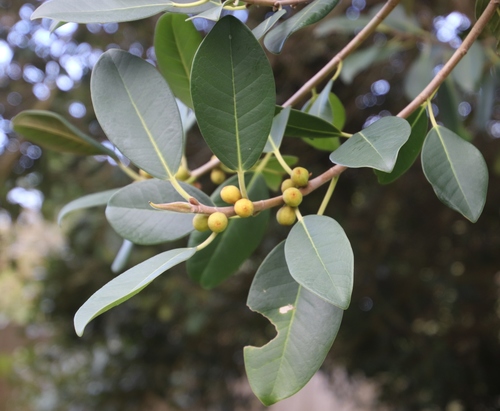
When mature, Ficus rubiginosa Desf. ex Vent. is a spreading, densely shading tree that can reach 30 m (100 ft) or more in height, though it rarely grows over 10 m (30 ft) in the Sydney region. Its buttressed trunk can reach 1.5 m (4 ft 11 in) in diameter, and its bark is yellow-brown. It can also grow as a hemiepiphyte on other plants, or as a 1–5 m (3–16 ft) high lithophyte. Its leaves are arranged alternately along stems, and can be ovate (egg-shaped), obovate (reverse egg-shaped), or oval. They range from 4–19.3 cm (1+5⁄8–7+5⁄8 in) long and 1.25–13.2 cm (1⁄2–5+1⁄4 in) wide, growing on 7–8.2 cm (2+3⁄4–3+1⁄4 in) long petioles (stalks that connect leaves to stems). The leaves are either smooth or covered in tiny rusty hairs. They have 16 to 62 pairs of lateral veins that branch off the midvein at an angle between 41.5–84.0°, and distinct basal veins that branch off the midvein at an angle between 18.5–78.9°. Like all figs, Ficus rubiginosa’s fruit, called a fig, is actually an inverted compound flower structure known as a syconium. Tiny flowers grow from the inner surface of the fig into its hollow central cavity. F. rubiginosa is monoecious: it bears both male and female flowers on the same plant, and even within the same syconium, though the two flower types mature at different times. The figs often grow in pairs; they start yellow, measure 4–10 mm (1⁄8–3⁄8 in) across, and ripen to a red color. Each fig is tipped with a small nipple, and grows on a 2–5 mm (1⁄8–1⁄4 in) stalk. Fruits can ripen year-round, though ripening is most common in spring and summer. Some individual trees hold both ripe and unripe fruit at the same time. F. rubiginosa closely resembles its relative the Moreton Bay fig (F. macrophylla), and the two are often confused where they share overlapping wild ranges. F. rubiginosa’s smaller leaves, shorter fruit stalks, and rusty-colored leaf undersides are the easiest features to tell them apart. It is also often confused with the small-leaved fig (F. obliqua); F. obliqua’s syconia are smaller, measuring 4–12 mm long and 4–11 mm in diameter, compared to F. rubiginosa’s syconia which measure 7–17 mm long and 8–17 mm in diameter. Ficus rubiginosa’s native range spans the entire eastern coastline of Australia, from the top of Cape York Peninsula in northern Queensland to the area around Bega on the south coast of New South Wales. Its range extends west to Porcupine Gorge National Park in Queensland and the far western plains of New South Wales. Two forms, F. rubiginosa f. rubiginosa and F. rubiginosa f. glabrescens, are found across most of this range, though F. rubiginosa f. glabrescens does not occur south of the New South Wales-Queensland border region. Lithophytic, hemiepiphytic, and full tree forms of F. rubiginosa can all occur together in the same local population. F. rubiginosa grows in rainforest, rainforest margins, gullies, riverbank habitats, vine thickets, and rocky hillsides. It grows on limestone outcrops in Kanangra-Boyd National Park. Fig seedlings often sprout from cracks in stone where seeds have become lodged; in natural environments this occurs on cliffs and rock faces, while in urban environments it occurs in building brickwork and other manmade stone structures. The soils it grows in are typically well-drained and low in nutrients, and derived from sandstone, quartzite, or basalt. In the Sydney region, F. rubiginosa grows from sea level up to 1000 m (3500 ft) altitude, in areas with an average annual rainfall of 600–1,400 mm (24–55 in). It is largely sympatric with F. obliqua, though its range extends further west into drier regions than F. obliqua’s does. Outside its native range, F. rubiginosa has naturalized to some degree in urban Melbourne and Adelaide (Australia), as well as in New Zealand, Hawaii, California, and Mediterranean Europe. It has been planted widely in Malta since the early 1990s, but has not been observed producing fruit there. Many bird and mammal species eat Ficus rubiginosa’s fruit. Birds include the rose-crowned fruit dove (Ptilinopus regina), wompoo fruit dove (P. magnificus), wonga pigeon (Leucosarcia melanoleuca), topknot pigeon (Lopholaimus antarcticus), Pacific koel (Eudynamys orientalis), Australasian swamphen (Porphyrio melanotus), Australian king parrot (Alisterus scapularis), Australasian figbird (Sphecotheres vieilloti), green catbird (Ailuroedus crassirostris), regent bowerbird (Sericulus chrysocephalus), satin bowerbird (Ptilonorhynchus violaceus), pied currawong (Strepera graculina), and the endangered Coxen's fig parrot. Mammals include the grey-headed flying fox (Pteropus poliocephalus) and spectacled flying fox (Pteropus conspicillatus). Many fruits fall to the ground around the tree, while others are dispersed by animals that consume them. The thrips species Gynaikothrips australis feeds on the underside of new leaves of F. rubiginosa, as well as on leaves of F. obliqua and F. macrophylla. When thrips feeding kills plant cells, nearby cells are triggered to form new meristem tissue, which develops into a gall. This causes infected leaves to become distorted and curl over. Thrips begin feeding when the tree produces new growth flushes, and live for around six weeks. At other times of year, thrips live on old leaves without feeding. This species pupates sheltered inside the tree’s bark. Thrips stay inside galls at night, wander during the day, and return to galls in the evening, sometimes moving to different galls across the tree. In spring, psyllids have almost completely defoliated F. rubiginosa trees growing in Sydney’s Royal Botanic Gardens. The pollinator wasp Pleistodontes imperialis crossed the Tasman Sea between Australia and New Zealand sometime between 1960 and 1972. After this arrival, F. rubiginosa seedlings began appearing in brick and stone walls, and on other trees, particularly in parks and gardens around Auckland, New Zealand; established plants have been recorded as far south as Napier. P. imperialis has also been transported to Hawaii, California, and Israel, where it has been observed pollinating F. rubiginosa. F. rubiginosa trees can live 100 years or more, and are known to resprout after bushfire, producing fruit within three years after damage. Ficus rubiginosa was first cultivated in the United Kingdom in 1789, where it is grown in glasshouses. It is commonly used as a large ornamental tree in eastern Australia, the North Island of New Zealand, Hawaii, and California, and is listed as an invasive species in some areas of these non-native regions. It works well as a shade tree in public parks and on golf courses. It does not grow as large as other fig species, so it is suited for slightly more confined spaces, such as lining car parks or suburban streets. However, it can produce large, intrusive surface roots, and its thin bark is easily damaged if struck. It tolerates both acidic and alkaline soils, and is hardy to US Hardiness Zones 10B and 11. It can reach 10 m (30 ft) high in 30 years of growth. Planting trees 8–12 m (30–40 ft) apart will eventually produce a continuous closed canopy. The trees provide valuable food for local birds and mammals, but they drop large quantities of fruit and leaves that leave a mess on the ground below. In 1911, William Guilfoyle briefly described a variegated F. rubiginosa from New South Wales that reached 12–15 ft high, naming it F. rubiginosa variety variegata. A variegated form of F. rubiginosa is currently in cultivation on Australia’s east coast and in the United States. This variegated form is a chimera that lacks chlorophyll in the second layer of the leaf meristem. Its leaves have an irregular central green patch along the midvein, with irregular yellow and green coloring elsewhere. Leaves that grow in winter generally have larger green patches than leaves that grow in summer. The chimera is genetically unstable, so branches with fully green growth appear sporadically. Despite its relatively large leaves, F. rubiginosa is popular for bonsai because it is very forgiving of working mistakes and difficult to kill; its leaves reduce readily in size when leaf-pruned in early summer. It is described as the best bonsai tree for beginners, and is one of the most frequently used native Australian species for bonsai. Its bark stays smooth and does not develop a rugged, aged appearance. A narrow-leaved cultivated form called “Little Ruby”, which originated north of Sydney, is also grown in horticulture. F. rubiginosa is also suitable for use as a houseplant in low, medium, or brightly lit indoor spaces, though its variegated form requires brighter light. It has earned the Royal Horticultural Society's Award of Garden Merit. It can be easily propagated via cuttings or aerial layering. F. rubiginosa’s light-colored wood is soft, brittle, and lightweight. It has some limited value for making items like toys and small boxes.