About Ficus pseudopalma Blanco
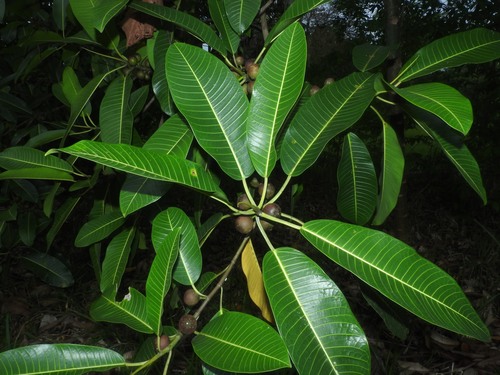
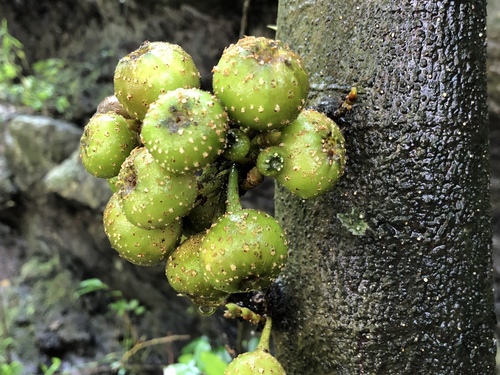
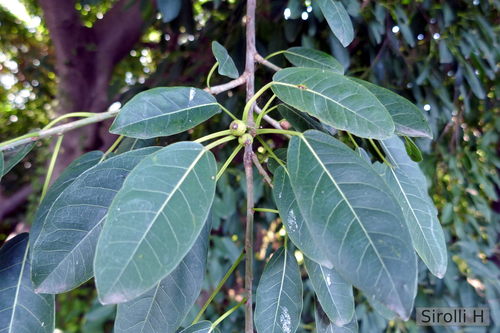
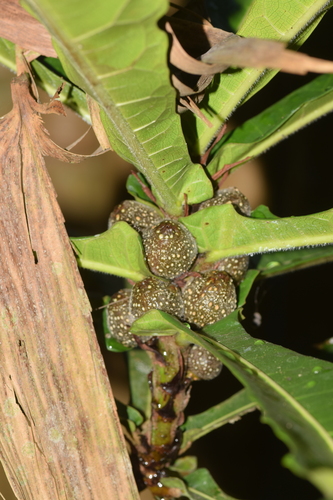
Ficus pseudopalma Blanco is a fig species in the subgenus Sycamorus of the mulberry family, Moraceae. Its common names are Philippine fig, dracaena fig, and palm-leaf fig. In the wild, it is endemic to the Philippines, occurring most especially on the island of Luzon. Outside its native range, it is cultivated as an ornamental plant. This species grows as an erect shrub or a rarely branching small tree. It has an unbranched, uncovered mesocaul stem, topped with a cluster of wavy-edged leaves that give the plant a palm-like appearance. This palm-like form is reflected in its species name pseudopalma, which means "false palm". The leaves measure 75–100 cm (30–40 in) long and up to 15 cm (6 in) wide, with a yellow midrib and dull teeth along the edges. The leaf blade is elevated above the midrib along the edges, forming a trough-like shape. It produces dark green figs that grow in pairs, with each fig reaching 2.5 cm (1 inch) in diameter. The figs are edible, but do not have a very pleasant flavor. On Luzon, Ficus pseudopalma grows in grassland and forest habitats, where it is considered a common species. The new shoots of this plant are eaten as a vegetable, and its leaves have a number of traditional medicinal uses, including use as a remedy for kidney stones. In the Bicol Region of the Philippines, the plant is called Lubi-lubi, and its leaves are cooked in coconut milk. In 2003, the leaves were sold in markets for US$0.74 per kilogram, and the species can be grown in plantations without pesticides to earn an adequate profit. This shrub has been used as a landscaping plant in Hawaii, but it has never escaped cultivation or become established in the wild there, because the specific wasp species that pollinates Ficus pseudopalma was never introduced to the islands.