About Ficus petiolaris Kunth
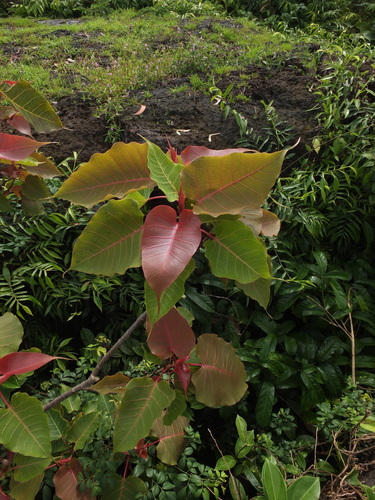
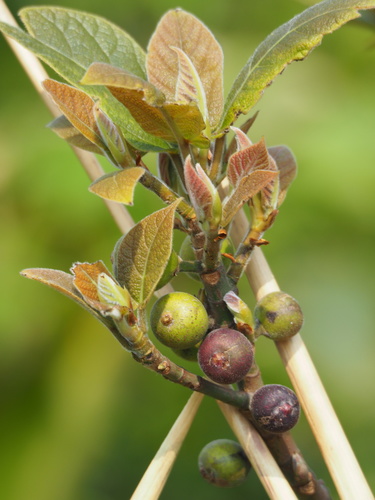
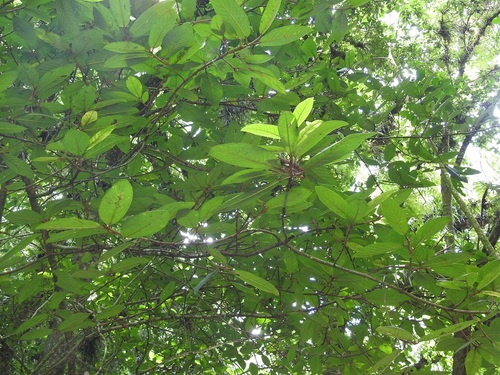
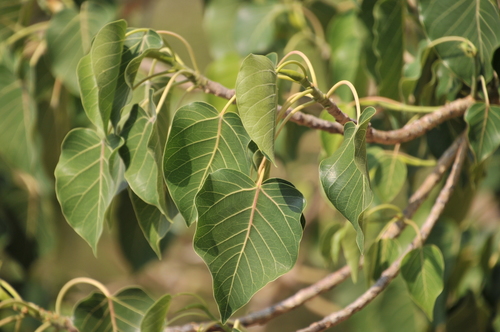
Ficus petiolaris Kunth is a tree species that can reach up to 30 meters in height in wild settings, but grows to only 8 to 10 meters tall when cultivated as a houseplant. Its trunk is yellowish-green in color. It produces heart-shaped leaves, which are bright green on their upper surface and have a tuft of whitish hairs on their lower surface. Its flowers and fruits are green, spherical, and marked with red velvety spots. Mature wild specimens have a rounded crown. This species is native to Mexico, where it grows in warm, semi-warm, and temperate climates at elevations between 550 and 1200 meters above sea level. It occurs as a wild plant associated with deciduous and sub-deciduous tropical forests, thorny forest, mesophilic mountain forest, oak forest, and pine forest. On the Baja California Peninsula, it is found from the southern Sierra de la Asamblea in central Baja California south into the Cape region of Baja California Sur, and also grows on many adjacent islands in the Gulf of California. Traditionally, the Aztecs used the bark of this species to make a type of paper called amate. Many surviving Aztec codices were written on amate paper. In the 16th century, Francisco Hernández de Toledo recorded that a decoction of this species' roots and bark moistens the tongue of people with fever, relieves chest pain, helps expel bile and phlegmatic humors through either upper or lower bodily ducts, and cures long-standing ulcers of the lips or other areas. In the 20th century, Maximino Martinez documented the species as an astringent used to heal fractures, gum cracks, herpes, and chest conditions. In Mexico today, this species is recommended for use against intestinal parasites, herpes, cough, and spleen stones, to regulate menstruation, and to heal fractures. In the Mexican state of Sonora, it is advised for use in cases of goiter, chest pains, phlegm, wounds, and ulcers. In Morelos, it is used to reduce fever. Medicinal preparations use the species' latex, juice, or resin. In Michoacán, macerated bark soaked for one day is used to prepare baths for hepatitis treatment, and the preparation is also taken fasting for nine days.