About Ficus obliqua G.Forst.
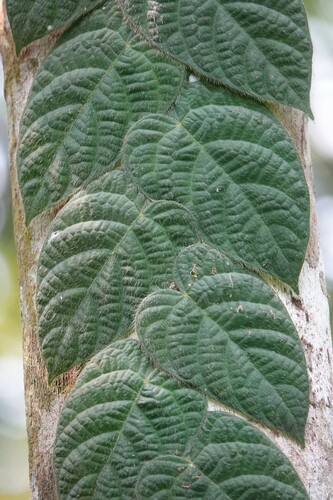
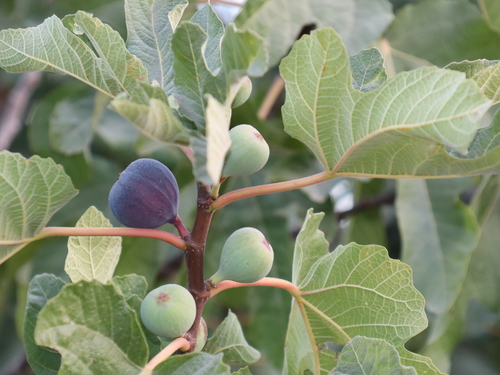
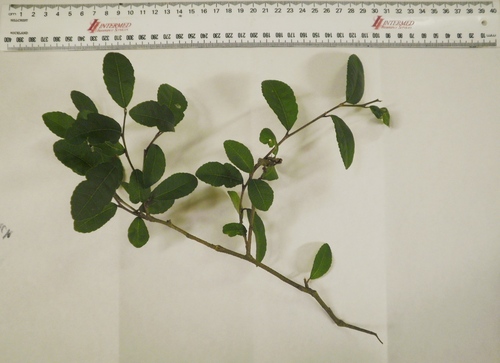
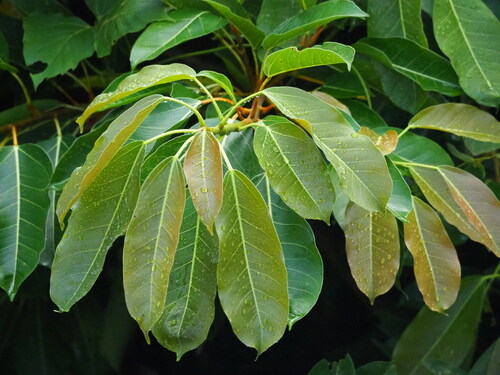
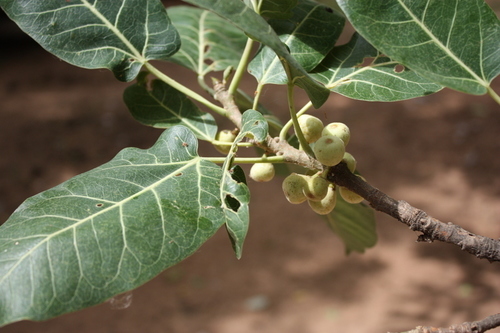
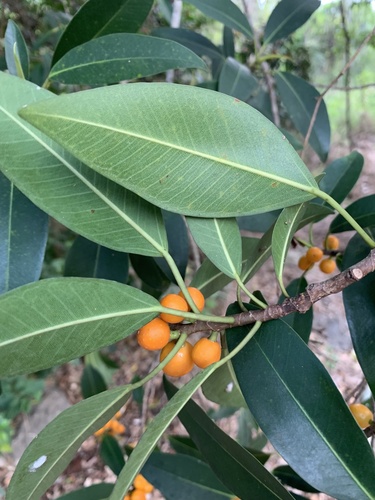
Ficus obliqua G.Forst. is a tree that can reach 15 to 60 metres (49 to 197 feet) in height, with a crown width of a similar size. It has a buttressed trunk that can grow up to 3 metres (9.8 feet) in diameter, covered in smooth, thin grey bark marked by lighter-coloured lenticels. Its glossy green leaves are elliptic to oblong in shape, measuring 5 to 8 centimetres (2.0 to 3.1 inches) long by 2 to 3.5 centimetres (0.79 to 1.38 inches) wide, and are borne on 1 to 2 centimetre (0.39 to 0.79 inch) petioles. Leaves are alternately arranged along stems. Its round fruit grows in pairs: unripe fruit is yellow, and ripens to orange or orange-red dotted with darker red, reaching a diameter of 6 to 10 millimetres (0.24 to 0.39 inches). Ripening typically occurs between April and July, though fruit may appear at other times of year. Like all figs, the fruit is an inverted inflorescence called a syconium, with tiny flowers growing from its inner surface. Ficus obliqua is monoecious, meaning the same individual plant produces both male and female flowers, and both flower types are present within the same fruit. Within any single fruit, female flowers mature several weeks earlier than male flowers.
Historically, Ficus obliqua has often been confused with the related species Ficus rubiginosa. It can be distinguished by its smaller fruit borne on shorter stalks, its glabrous (hairless) leaves, and ascending hyaline hairs along its petioles. F. rubiginosa has some forms that have both glabrous leaves and petioles, while other forms have both structures covered in fine fur. The syconia of F. obliqua are smaller too, measuring 4.3–11.9 mm long and 4.4–11.0 mm in diameter, compared to 7.4–17.3 mm long and 7.6–17.3 mm in diameter for F. rubiginosa. Ficus brachypoda, a lithophytic species from arid northern and western Australia, has a short petiole and leaf shape that align it with Ficus platypoda.
Ficus obliqua grows from Mount Dromedary (36° S) in southern New South Wales northwards along the Australian coast and Great Dividing Range to the tip of Cape York Peninsula in north Queensland. Outside Australia, it is found on New Guinea and its offshore islands, across eastern Indonesia as far west as Sulawesi, and east into the southwestern Pacific, where it occurs in New Caledonia, Fiji, Tonga, Samoa and Vanuatu. It was previously thought to grow in Western Australia, but those collections are now classified as Ficus brachypoda. It prefers soils with high nutrient and water content; in the Sydney region, it grows on sandstone or latite soils. Its natural habitat is warm temperate to moist subtropical rainforest, where large specimens grow as emergent trees rising above the main canopy.
A number of bird species eat the fruit of Ficus obliqua and disperse its seeds. The double-eyed fig parrot (Cyclopsitta diophthalma) feeds on the fruit, steadily dropping fruity detritus onto the ground below. Other Australian bird consumers include the rainbow lorikeet (Trichoglossus moluccanus), southern cassowary (Casuarius casuarius), brown cuckoo-dove (Macropygia phasianella), rose-crowned fruit dove (Ptilinopus regina), wompoo fruit dove (Ptilinopus magnificus), wonga pigeon (Leucosarcia melanoleuca), topknot pigeon (Lopholaimus antarcticus), silvereye (Zosterops lateralis), pied currawong (Strepera graculina), black-faced cuckoo-shrike (Coracina novaehollandae), olive-backed oriole (Oriolus sagittatus), Australasian figbird (Sphecotheres vieilloti), green catbird (Ailuroedus crassirostris), regent bowerbird (Sericulus chrysocephalus), satin bowerbird (Ptilonorhynchus violaceus), and Lewin's honeyeater (Meliphaga lewinii). Ficus obliqua is an important food source for the western Polynesian species the many-colored fruit dove (Ptilinopus perousii) and crimson-crowned fruit dove (Ptilinopus porphyraceus), and it has been recommended for amenity planting in Tonga to support these birds. Two species of flying fox, the spectacled flying fox (Pteropus conspicillatus) and the grey-headed flying fox (Pteropus poliocephalus), also eat its fruit.
The leaves of Ficus obliqua are a food source for the larvae of the common crow butterfly (Euploea core), the no-brand crow butterfly (Euploea alcathoe), and the geometer moth Scopula epigypsa. The thrips species Gynaikothrips australis feeds on the underside of new leaves of F. obliqua, as well as on F. rubiginosa and F. macrophylla. When plant cells die from feeding, nearby cells are triggered to form meristem tissue, which develops into a gall and distorts and curls the affected leaves. These thrips stay inside galls at night, wander during the day, and return to galls in the evening, sometimes moving to different galls on the same tree. Feeding starts when the tree produces new growth flushes, and the thrips' full life cycle is around six weeks. At other times, thrips live on old leaves without feeding, or pupate sheltered in the tree's bark.
All figs share an obligate mutualism with fig wasps of the family Agaonidae: figs are only pollinated by fig wasps, and fig wasps can only reproduce inside fig flowers. It was generally thought that each fig species depends on a single wasp species for pollination, and the wasps are similarly dependent on that specific fig species to reproduce. However, this assumption has been challenged by the discovery of cryptic species complexes within what was previously thought to be single fig wasp species. Ficus obliqua is pollinated by two species of fig wasp: Pleistodontes greenwoodi and Pleistodontes xanthocephalus. As noted earlier, female and male flowers within each syconium mature at different times. Female wasps enter the syconium and lay eggs in the female flowers as those flowers mature. After the eggs hatch, the new wasp progeny mate. The new generation of female wasps collects pollen from the now-mature male flowers, then leaves to enter other syconia and repeat the reproductive cycle. A field study conducted in Brisbane found that Ficus obliqua trees often bear both male-phase and female-phase syconia at the same time, which may benefit reproduction in isolated populations such as those on islands. The same study found a slightly reduced number of male-phase syconia in winter, which is thought to be caused by increased mortality of the wasp pollinator in cooler months.
Seed-dispersing animals that eat Ficus obliqua fruit spread the seeds, which then germinate and grow either on other plants (as epiphytes) or on rocks (as lithophytes). As young plants develop, they send roots down to the forest floor. Figs that grow on other plants gradually enlarge until they strangle their host tree. Ficus obliqua is long-lived, with individuals thought to live more than 500 years.
Ficus obliqua makes an elegant shade tree for parks or open fields, and adapts well to different types of soil. A well-known specimen growing in Mick Ryan Park, Milton on the New South Wales south coast stands 14 m (46 ft) tall and 38 m (125 ft) across, and serves as a local landmark. Like other fig species that grow into large trees, Ficus obliqua is only suitable for very large gardens, because its aggressive root system invades drains and garden beds. It also drops large amounts of fruit and leaves, leaving a mess under the tree. Although it is used much less often for bonsai than F. rubiginosa, Ficus obliqua is well-suited to the medium: its small leaves and tendency for its trunk to thicken make it ideal for bonsai specimens 10–80 cm (3.9–31.5 in) in height. It is found in bonsai nurseries mainly in the Brisbane area, where it is a locally common species, and is very highly regarded by bonsai proponent Bradley Barlow. Barlow entered a Brisbane-grown Ficus obliqua specimen in the 2006 Bonsai Clubs International competition, where it won a prize. It is also suited for use as an indoor plant in spaces with low, medium or bright light. Its timber is too soft to be used for woodworking.
In Fiji, where Ficus obliqua is known as baka or baka ni viti, many parts of the species are used in traditional Fijian medicine, and it was previously considered sacred there. Its white sap is used to treat painful or swollen joints and limbs or boils, or diluted with water and drunk to improve breast milk production. Liquid extracted from its root bark is used for headaches, or diluted to improve health after childbirth, and its leaves are applied to venereal lesions. The species has also been traditionally used to treat boils in Samoa and Tonga.