About Ficus maxima Mill.
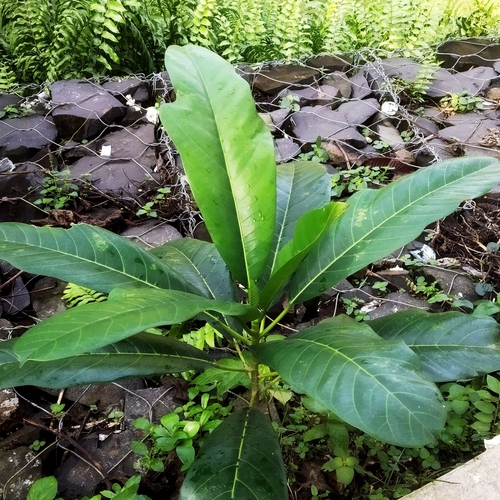
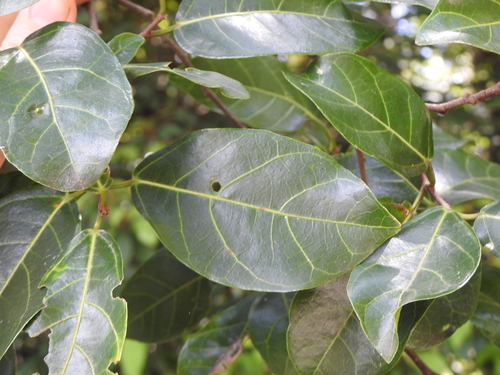
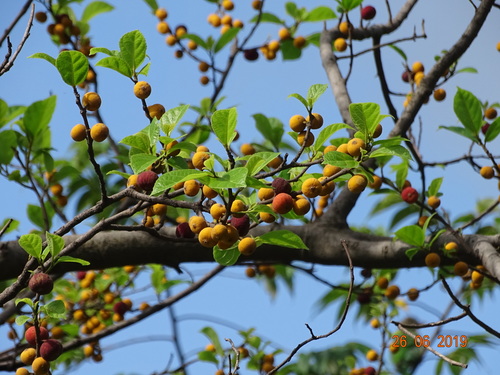
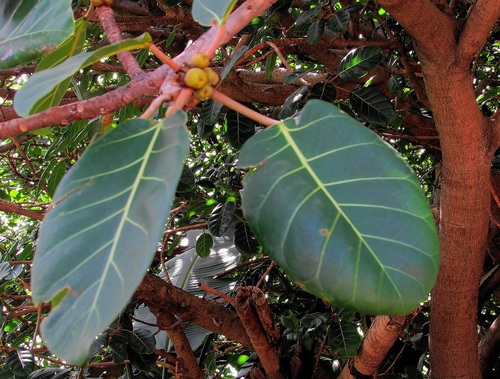
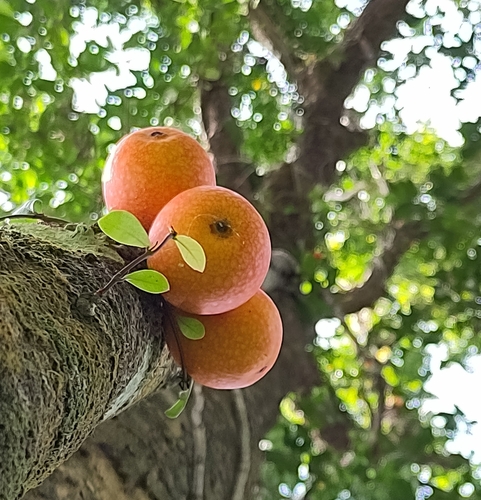
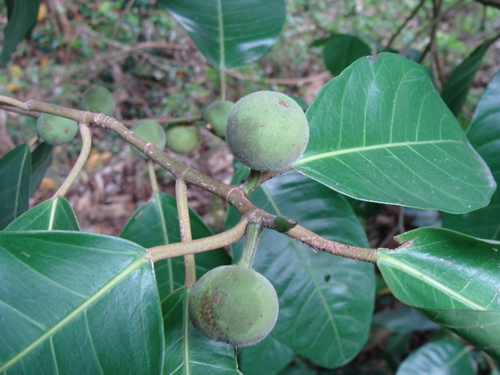
Ficus maxima Mill. is a tree that grows between 5 and 30 metres (16 to 98 feet) tall. Its leaves vary in shape from long and narrow to more oval, and measure 6 to 24 centimetres (2 to 9 inches) long and 2.5 to 12 centimetres (0.98 to 4.72 inches) wide. F. maxima is monoecious, meaning each individual tree bears both functional male and female flowers. Its figs are produced singly, and measure 1 to 2 centimetres (0.39 to 0.79 inches) in diameter, occasionally reaching up to 3 centimetres (1.2 inches).
Ficus maxima has a distribution that ranges from Paraguay and Bolivia in the south to Mexico in the north, where it is widespread and common. It occurs in 14 states across the southern and central parts of Mexico, and grows in tropical deciduous forest, tropical semi-evergreen forest, tropical evergreen forest, oak forest, and aquatic or subaquatic habitats. It is found throughout Central America, including Guatemala, Belize, Honduras, Nicaragua, El Salvador, Costa Rica and Panama. It is present in Cuba and Jamaica in the Greater Antilles, and Trinidad and Tobago in the southern Caribbean. In South America, it occurs across Colombia, Venezuela, Guyana, Suriname, French Guiana, Ecuador, Peru, Bolivia, Paraguay, and the Brazilian states of Amapá, Amazonas, Mato Grosso, Minas Gerais, and Pará.
Figs share an obligate mutualism with fig wasps from the family Agaonidae: figs are only pollinated by fig wasps, and fig wasps can only reproduce in fig flowers. In general, each fig species depends on a single species of fig wasp for pollination, and each fig wasp species can only reproduce in the flowers of a single fig tree species. Ficus maxima is pollinated by Tetrapus americanus, though recent research suggests that the taxon currently known as T. americanus is a cryptic species complex made up of at least two non-sister species.
Figs have complex inflorescences called syconia, where flowers are entirely enclosed within a closed structure, with only a small pore called an ostiole connecting the inflorescence to the outside. As a monoecious fig, F. maxima has both male and female flowers within a single syconium. Female flowers mature first; once mature, they produce a volatile chemical attractant that is detected by female Tetrapus americanus wasps. These female wasps are about 2 millimetres (0.079 inches) long and can produce roughly 190 offspring each. Females arrive carrying pollen from their natal tree, then squeeze through the ostiole into the interior of the syconium.
The syconium holds 500 to 600 female flowers arranged in multiple layers. Flowers closer to the outer wall of the fig have short pedicels and long styles, while flowers closer to the interior chamber have long pedicels and short styles. Female wasps typically lay their eggs in the short-styled flowers, while longer-styled flowers are more likely to be pollinated. Eggs hatch and larvae parasitise the flowers they were laid in, while pollinated, unparasitised flowers develop into seeds. Male wasps mature and emerge before females; they mate with females that have not yet emerged from their galls, then cut exit holes through the outer wall of the syconium for females to exit. Male flowers mature around the same time that female wasps emerge, and shed their pollen onto the newly emerged females. Like roughly one third of all fig species, Ficus maxima is passively pollinated. Newly emerged females leave through the exit holes cut by males, and fly off to find another syconium to lay their eggs. After the females leave, the figs ripen. Ripe figs are eaten by a variety of mammals and birds, which disperse the plant's seeds.
Figs are sometimes considered potential keystone species for fruit-eating animal communities, because their asynchronous fruiting patterns make them an important source of fruit when other food sources are scarce. At Tinigua National Park in Colombia, Ficus maxima was an important fruit producer during periods of fruit scarcity in one out of three years of study. This led Colombian ecologist Pablo Stevens to consider it a possible keystone species, but he ultimately chose not to include it in his final list of potential keystone species at the park.
Ficus maxima fruit is eaten by birds and mammals. These animals act as seed dispersers when they defaecate or regurgitate intact seeds, or when they drop fruit below the parent tree. One study of Ficus fruit consumed by bats in Panama found that F. maxima fruit has relatively high protein levels and low levels of water-soluble carbohydrates. Black howler monkeys in Belize consume F. maxima fruit, and both young and mature leaves of the species. In southern Veracruz, Mexico, F. maxima was recorded as the third most important food source for a studied population of Mexican howler monkeys, which feed on its young leaves, mature leaves, mature fruit, and petioles. Venezuelan red howlers have been observed feeding on Ficus maxima fruit in Colombia.
The interaction between figs and fig wasps is very well-documented. In addition to pollinators, Ficus species are used by a group of non-pollinating chalcidoid wasps whose larvae develop inside the figs. Both pollinating and non-pollinating wasps act as hosts for parasitoid wasps. Aside from Tetrapus americanus, Ficus maxima figs collected in Brazil have also been found to contain non-pollinating wasps of the genus Critogaster, mites, ants, beetles, and dipteran and lepidopteran larvae. Norwegian biologist Frode Ødegaard recorded a total of 78 phytophagous (plant-eating) insect species on a single Ficus maxima tree in Panamanian dry forest: 59 were wood-eating insects, 12 fed on green plant parts, and 7 were flower visitors. Among the 24 tree species sampled in the study, F. maxima supported the fourth most specialised phytophagous insect fauna, and the second largest wood-feeding insect fauna.
Ficus maxima has a number of documented human uses. The Lacandon Maya people use it to treat snakebite: leaves are moistened by chewing, then applied to the bite wound. In the Ecuadorian provinces of Loja and Zamora-Chinchipe, an infusion made from its leaves is used to treat internal inflammations. The Paya people of Honduras use the species for firewood, and to treat gingivitis. The Tacana people of Bolivia, and people living in Guatemala's Petén Department, use the plant's latex to treat intestinal parasites. In Brazil, the species is used as an anthelmintic, antirheumatic, anti-anaemic, and antipyretic. Its latex is also used to bind limestone soils to make cal, a type of adobe cement. Researchers Gaspar Diaz M. and colleagues have isolated four methoxyflavones from Ficus maxima leaves, and researcher David Lentz and colleagues have observed antimicrobial activity in extracts of Ficus maxima.