About Ficus elastica Roxb.
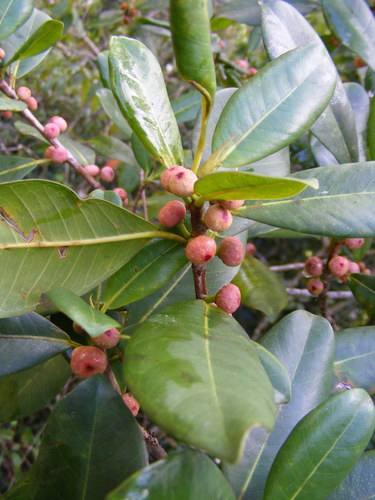
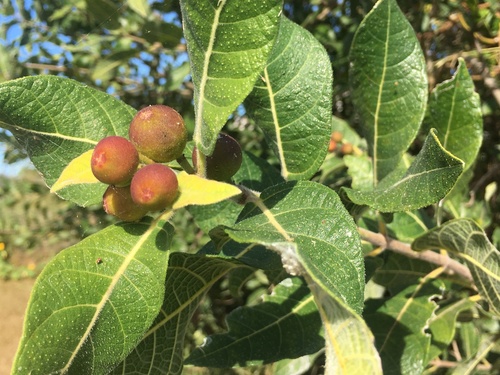
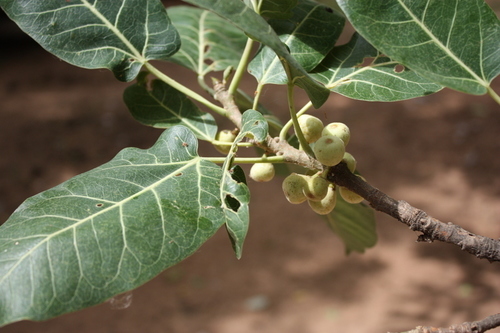
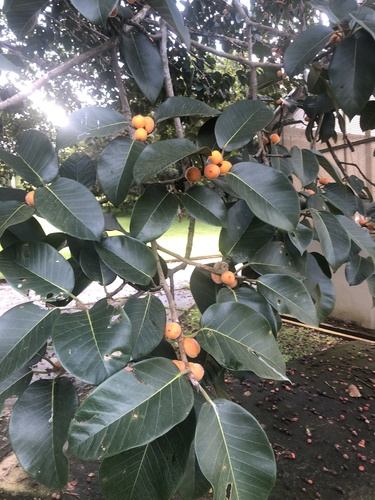
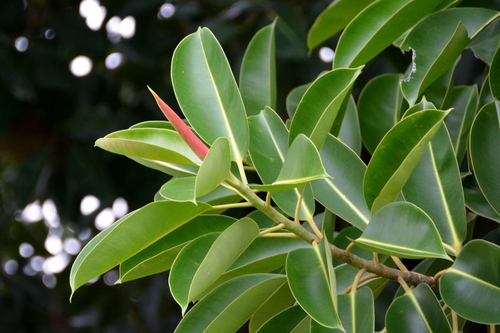
Ficus elastica Roxb. is a large tree belonging to the banyan group of figs. It grows 30–40 m (100–130 ft) tall, and rarely reaches up to 60 m (195 ft). It has a stout trunk that can grow up to 2 m (6 ft 7 in) in diameter. The trunk develops aerial and buttressing roots that anchor the tree in soil and help support its heavy branches. It produces broad, shiny oval leaves that are 10–35 cm (4–14 in) long and 5–15 cm (2–6 in) wide. Leaf size is largest on young plants, occasionally reaching 45 cm (17+1⁄2 in) in length, while leaves on old trees are much smaller, typically 10 cm (4 in) long. New leaves develop inside a sheath at the apical meristem, which grows larger as the new leaf matures. Once the leaf is fully mature, it unfurls, and the sheath drops off the plant. Another immature leaf already forms inside the new leaf while it develops. This tree has a dense canopy. The natural range of Ficus elastica extends from Nepal in the north to Indonesia, Bhutan, Northeastern India, Bangladesh, Myanmar, Thailand, Yunnan in China, and Malaysia. It has been widely introduced to most tropical regions of the world, including Hawaii and the West Indies. In Europe, it grows in mild locations across the Mediterranean Basin. Like other members of the genus Ficus, Ficus elastica requires a specific species of fig wasp for pollination, in a co-evolved relationship. Because of this specialized relationship, the rubber plant does not produce highly colourful or fragrant flowers to attract other pollinators. Its fruit is a small yellow-green oval fig, 1 cm (1⁄2 in) long, that is barely edible. These are false fruits that only contain fertile seeds in areas where the pollinating fig wasp is present. In parts of India, people guide the tree's roots across chasms to form living bridges. Large bridges woven from Ficus elastica aerial roots still exist today in Meghalaya, India. Aerial roots can grow on Ficus elastica specimens as small as 1 foot tall, even though the trees used for these bridges are very large.