About Ficus citrifolia Mill.
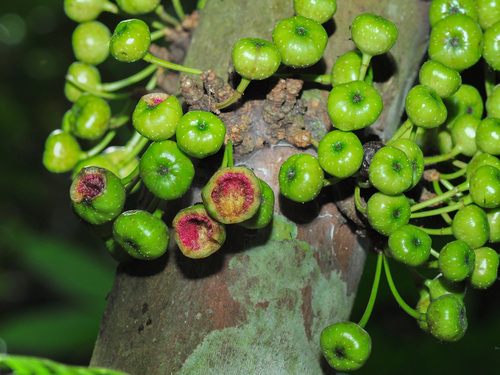
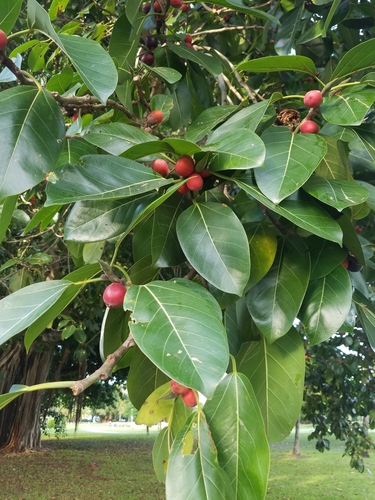
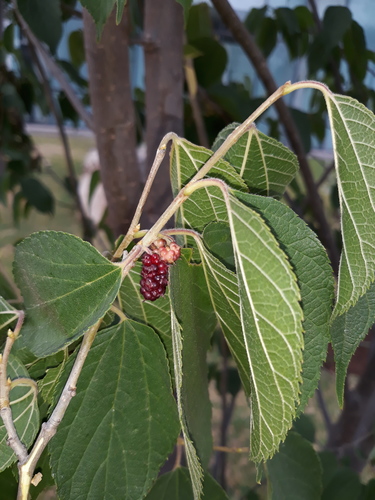
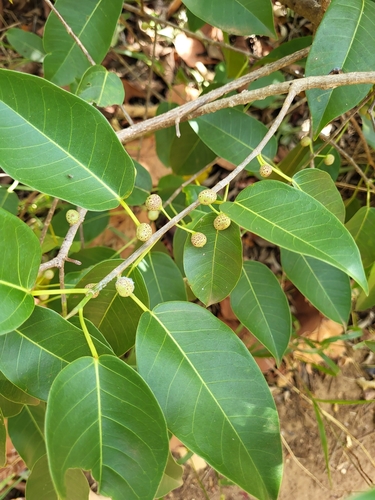
Ficus citrifolia trees typically reach 15 m (50 ft) in height. They can cover a wide area by dropping aerial roots from branches that spread horizontally, and these roots fuse with the parent tree as they grow. Trees feature a broad crown, light grey bark, some aerial roots, and milky sap. The leaves are dark green, oval-shaped, with a rounded base and a pointed tip. Small flowers are enclosed inside open-ended fruit. Fruit grows on the ends of long stalks that protrude from leaf axils. Unripe fruit is yellow, and turns dark-red when fully ripe; ripe fruit is sweet and can be eaten raw. New Ficus citrifolia individuals start life as epiphytes, a growth strategy that lets them avoid competition for light and land. This species commonly grows on and attacks palms, bald cypress, oaks, and other trees, strangling its host as it grows. Ficus citrifolia experiences strong selective pressure to flower and produce fruit year-round due to its mutualistic relationship with its pollinating agaonid wasp. Agaonid wasps share a symbiotic relationship with figs: each agaonid wasp species pollinates only one fig species, and each fig species is pollinated by only one wasp species. Ficus citrifolia is specifically pollinated by Pegoscapus assuetus. After pollination, figs ripen quickly. Fruit growth is slower during cold dry months, and concentrated during hot, rainy months. Fruiting trees are very productive; a single tree can produce up to 1,000,000 fruits, each with a diameter of 1–2.5 cm. Ripe fruit has a purgative effect on the digestive systems of many animals that eat it, so the tree's seeds are widely dispersed through animal dung. In southern Florida, the invertebrates that live inside Ficus citrifolia syconia include pollinating wasp P. assuetus, up to eight or more species of non-pollinating wasps, a plant-parasitic nematode carried by the pollinator, a parasitic nematode that attacks pollinating wasps, mites, a midge, and a predatory rove beetle whose adults and larvae both feed on fig wasps. The plant-parasitic nematode associated with F. citrifolia syconia and pollinator P. assuetus is Schistonchus laevigatus, a member of the family Aphelenchoididae. Parasitodiplogaster laevigata is a parasite of the pollinator P. assuetus. Unidentified mites belonging to the family Tarsonemidae (order Acarina) have been found in the syconia of Ficus aurea and Ficus citrifolia; these mites have not been classified even to genus, and their behavior has not been described. The midge Ficiomyia perarticulata (family Cecidomyiidae) lays its eggs in the walls of F. citrifolia syconia, and its developing larvae trigger the plant to form galls at the oviposition site. Charoxus spinifer, a rove beetle in the family Staphylinidae (order Coleoptera), has adults that enter late-stage syconia of Ficus aurea and F. citrifolia. Adult beetles eat fig wasps; larvae develop inside the syconia and also prey on fig wasps, before pupating in the ground. An extract of Ficus citrifolia may hold therapeutic value for chemotherapy patients.