About Ficus burtt-davyi Hutch.
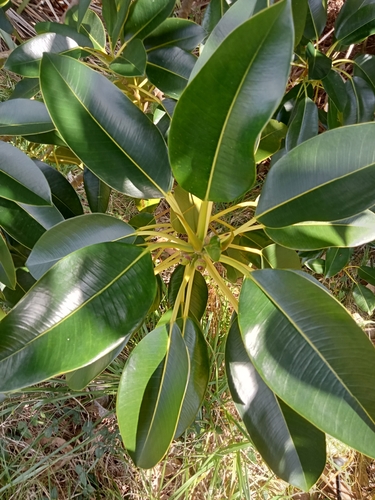
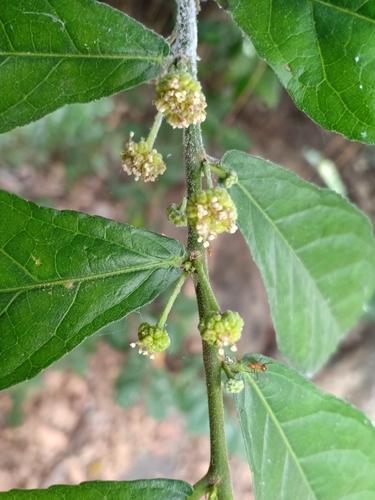
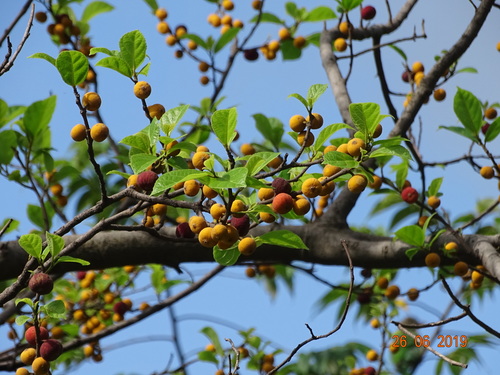
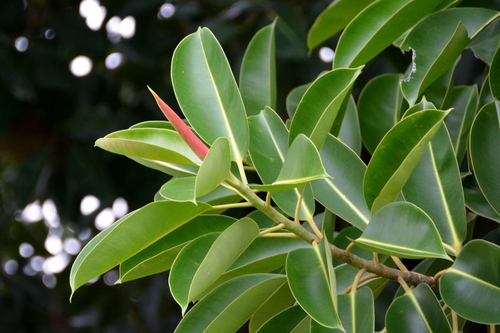
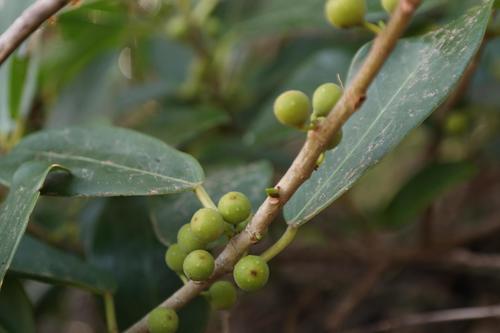
Ficus burtt-davyi Hutch. is a fig species in the mulberry family Moraceae, endemic to Southern Africa. It grows in coastal and inland forests up to 1,500 m (4,920 ft) in elevation, with a natural range extending from the vicinity of Mossel Bay in the Southern Cape to southern Mozambique. Populations growing on coastal dunes in the northern portion of its range are salt tolerant, and form low thickets along woodland margins. In the southern and eastern Cape forests, this species grows as a strangler or liana; when it grows on rocky outcrops and cliffs, it usually develops into a rock-splitter. In its epiphytic growth form, Ficus burtt-davyi begins life in the forks of tree branches, where accumulated organic debris supports germination and early development. It sends down long, thin roots to reach soil and water below. Over time, the roots thicken and increase in number, and can eventually enclose the host tree, strangling and killing it. This leaves the fig to stand alone with no competition for available resources. When growing without support, stems can reach 1 meter in diameter, and the plant can grow up to 20 meters in height, with a dense canopy that makes it an excellent shade tree. Its bark is thin, smooth, grey, and fibrous; indigenous tribes widely use this bark as rough cordage. Young branchlets are covered with minute, soft, erect hairs. Its tolerance of drought conditions makes it a popular species among Bonsai growers. The fruits of Ficus burtt-davyi are important as both food and traditional medicine, and contain laxative substances, flavonoids, sugars, vitamins A and C, acids, and enzymes. The plant's latex is an allergen and a serious eye irritant. There are roughly 900 species of figs worldwide, and with rare exceptions, each fig species relies on one specific species of fig wasp from the family Agaonidae for pollination. Ficus burtt-davyi follows this pattern, and depends on the minute fig wasp Elisabethiella baijnathi Wiebes. to complete pollination. Pollinator-specific volatile attractants are released through the ostioles of ripe figs, and for F. burtt-davyi, these attract only adult female Elisabethiella baijnathi. Fig trees are keystone species in many tropical and subtropical ecosystems. Because they produce fruit steadily throughout the year, they feed a wide diversity of animal life, and animals in turn disperse the figs' seeds. Immature F. burtt-davyi fruits are green with white spots; ripe fruits are yellowish. Fruits grow singly or in pairs from leaf axils, and measure 5-10mm in diameter. Fourcade described the wood of this species as "very light and soft, very weak, elastic, porous, with alternate concentric layers of soft and firm tissue; medullary rays fine and close; pores moderately large and numerous, irregularly distributed; colour white or grey, tinged with brown; makes rough boards, but decays rapidly if exposed to the weather." This species was named in honor of botanist Joseph Burtt Davy, who worked in South Africa between 1903 and 1919.