About Ficus benjamina L.
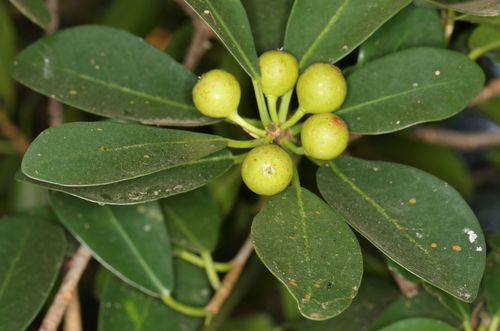
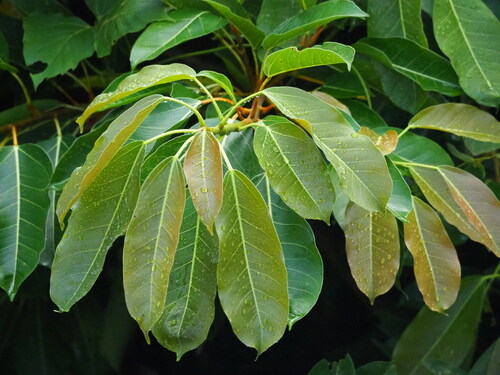
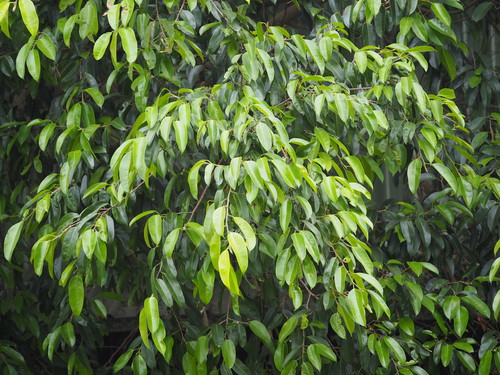
Ficus benjamina L., commonly known as weeping fig, grows as a tree reaching up to 30 m (98 feet) tall in natural conditions, with gracefully drooping branchlets. It has glossy, 6–13 cm (2+3⁄8–5+1⁄8 inches) oval leaves with acuminate tips. Its bark is light gray and smooth, while the bark of young branches is brownish. The widely spread, heavily branched canopy often reaches 10 metres (33 ft) across, and this species is a relatively small-leaved fig. Its leaves are simple, entire and stalked, with a petiole 1 to 2.5 cm (3⁄8 to 1 inch) long. Young foliage is light green and slightly wavy, while older leaves are green and smooth. Leaf blades range from ovate to ovate-lanceolate, with wedge-shaped to broadly rounded bases and a short drooping acuminate tip. Leaf blades are pale glossy to dull, 5 to 12 cm (2 to 4+1⁄2 inches) long and 2 to 6 cm (1 to 2+1⁄2 inches) wide, with yellow crystal cells called cystolites near the leaf margins. This species has two separate, membranous, deciduous, lanceolate stipules that are 6 to 12 mm (1⁄4 to 1⁄2 inch) long, rarely reaching 15 mm or 9⁄16 inch. F. benjamina is monoecious. Its inflorescences are spherical to egg-shaped, shiny green, and 1.5 cm (1⁄2 inch) in diameter. The inflorescences hold three types of flowers: male flowers, fertile female flowers, and sterile female flowers. Scattered, stalked male flowers have free sepals and one stamen. Most fertile female flowers are sessile, with three or four sepals and an egg-shaped ovary. The more or less lateral style ends in an enlarged scar. Pollination of F. benjamina only occurs via a specific type of wasp that lives symbiotically with the tree. When ripe, the collective fig fruit is orange-red, with a diameter of 2.0 to 2.5 cm (3⁄4 to 1 inch). The tree is grown as an ornamental bush and indoor plant in many regions, and it is also considered one of the best shade trees, capable of growing to enormous size with good carbon sequestration capacity. In tropical, subtropical, and warm temperate latitudes, weeping fig grows into a very large, stately tree suitable for parks and other urban settings such as wide roads, and it is often cultivated for this purpose. A well-known example of this cultivation is the heritage-listed Bourbong Street Weeping Figs in Bundaberg. F. benjamina is a very popular houseplant in temperate areas, valued for its elegant growth and tolerance of poor growing conditions. It grows best in bright, sunny conditions, but can tolerate considerable shade. It requires moderate watering in summer, and only enough water to prevent drying out in winter. Favorable conditions for rapid, noticeable growth include longer days, relatively high daytime temperatures, and moderate nighttime temperatures. It does not require misting. The plant is sensitive to cold, and should be protected from strong drafts. When grown indoors, it can outgrow its space and may need drastic pruning or full replacement. F. benjamina has been shown to effectively remove gaseous formaldehyde from indoor air. It also helps eliminate heavy metals, most commonly in urban environments, and has been used as a biomonitor in New Mexico. The fruit of F. benjamina is edible, and its figs are often consumed dried, but the species is not typically grown for fruit production. Its leaves are known to have pharmaceutical benefits including antioxidant properties. The leaves are very sensitive to small changes in light. If the tree is rotated or relocated, it responds by dropping many of its leaves, then grows new leaves adapted to the new light intensity. The plant is also sensitive to changes in other environmental factors including temperature, humidity and relocation.