About Ficus amplissima Sm.
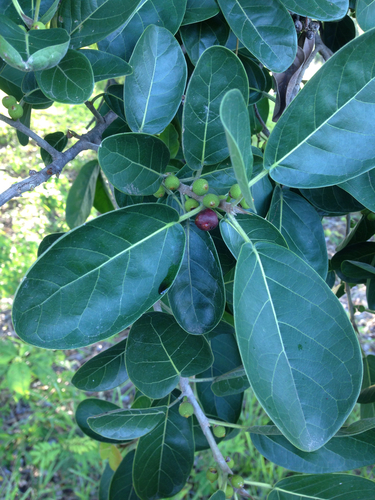
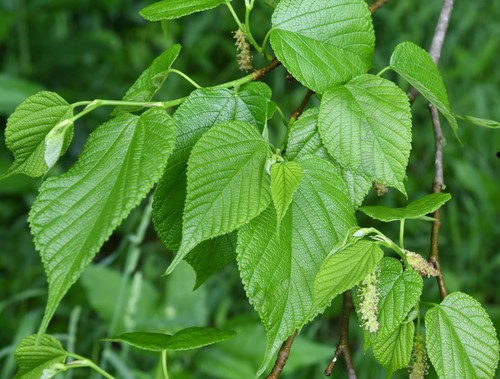
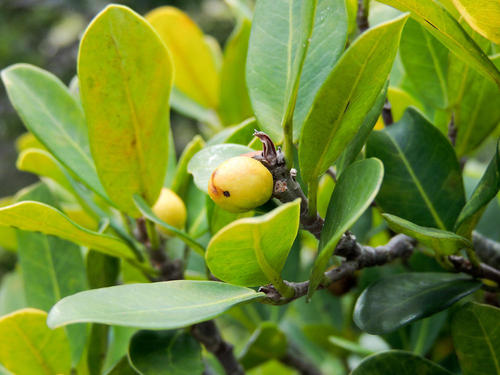
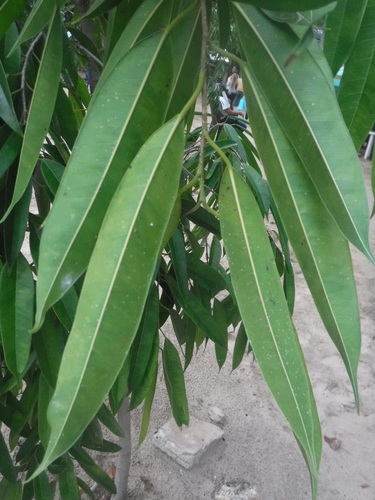
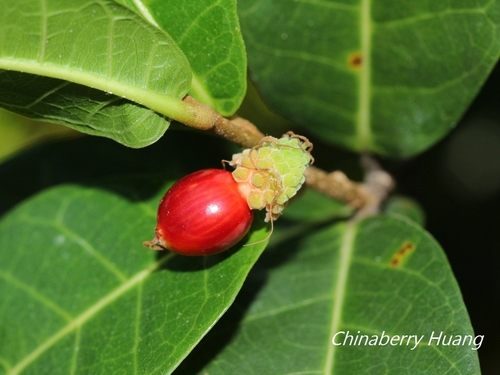
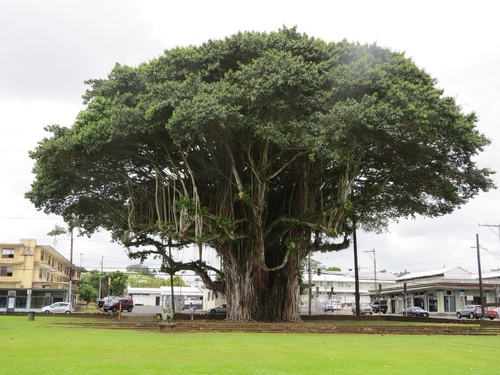
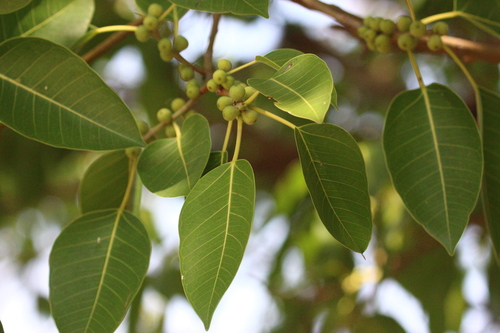
Ficus amplissima Sm. is a large evergreen or semi-deciduous tree with a widely spreading crown that reaches over 10 m (33 ft) across. In natural conditions, it can grow up to 25 m (82 ft) tall, with a trunk diameter of up to 2 m (6 ft 7 in). It has a moderate to dense number of aerial roots, which are generally wrapped around the top of the trunk. Its leaves are simple and arranged alternately on branches. They range in shape from broadly ovate elliptic-lanceolate to ovate-oblong, with a blunt or acute tip, an entire margin, and an acute-cuneate or rounded base. Leaf blades measure 5–14 cm (2.0–5.5 in) long and 2.5–9 cm (0.98–3.54 in) broad, attached to 1.5–5 cm (0.59–1.97 in) long petioles. Petioles are slender and grooved on the upper side, and glabrous and glandular at the apex on the lower side. The leaf lamina is glabrous and coriaceous, trinerved from the base. The midrib is raised above the leaf surface, and 8 to 10 pairs of slender, prominent parallel lateral nerves are present; the tertiary nerves are obscured and reticulate. The bark of the trunk is smooth, thornless, greenish-gray, and reflects a blaze yellow color, and it exudes large amounts of milky white latex. Its branches and branchlets are terete, with a glabrous or puberulous surface that bears annular scars and has a pale yellow tinge. Its fruits are small, stalkless figs 1–1.5 cm (0.39–0.59 in) in diameter. They start light green, and ripen into red or purple syconia that contain smooth achenes. Ficus amplissima typically begins life as an epiphyte growing in the branch of another tree. It grows aerial roots that can obtain nutrients once they reach the soil; these roots can surround the host tree’s trunk. Combined with F. amplissima’s growth in the host’s branches, this can eventually kill the host tree. This species is native to Central, Eastern and southern Peninsular India, Sri Lanka and the Maldives, and has a significant distribution across the Western Ghats (Sahyadaris) of India. It is an endemic species, and has not been recorded outside its native habitat. It occurs rarely in the northern and eastern Indian states of Bihar, Gujarat and Rajasthan, and grows abundantly in the southern Indian states of Andhra Pradesh, Goa, Karnataka, Maharashtra, Tamil Nadu, Telangana and Kerala. In Pakistan, it is cultivated in Lahore and Sindh. Ficus amplissima tolerates a range of climate zones, corresponding to Köppen climate classification categories Af, Am, Aw/As, Bsh, Cfa and Cwa. The ideal environment for its growth provides full sunlight, well-drained soil, moderate water and soil moisture, and air temperatures between 25 °C (77 °F) and 35 °C (95 °F). In India, this native species grows both naturally in the wild and in cultivation, occurring up to altitudes of 1,000 metres (3,300 ft). It is tolerant of semi-arid climates, making it moderately drought resistant. Its growth increases substantially in areas that receive full sunlight, but sustained temperatures below 15 °C (59 °F) or above 35 °C (95 °F) negatively affect its overall growth and health. Under these unfavorable conditions, aftercare is needed until the tree is established to ensure a high survival rate. Ficus amplissima relies on a single species of agaonid fig wasp as its sole pollinator; this wasp lays its eggs only on Ficus amplissima trees. Like all fig trees, this species has a unique fertilization system where the fig species depends on a single specialized pollinating wasp species, which in turn depends on the fig tree to reproduce. Ficus amplissima produces three types of flowers inside its fruit: male flowers, long-styled female flowers, and short-styled female flowers. The short-styled female flower is known as a gall flower. A female fig wasp enters the fig to lay its eggs on the short-styled female flowers, and pollinates the long-styled female flowers in the process. Wingless male fig wasps emerge first, inseminate the emerging females, and bore exit tunnels out of the fig for the winged females. Female wasps then exit the fig, collect pollen from the male flowers, and search for new figs to oviposit in. Ficus amplissima flowers asynchronously to support the life cycle of its fig wasp pollinators. Local fig wasp populations must reach a minimum size to ensure that at any time, some trees release wasps while others receive wasps. Short-lived pollinator wasps will go locally extinct if no figs are available. Ficus amplissima is most commonly cultivated to provide shade in coffee plantations, due to its height and dense, wide-spreading foliage. It is often grown along avenues or road verges, and can also be found on tank bunds or along the boundaries of agricultural fields. In Karnataka and Tamil Nadu, it is cultivated in parks and along roadsides and pavements. In Kerala and coastal Maharashtra, it occurs occasionally as a subcanopy tree in disturbed tropical evergreen or moist deciduous forests at altitudes up to 1,000 m (3,300 ft). It is also used as an ornamental tree, and is commonly grown as bonsai or kept as a houseplant, generally placed indoors in living rooms or on terraces. This species has a long history of traditional use in Ayurveda, Siddha, and Unani medicine to treat diabetes. Its bark acts as a natural anti-diabetic and anti-oxidant that reduces blood glucose levels. Phenols in its foliage give the leaves anti-inflammatory and wound healing properties. In native medicine, leaf juice is applied to chronic wounds, while latex is applied to fresh wounds. People chew Ficus amplissima figs and suck their juice to treat mouth ulcers. Its leaves and branches are used as fodder for cows, goats, and sheep. The wood burns well, so it is widely used as fuelwood in rural areas. Raw or ripened fruits are used to make pickles. The trunk produces hard, high-quality timber that is used to build furniture. Rural farmers also use this timber to make agricultural tools. The bark produces strong fibers that are used to make ropes and bags. It is also planted as polewood for use on farms.