About Ficinia spiralis (A.Rich.) Muasya & de Lange
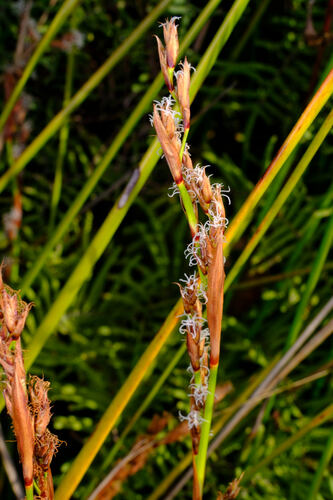
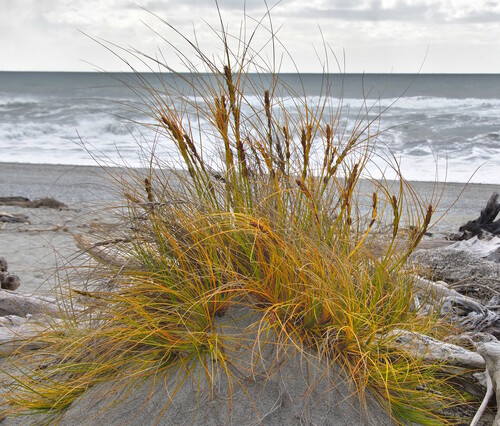
Pīngao, Ficinia spiralis (A.Rich.) Muasya & de Lange, is a stout, grass-like plant in the sedge family that grows 30–90 cm (12–35 in) tall and lives on active sand dunes. This species is found only in New Zealand, and it can be easily told apart from other dune plants like spinifex or marram grass. From a distance, patches of pīngao have a distinctive orange hue. Most individuals grow long, prostrate, tough rope-like stolons that creep along the sand surface until they become buried by shifting sand, leaving only the upper portion of the plant's leaves exposed. Some populations in southern South Island grow as dense tussock-like plants without extensive stolons. Numerous tough, roughly textured leaves grow in dense tufts on well-spaced, short, upright stems called tillers along the length of stolons. These narrow leaves are 2–5 mm wide; their color ranges from bright green when young, through golden yellow, to deep orange when the plant is mature. Small dark brown flowers develop in spring, arranged in spirals as tight clusters around the upper 10–30 cm of the upright stem (culm), interspersed with leaf-like bracts. The seeds are shiny, dark brown, egg-shaped, 3–5 mm long; they ripen and fall in early summer. Pīngao can also reproduce vegetatively through its stolons. This species is endemic to New Zealand, occurring in sand dunes across mainland New Zealand and the Chatham Islands. Pīngao forms an important habitat for native New Zealand bird and insect species, including the New Zealand pipit, Australasian harrier, New Zealand dotterel, and katipō spider.