About Ficimia streckeri Taylor, 1931
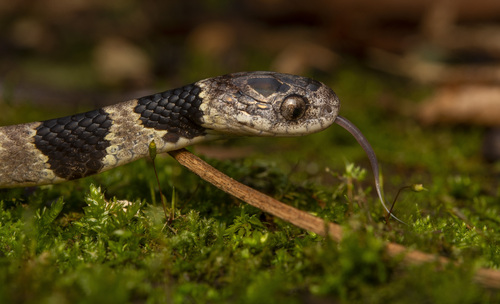
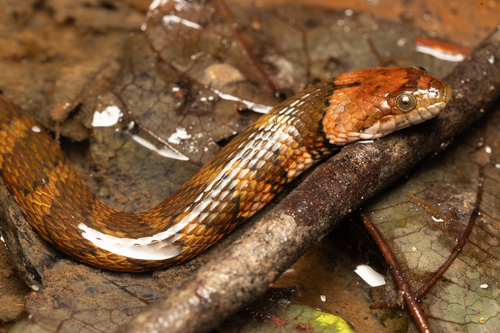
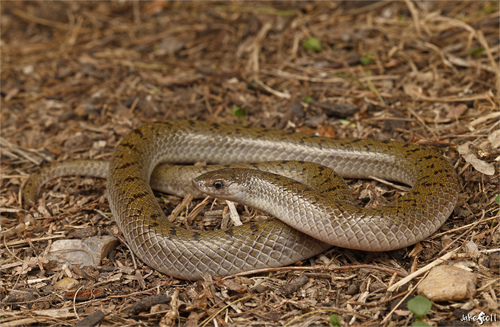
The Mexican hooknose snake, scientifically named Ficimia streckeri Taylor, 1931, usually has a total length (including the tail) between 5 and 11 inches (13 to 28 cm). H.M. Smith and Brodie (1982) recorded a maximum total length of 47.9 cm, which is almost 19 inches. It is typically brown or gray, with up to 60 brown or brown-green blotches running along its back; these blotches are elongated enough to almost look like stripes. The underside of the snake is white or cream-colored. Its most recognizable feature is an upturned snout, similar to that of hognose snakes, which gives the species its common name. Unlike hognose snakes, however, the Mexican hooknose snake has smooth dorsal scales. The arrangement of its head shields is also distinctive: it has no internasals, and the rostral scale separates the prefrontal scales and contacts the frontal scale. Its smooth dorsal scales are arranged in 17 rows at midbody. The number of ventral scales ranges from 126 to 155, and the number of subcaudal scales ranges from 28 to 41. F. streckeri occurs primarily in the Mexican states of Hidalgo, Nuevo León, Puebla, eastern San Luis Potosí, and Tamaulipas, and its range extends north into southern Texas, United States. The Mexican hooknose snake lives in woodlands on the Rio Grande river plain, close to both natural and man-made water sources. The Mexican hooknose snake is oviparous.