About Ficedula zanthopygia (Hay, 1845)
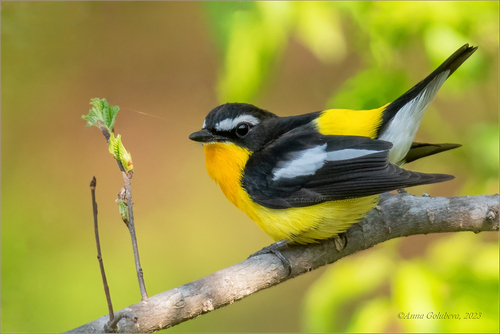
Identification: The yellow rump is distinctive in this species across all plumages. The male has a distinctive white supercilium, which distinguishes it from the narcissus flycatcher and the green-backed flycatcher. Females and first-year males are olive-grey on the upperparts and have blackish tails. In 1910, Hartert classified this species as a member of the narcissina species group. Some individuals with a yellow supercilium have been classified as hybrids between this species and the narcissus flycatcher. Elise's flycatcher, usually treated as a subspecies of the narcissus flycatcher, was once included in this species complex. Both elisae and zanthopygia have been observed breeding separately in the same area of oak forest near Peking, which supports the argument that they are distinct species. There are also clear differences in calls and morphology between the two. The genus Muscicapa has been determined to be polyphyletic, and its classification is still being resolved. By contrast, the genus Ficedula is now recognized as monophyletic; it originated in east Asia, and its diversification occurred following climate changes in the Pliocene. Males of this species have black upperparts, a white supercilium, a white wingpatch, rich yellow underparts, and a yellow rump. Females are greyish or olive-green on the upperparts, paler on the underparts, with a wingbar and a yellow rump, and may show yellow coloration on the throat. Ecology: The breeding range of Ficedula zanthopygia covers Manchuria, Korea, and China. In the Xiaoxingan region, nesting takes place mainly in May and June. They breed primarily in low valleys at the base of hills. A breeding pair has a home range of approximately 2000 to 5000 square meters. The female alone builds the nest, a process that takes about three to four days. The clutch size is 4 to 7 eggs, which the female alone incubates for approximately 11 to 12 days. Adult birds forage within 70 meters (230 feet) of the nest to feed their chicks. Young birds fledge 14 to 15 days after hatching. This species was first recorded wintering in central India in 1989, and has since been found wintering in southwestern India and Sri Lanka. Proterothrix megacaula, a species of ectoparasitic feather mite, was first discovered and described from the body of a yellow-rumped flycatcher in China.