About Ficedula superciliaris (Jerdon, 1840)
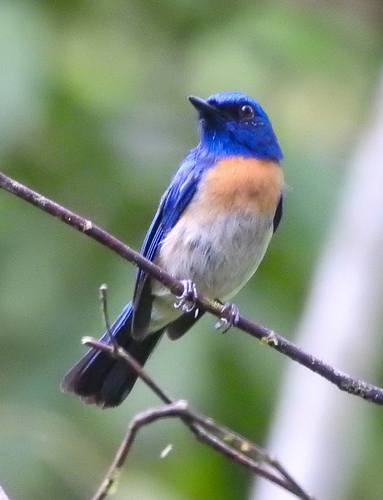
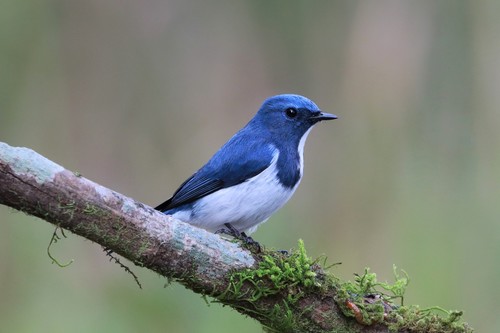
Ficedula superciliaris (Jerdon, 1840) is a small bird, measuring approximately 10 cm in length – a little smaller than a sparrow – with a stocky body build. Males have deep blue plumage on their upperparts, plus deep blue coloration on the sides of the head and neck. A prominent white patch extends from the center of the throat, through the breast, to the belly. The amount of white on the brow and tail shows clinal variation moving west to east along the Himalayan foothills; this variation is often used to recognize three distinct subspecies. The western subspecies, found in the western Himalayas, has a distinct white supercilium and white bases on the outer tail feathers. The eastern subspecies, Ficedula superciliaris aestigma from the eastern Himalayas, does not have distinct white patches. The population found in the south Assam hills, sometimes classified as the third subspecies cleta, has no supercilium at all. These birds are usually solitary, but will sometimes join mixed hunting flocks during the winter. They mostly stay in low trees and bushes, foraging among the foliage canopy, and rarely venture out into open areas. They constantly jerk their tails upward, a movement often paired with fluffing of the head feathers and a trrr call, particularly near nests. Their diet consists mainly of insects. In summer, this species is a common breeding visitor to the Himalayas: the western race occurs from Jammu and Kashmir and Himachal Pradesh to Uttarakhand, and intergrades with the eastern race Ficedula superciliaris aestigma within Nepal. The eastern race continues through the eastern Himalayas from Bhutan to Arunachal Pradesh. Breeding occurs between elevations of 2000 m and 2700 m, and can occasionally occur as low as 1800 m or as high as 3200 m. A population also lives in the lower hills of Meghalaya, Nagaland, the Khasi Hills and Cachar Hills, which is sometimes considered the third subspecies; the winter movements of this population are not documented. Its breeding habitat consists of open mixed forests of species including oak, rhododendron, pine, and fir, and it can occasionally be found in orchards. In winter, this species occurs in central India, ranging south from Delhi to northern Maharashtra and Goa, and east to Andhra Pradesh and Odisha. Wintering populations in eastern Indian states, which likely originate from Nepal and Sikkim, have mixed traits: a large portion of these individuals also have a white supercilium and basal tail patches. Ficedula superciliaris is also occasionally recorded as a vagrant in northern Bangladesh.